


In Lithuania, ordinary life continues—coffee mornings, school runs, weekend trips to the forest—but underneath the calm rhythm there is now a new and unsettling awareness of contingency. The country has quietly approved a plan to evacuate its population in the event of a military threat, a decision that was confirmed by the Interior Ministry back in July but only fully understood this week, when officials began describing what such an evacuation would actually look like. The plan is not a response to any single battlefield development but to the broader shift in European security after Russia’s full-scale invasion of Ukraine, and to the mounting worry along NATO’s eastern flank that the war could spill over. For the people of Vilnius, the practical question is no longer abstract. Žygimantas Solovyovas, a civil defense official in the capital, put it bluntly: evacuation cannot wait until shells are falling. He warned that residents should not expect to calmly drive out of the city along a designated route during an active attack. That kind of message lands differently than a government brochure. It is aimed at a population that has seen news footage of Ukrainian cities under fire and has quietly begun taking note of the nearest shelter, the quickest way out of town, the spare fuel canister in the garage. The plan is designed to be a controlled process rather than a panic, but it also assumes that at least three-quarters of the population will have to manage on their own. For the rest—families with small children, people with disabilities, older adults without relatives nearby—municipalities will provide transport and assistance. There is no explicit mention of Russia in the official text, and there doesn’t need to be. Everyone in this part of the world understands what the contingency is for, and why a decade of warnings from Baltic capitals is finally being translated into concrete, numbered routes and collection points.
The details of the plan, released gradually and reported by Polish radio, show both careful thinking and the enormous difficulty of moving hundreds of thousands of people. From Vilnius, three main evacuation corridors have been identified. Two run north and west within Lithuania itself, deeper into the country, while the third heads southwest to Poland’s Podlaskie province, which would serve as a transit corridor. That choice is itself remarkable. A decade ago, the idea of Lithuania sending its citizens toward Poland under a military threat would have seemed almost unthinkable; today, it reflects a level of trust and interoperability between Warsaw and Vilnius that has grown out of joint defense planning and shared anxiety about Moscow. Local governments in Podlaskie, Polish radio reported, are already involved in emergency planning exercises, preparing for the possibility that they will receive thousands of civilians in a short period of time. The plan also emphasizes that municipal authorities will prioritize those who cannot evacuate by private car, setting up collection points and transport for the vulnerable. But the planners are brutally honest about the limits of a civilian response under fire. If the shelling has already begun, the instruction to residents changes: do not try to leave; shelter in place. The assumption behind the plan is that a decision to evacuate must come early—before the immediate threat exists—because once roads are congested, bridges are compromised, or attacks are underway, the orderly process will break down. Officials have begun holding information campaigns, explaining to residents not only the routes and collection points but also the psychological need to treat evacuation as routine, like a fire drill. For the elderly who remember Soviet occupation, and for young parents who have only known independence, the message requires an uncomfortable adjustment: the state is asking them to prepare for something they hope will never happen, and to trust that preparation rather than improvisation will keep them alive.
The reason for this urgency has become far more concrete in recent months. This week, NATO fighter jets destroyed a drone carrying explosives after it crossed from Belarus into Lithuanian airspace. Lithuania’s President Gitanas Nauseda said Moscow may be deliberately allowing its drones to deviate from planned courses and enter NATO territory—an act that could be interpreted as testing, as intimidation, or as a loud signal that the war in Ukraine is no longer contained to that country’s borders. The drone incident is only one layer in a pattern of incidents and accusations. Polish Prime Minister Donald Tusk told parliament, in unusually direct terms, that intelligence shared by NATO allies, Ukraine, and the United States suggested Russia might send drones or missiles into Polish or other European territory as part of hybrid operations against countries supporting Ukraine. No one knows exactly how such a strike would be framed, denied, or exploited, but the fear is that Moscow would consider it a calculated risk rather than a reckless escalation. For the people of the Baltic states, these are not distant geopolitical abstractions. A drone buzzing over a farming village in Lithuania, an air raid alert triggered by a civilian aircraft, a convoy of military vehicles moving toward the border—these events reach ordinary people as rumors, warnings on a phone, and nervous conversations between neighbors. The evacuation plan may be a civil defense document, but it is also an attempt to convert fear into predictability, to draw a line between the general unease of living next to a volatile adversary and a clear set of steps that a family can take if the worst occurs. The fact that officials do not mention Russia directly is regarded by many as a diplomatic convention rather than an indication of genuine uncertainty. The threat is named in the preparations, the exercises, and the fortifications even when it is not named in the press release.
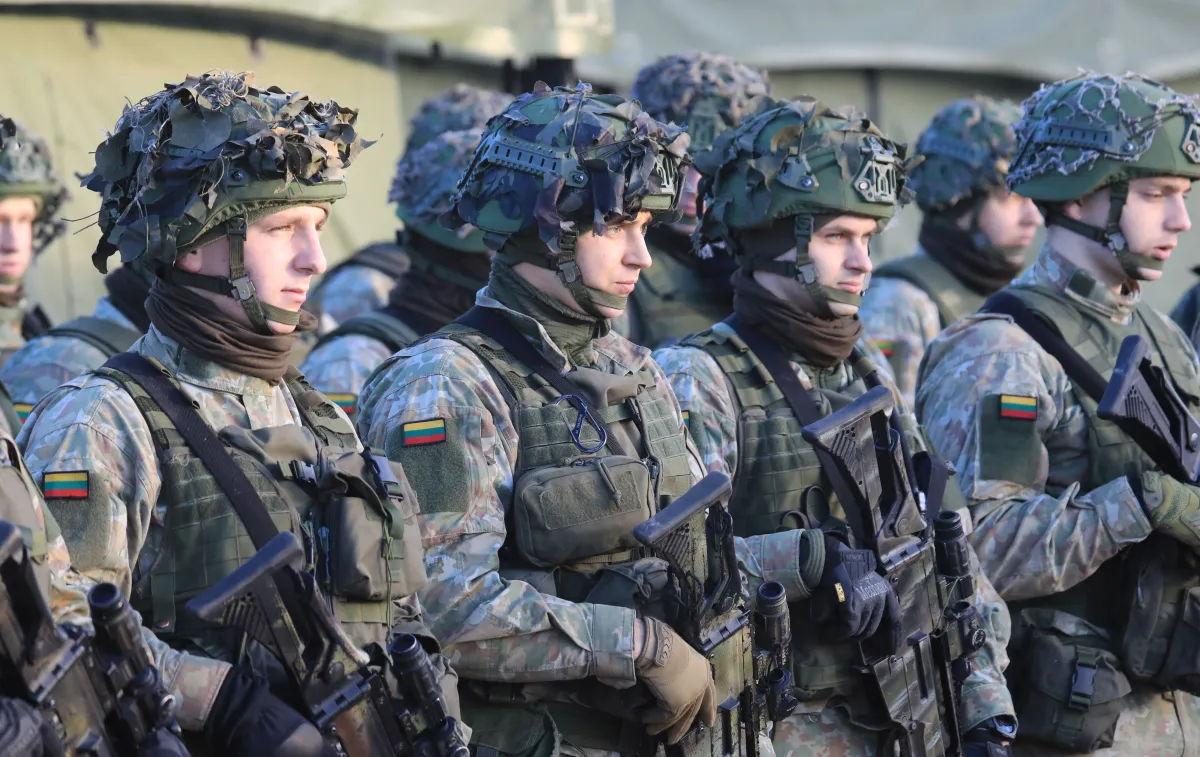
Lithuania is not stopping at paper plans. The Defense Ministry has moved aggressively to reinforce the border with Belarus and Russia’s Kaliningrad region, the isolated Russian enclave on the Baltic Sea that would likely play a critical role in any conflict between Moscow and NATO. Defense Minister Robertas Kaunas has described fortifications stretching at different depths from the frontier—covering areas up to five, twenty, and fifty kilometers from the border—with the explicit aim of limiting an enemy’s ability to maneuver. These are not just symbolic trenches; they include anti-tank obstacles, bunkers, and prepared positions designed to slow an invasion and give NATO forces time to respond. For the border towns, the changes are visible. Once-quiet rural lanes now see military engineering vehicles; fences and barriers are being built in fields; reservists train in forests that until recently were the province of mushroom pickers and hikers. There is a strange, layered quality to life here. The same land that has been farmed for centuries is being seeded with concrete reinforced obstacles. The government insists that the fortifications are purely defensive, and that NATO’s capacity to defend its eastern members is stronger than ever. But the deeper message to the local population is more ambivalent: they are being prepared for a war that may not happen but cannot be ruled out. The evacuation plan and the fortifications are two halves of the same psychological project—to make the threat real enough that people take action, but not so real that they despair. For older residents, there is also a painful memory of the Soviet era, when the idea of escaping the country under threat usually meant not at all. The current plan, with its clear routes and Polish cooperation, is meant to signal that things are different now: Lithuania is not alone, and its people have somewhere to go.
The sense of exposure is not unique to Lithuania. Latvia, its northern neighbor, will hold elections on October 3, and for the week leading up to that vote the country’s skies will be watched by four German Eurofighter jets stationed at Lielvārde Air Base. The German Defense Ministry said the jets would be sent from late September into early October at the request of NATO allies—an extraordinary arrangement that underscores how seriously the security situation is regarded. Olga Lautman, a researcher and analyst on Russian intelligence, captured the surreal quality of the moment in a post on her Substack: “Latvians will be going to vote under the protection of German fighter jets. None of this is normal, and it says a lot about how seriously the Baltic states are taking the threat.” The image is striking because it joins two things that should not belong together in modern Europe: the ordinary ritual of a democratic election and the existential need for armed protection overhead. Further north, Finland is building a 120-mile-long fence along its border with Russia, a response to Helsinki’s accusation that Moscow has weaponized asylum seekers by pushing migrants to the frontier and creating hybrid pressure. The fence is intended to give Finnish border guards control over a land border that was once open and friendly; now it is being hardened, watched, and fortified. Taken together, these measures paint a portrait of a region that has moved from shock at the return of war in Europe to a quiet, systematic adaptation to a long confrontation. Governments are not shouting about panic; they are adjusting budgets, reinforcing borders, coordinating air defenses, and asking citizens to think about evacuation routes alongside emergency contacts and weekend plans. But the human cost of this adaptation is real: a generation of Baltic residents is learning to live with contingency, to read news of drone sightings in the same tone they once read about snowstorms, and to accept defense ministers announcing new bunkers as casually as city councils announcing road repairs.
What the evacuation plan ultimately reveals is the emergence of a different kind of European solidarity—one built not on summits and communiqués, but on shared civil defense procedures and the quiet acceptance that a threat to one Baltic capital is a threat to all. The cooperation between Vilnius and Warsaw over the Podlaskie transit corridor demonstrates how much the strategic map has shifted. Poland, itself a frontline state with a long and painful history of Soviet dominance, is now prepared to receive tens of thousands of Lithuanian civilians in a crisis, while its own military works with NATO allies to deter the same adversary. The plan is not a surrender document; it is a statement of resilience. It tells the people of Lithuania that the state will do its best to protect them, but it also tells them that they have a part to play—in preparing, in following instructions, in leaving before it is too late. The human aspect is perhaps the most difficult to translate into official language. How do you reassure a family with a newborn, or a woman caring for her elderly mother, that the routes will work, that there will be fuel, that the Polish authorities will have a place for them? You cannot, completely. What you can do is be honest about the danger and clear about the plan, and that is the strange gift of this moment. The Baltic states are not pretending that everything is normal. They are not hiding behind euphemism or diplomatic ambiguity. They are telling their citizens that the world has changed, that the threat is real, and that the response must be prepared—without letting that preparation become overwhelming. If there is hope in this story, it is in the networks of neighbors, municipalities, and allied states that are being stitched together in these plans. No one knows whether the evacuation routes will ever have to be used, whether the Eurofighters will have to fire on anything more than a surveillance drone, or whether the fortified border will one day be dismantled by a more peaceful generation. But the plan itself, with all its practical details and uncomfortable implications, is a testament to a simple truth: the people of this region have learned that peace is not something they can take for granted, and that the best answer to fear is not illusion, but preparation.