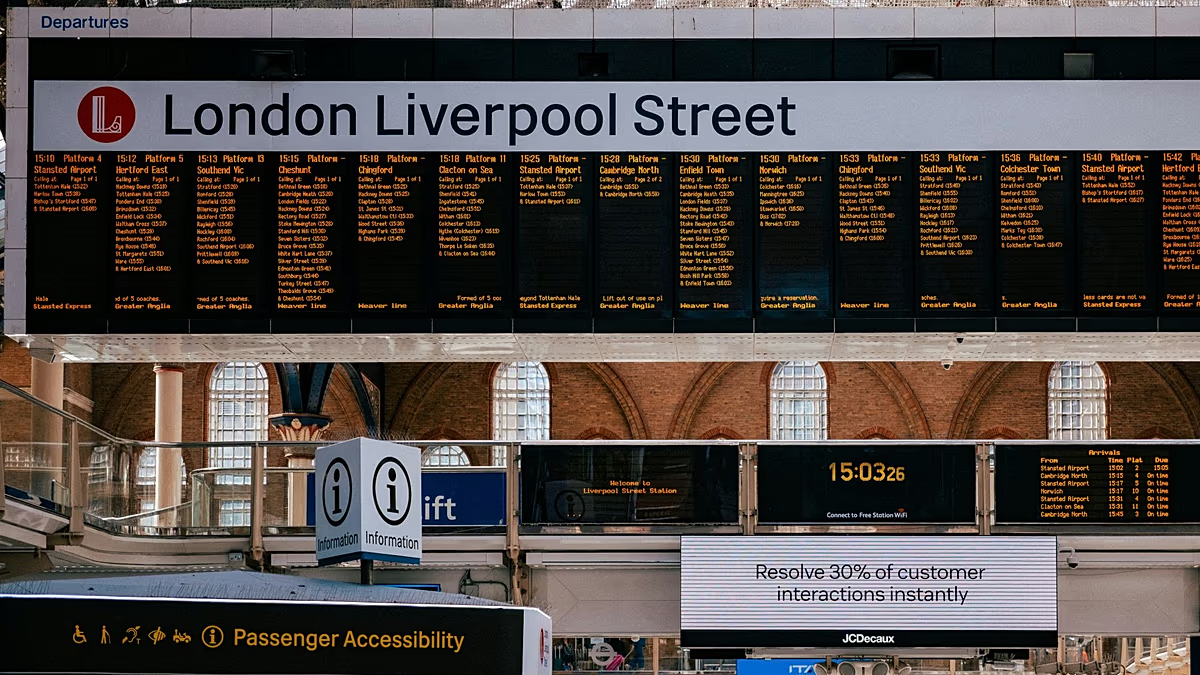




It happens to nearly every rail passenger at some point. You’re standing on a cold platform, coffee in hand, mentally rehearsing the meeting or appointment ahead, when the electronic board flicks to that dreaded word: “cancelled.” A collective groan ripples through the crowd. People check their phones, call loved ones, and begin the frantic search for alternatives. In the United Kingdom, that moment of frustration has always been made far worse by a deeply confusing and unforgiving ticketing system. Even if another train is rolling in moments later, pulling up on the same track and heading to the same destination, passengers have often been told their ticket is worthless on that service. The reason: the train is run by a different operator, and the ticket was bought for a specific company. Suddenly, a cancelled service becomes an expensive ordeal, forcing travellers to buy a second ticket simply because they were unlucky enough to travel with the wrong company on the wrong day. But finally, that is about to change. From this Sunday, 20 September, passengers across several major rail routes will benefit from a new rule that allows them to use their existing ticket on another participating operator’s train when their original service is cancelled. It’s a small phrase, but for anyone who has ever stood helplessly on a platform, it represents a significant shift in how passengers are treated when disruption strikes.
To understand why this change matters so much, it helps to look at the baffling reality of the current system. The United Kingdom’s rail network is not one unified service in the way most people imagine; it is a patchwork of private operators, each with its own ticket prices, restrictions, and staff. On paper, this competition is supposed to improve things. In practice, it often means that a passenger holding a ticket for, say, a Great Western Railway service can be told by an Avanti West Coast conductor that the ticket is “not valid” on their train, even when the train is travelling the same route and the original service has just been cancelled. There is something almost absurd about the situation: you are standing next to a train that can take you where you need to go, but an invisible wall of admin and revenue protection prevents you from boarding. Instead, you are told to wait at the station, perhaps for hours, until another train operated by the exact same company happens to arrive. If you cannot wait, your only option is to buy a new ticket, sometimes at a walk-up fare that costs far more than what you originally paid. For years, passenger groups and watchdogs have argued that this is unfair. People do not purchase a ticket with a loyalty to a particular rail company; they purchase a ticket to get from A to B. When a train is cancelled, the fault lies with the operator, not the passenger. Yet the passenger has been forced to carry the cost, the anxiety, and the inconvenience. It is a classic case of a system designed for the convenience of companies, not the people who pay for it.
The new policy, which takes effect on Sunday, 20 September, is designed to sweep away at least some of that nonsense. Under the new rules, if your train is cancelled, your original ticket will be accepted on another participating operator’s service, provided that train departs within two hours before or after the cancelled service. In other words, you will no longer be trapped at the station, watching perfectly good trains leave without you. Instead, you will be able to check the departure board, find a reasonable alternative service, and simply board it using the ticket you already have. The phrase used in the announcement is that the ticket is valid for trains departing “using a direct or reasonable alternative route.” This is a welcome dose of flexibility. It acknowledges that rail journeys are rarely simple, and that a reasonable alternative might not always be exactly the same route, but it will still get you to your destination. Even better, you do not need to download a new ticket, print anything, or visit a ticket office. You simply keep the ticket you have, and when the inspector comes around, you show it and explain that your original train was cancelled. The conductor will accept it as proof of travel. No arguments, no penalty fares, no being treated like a fare dodger. For a country that loves queuing and paperwork, this is unexpectedly smooth. It is a practical, human solution to a problem that should never have existed in the first place.
The announcement has been welcomed by Transport Focus, the independent watchdog that represents rail passengers in Britain. Its chief executive, Alex Robertson, put it plainly: “When passengers are delayed, they just want to get where they need to be, not worry about whether their ticket will be accepted on another train.” That sentence sums up the entire issue. When a train is cancelled, the real problem is not the cancellation itself — cancellations happen, especially in an ageing and overstretched railway system. The real problem is the lack of empathy and flexibility that follows. Passengers are left in a state of uncertainty, not knowing whether they are allowed to board the next train, whether they will be fined for doing so, or whether they need to spend more money. Robertson described the change as one that “we have long called for,” and he is right. For years, passenger groups have argued that ticket acceptance should be automatic whenever a service is cancelled. It should not be something passengers have to fight for at the ticket office, or beg for from a grumpy guard. Robertson also added an important note: the key now is making sure passengers get clear information about their options whenever disruption occurs. That means station screens, apps, and staff should all be telling passengers, “Your train is cancelled, but here is what you can do,” rather than leaving them to figure it out alone. A rule is only useful if people know it exists and understand how to use it. This is a step forward, but it must be accompanied by better communication at every stage of the journey.
The change is being introduced across a growing network of operators. Cross-operator ticket acceptance was already in place across all publicly-owned train companies, but from Sunday it will be expanded to include some of the biggest names in the private sector: Avanti West Coast, Chiltern Railways, CrossCountry, and Great Western Railway. East Midlands Railway will also join the scheme at a later date. This is not just a minor tweak; it is a meaningful expansion that covers some of the busiest intercity routes in the country. For example, a passenger travelling between London and Birmingham, or London and Manchester, can now breathe a little easier knowing that if their Avanti service is cancelled, they may be able to board a Chiltern or CrossCountry train without being turned away. The same applies to long-distance CrossCountry services, which often struggle with delays, and to Great Western Railway routes stretching from London through the Thames Valley and into the West Country. There are still limitations, of course. The policy applies to “participating operators,” which means it is not yet universal. Some train companies are still not part of the scheme, and passengers should always check the specific conditions of their ticket before relying on this rule. But the direction of travel is clear: the rail industry is slowly moving toward a more passenger-centred approach. It recognises that borders between operators are invisible to travellers, and that punishing people for the failures of the system only erodes public trust in train travel.
Ultimately, this change is about more than just tickets and operators. It is about respect. When a train is cancelled, passengers are already facing a late arrival, a missed meeting, or a disrupted family plan. The last thing they need is to be treated as though they have done something wrong by trying to catch the next available train. By making it easier to use tickets on alternative services, the rail industry is acknowledging a simple truth: people matter more than paperwork. No one expects the railway to be perfect. Trains will still be delayed, and plans will still be upset. But the response to disruption says everything about how an organisation views its customers. For decades, the default answer in the UK has been a defensive “no.” Now, at least on some routes, the default is changing to a practical “yes.” It is a small, welcome victory for common sense. And for everyone who has ever stood on a crowded platform with a useless ticket in their hand, watching the train they need pull out of the station, it will make the moment of cancellation a little less infuriating, and a little more human. So from Sunday, when the board flashes that dreaded word, remember: you may have more options than before. Keep your ticket, stay calm, and look for the next reasonable departure. You have every right to be on it.