



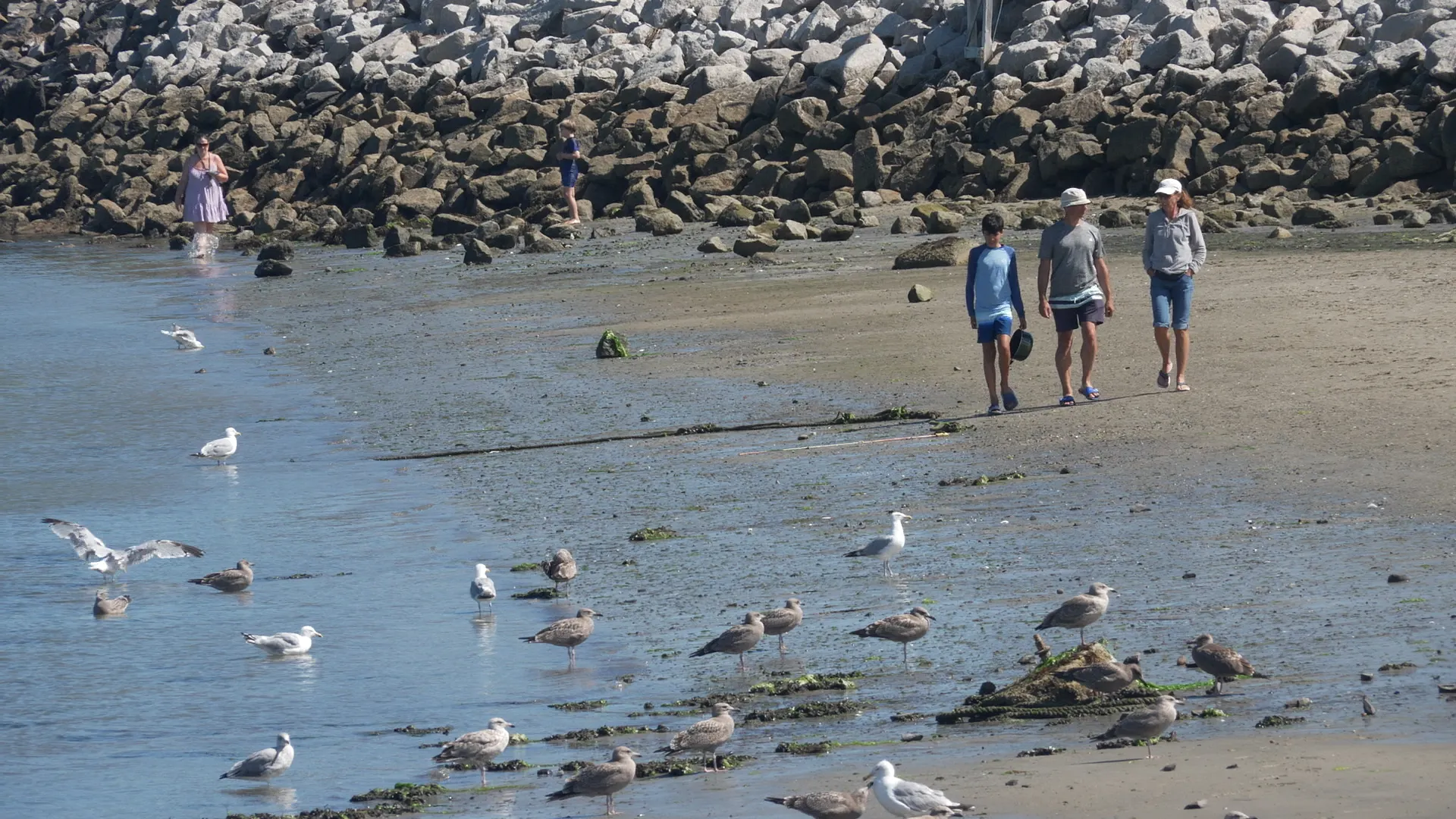
The summer sun hangs heavy over the sandy shores of Scarborough, Maine, but the usual soundtrack of crashing waves and laughing children is now punctuated by a new, electric tension. Just a few years ago, the idea of a great white shark patrolling the shallows off Pine Point Beach would have been the stuff of campfire stories, a distant fear reserved for the Pacific or the Florida coast. Today, it is a reality that has local authorities and residents buzzing with a mix of wonder and caution. The town’s harbor master, Daryen Granata, has spent the last several weeks fielding a relentless stream of concerned calls from beachgoers. The sightings have become so frequent that the police department has taken notice, urging swimmers to remain vigilant. Granata describes a typical day now: a drone hums overhead, a crowd gathers on the sand, and below the surface, a dark shadow glides with unsettling grace. “We were seeing them off Pine Point Beach for a substantial amount of time,” Granata recalls, noting the sharks have since migrated north along the coast, now frequently spotted near Scarborough Beach State Park. “We’re still seeing them on a daily basis, even three weeks into this. It has completely changed the atmosphere here.”
This dramatic shift has turned the local ecosystem into a public spectacle, but scientists are quick to point out that the surge in reports isn’t purely a story of more sharks in the water; it is also a story about how we are looking at the ocean. For decades, humans relied on the naked eye and sheer luck to spot marine life. Today, the average beachgoer is armed with a high-definition camera in their pocket, and a growing number of hobbyists fly drones equipped with 4K cameras over the surf. This technological revolution has turned ordinary citizens into accidental marine biologists. Matt Davis, a marine resource scientist with the Maine Department of Marine Resources, highlights this dramatic change in observation. “We’ve had great weather this year for beach tourism, and we also have a number of people with drones actively looking for sharks, so sightings are high,” Davis explains. The transformation is staggering; ten or fifteen years ago, a shark sighting was a rare, anecdotal event whispered about at the local bait shop. Now, a sighting is instantly captured, geotagged, and uploaded to social media platforms, spreading across thousands of screens within minutes. “Previously, people weren’t looking for sharks with the same intensity or aerial equipment,” Davis adds, emphasizing that the ubiquity of high-grade technology has fundamentally changed our awareness of what lies beneath the waves.
Behind the viral videos and the fearful headlines, however, lies an incredible ecological success story that has been decades in the making. The presence of these apex predators in the Gulf of Maine is a testament to the resilience of nature when given the chance to rebound. In the 1990s, the federal government implemented strict protections for white sharks, which had been heavily overfished for decades. These regulations, combined with a parallel conservation effort, have allowed the population to slowly but steadily recover. Furthermore, the ecosystem has shifted to support them. The once-depleted seal population along the Maine coast has experienced a remarkable resurgence, providing a massive, calorie-rich food source for adult sharks. But it isn’t just the seals; younger sharks are drawn inshore by an abundance of smaller baitfish. “There’s a lot of bait around along the Maine coast in the form of striped bass and Atlantic menhaden, both of which are eaten by juvenile white sharks,” explains Dr. Walt Golet, an assistant professor of marine sciences at the University of Maine. This combination of a recovering predator population and an abundant food web has created the perfect conditions for the sharks to return to waters they once dominated. Davis frames this not as a threat, but as a restoration: “Think of this as a population success story in that the ocean is regaining one of its apex predators to help balance the food chain.”
Yet, even as the conservation efforts bear fruit, the changing climate is rewriting the rules of this delicate balance. The Gulf of Maine is warming at an alarming rate, faster than most of the world’s oceans. This temperature shift is having profound effects on marine migration patterns. Traditionally, white sharks would visit these waters during the warm summer months, feeding voraciously before migrating south to the Carolinas or Florida for the winter. However, as water temperatures remain elevated well into the autumn and early winter, researchers are beginning to question whether these sharks might soon become year-round residents. Dr. Golet cautions against jumping to conclusions, noting that the perceived increase in population might be more nuanced than a simple boom in numbers. “I would say there’s no question that there’s been a lot more sightings this year,” Golet states. “But does that translate to a higher number of sharks? That is a much more nuanced question.” He points out that a single shark can be sighted multiple times by different people, skewing the data. Furthermore, the generation time for white sharks is incredibly long—roughly 25 to 30 years—meaning the full impact of the 1990s protections is only just beginning to show up in the adult population. The convergence of environmental protection, a warming ocean, and increased human observation makes it incredibly difficult to distinguish between a genuine population surge and a temporary shift in distribution.
For the people who call the Maine coast home, the presence of these sharks is a profound psychological shift. Growing up in Scarborough, lifelong resident Kelsey Donohue remembers a time when the ocean seemed benign. “There are definitely more sharks in Maine than I’ve ever seen in my entire life,” Donohue says with a nervous laugh. “Like growing up here, we used to joke around about sharks. We would say, ‘Oh, we live in Maine, so we never see sharks.'” It was a source of local pride, a feeling of safety that allowed parents to let their children splash in the surf without a second thought. That innocence has been shattered. Betty MacLeod, another longtime resident, echoed this sentiment, recalling how hearing about a shark sighting right off Pine Point was a shock to the system—a visceral reminder that the ocean is a wild, untamed frontier. The daily experience of beachgoers has transformed. Surfers now scan the horizon with a new wariness, keeping their boards close to their chests. Parents are more likely to keep their children in ankle-deep water. The awe of seeing a fin break the surface is immediately tempered by a primal fear, a recognition that humans are merely visitors in a vast and powerful domain. The ocean has become a place of heightened awareness, where the line between recreation and survival feels thinner than ever before.
In response to this new reality, the Scarborough Police Department and local marine officials are shifting their focus from simple observation to proactive public safety. Their advice, while straightforward, is designed to minimize the risk of an encounter. “Just be cognizant of what you’re doing and where you are,” Granata advises. “Just have good situational awareness, that’s all.” Officials are urging swimmers to avoid the water entirely during dawn and dusk, the prime hunting hours for sharks when visibility is low and baitfish are most active. Swimming alone is strongly discouraged, as sharks are more likely to investigate a solitary, splashing target. Beachgoers are advised to avoid murky water where sharks might be hunting, and to steer clear of areas where seals are present. Even something as seemingly harmless as shiny jewelry can catch the light and mimic the flash of a fish scale, attracting unwanted curiosity. Those with open wounds are told to stay on the beach, as the scent of blood can travel for miles. While these guidelines may seem like a long list of frightening restrictions, they are designed to foster coexistence rather than panic. As the waters of the Gulf of Maine continue to warm and the ecosystem evolves, the state is learning that the presence of sharks is not a temporary anomaly but a permanent fixture of the coastal landscape. It is a humbling reminder that conservation works, and that as the ocean recovers, we must learn to share it with the magnificent, awe-inspiring creatures that have always called it home.