



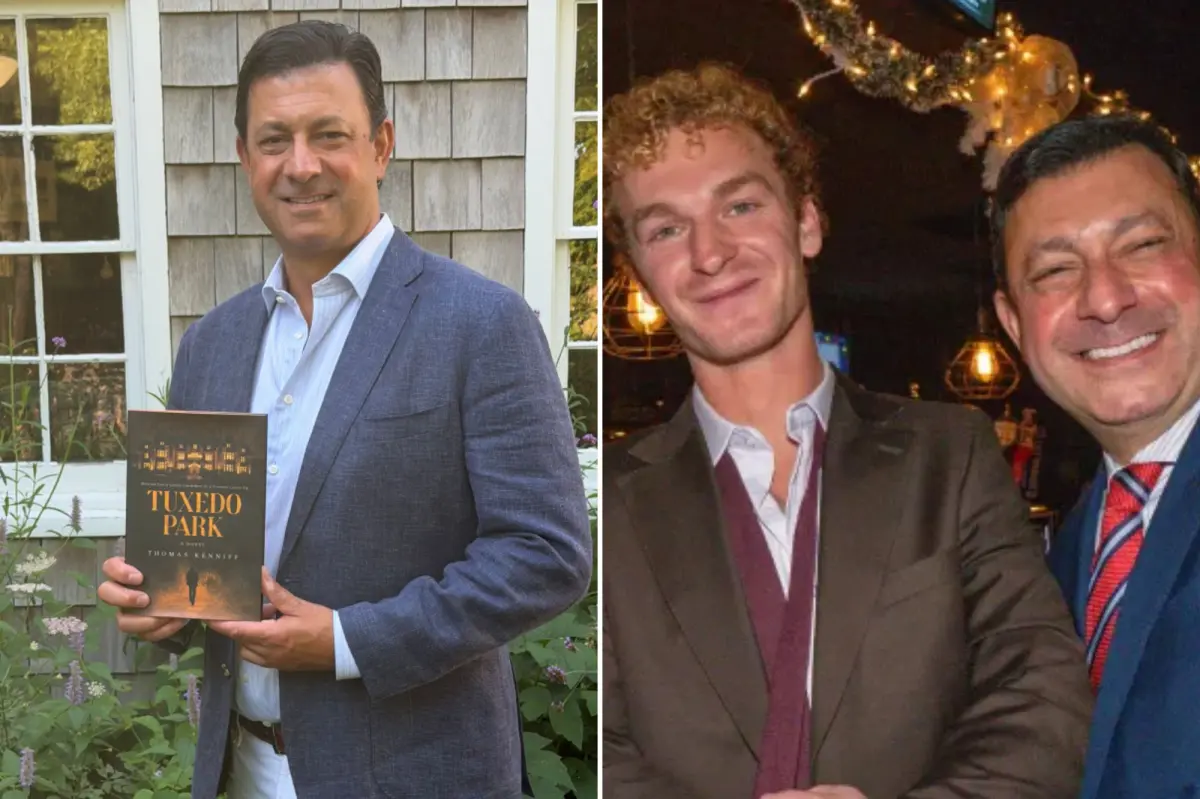
When Thomas Kenniff walked out of a Manhattan courtroom in late 2024, he was no longer just another attorney in a crowded field; he was one half of the legal team that had successfully defended Daniel Penny, a case that had gripped the nation and sparked fierce debate. At 51, Kenniff had already lived several lives: Army National Guard major, prosecutor, private defense lawyer, husband, and father. But the verdict in that sensational trial was not the end of his story; it was simply the closing of one chapter and the opening of another. Just months later, Kenniff’s debut novel, Tuxedo Park, hit bookstore shelves, and the legal thriller is already generating the kind of buzz most first-time authors only dream about. Published by Post Hill Press, the book arrived on a Tuesday with a hefty endorsement: former Illinois Governor Rod Blagojevich, a man who knows a thing or two about political intrigue and the machinery of power, took to social media to call Kenniff “the next Scott Turow,” comparing him to the lawyer-turned-author whose Presumed Innocent remains a benchmark of the genre. It is a heady compliment, especially coming from Blagojevich, who spent eight years in federal prison on corruption charges before receiving a pardon from President Trump in February 2025. If anyone recognizes a compelling story about ambition, betrayal, and the dark corners of public life, it is surely him. But Kenniff’s influences run deeper than a tweet; he grew up devouring legal thrillers, and he credits John Grisham, especially A Time to Kill, with planting the seed of a dream he never quite let go of.
The novel itself is a taut, atmospheric legal thriller rooted in a place Kenniff knows intimately. Tuxedo Park opens with prosecutor John Palmer learning that his old flame, Susan Sterling, a glamorous former model, has been abducted from outside her family home in the exclusive, gated village of Tuxedo Park. The old-money enclave, tucked into Orange County, New York, was once the playground of Gilded Age aristocrats, and its grand homes were designed to keep the messy outside world at bay. That sense of enforced tranquility makes Susan’s disappearance all the more chilling. When her body is found in a nearby forest, the investigation points toward Kent Dawson, a charming, Kennedy-esque senator who has just been elected president. Palmer, along with his mentor and fellow lawyer Don Haggerty, is thrust into a race against time, navigating stonewalling bureaucrats, shadowy black ops, and a ruthless political machine desperate to see their man inaugurated. The story moves through the courthouses and government buildings of downtown Manhattan, but its heart beats in that strange, walled-off village where Kenniff spent so many weekends as a child. As Kenniff explains, there is something inherently dramatic about the idea of something terrible happening in a place that is supposed to be immune to trouble. Tuxedo Park is literally behind gilded gates, a place where wealth and privilege create an illusion of safety, and it is precisely that illusion he wanted to shatter. He conjures a world where the powerful believe they can outrun consequence, but the echoes of a woman’s death refuse to stay buried.
For Kenniff, the story is deeply personal. His grandmother lived in Tuxedo Park, and his uncle built homes in the area, so the village was woven into the fabric of his childhood. Those regular weekend visits fed a young imagination that was already running wild. He describes himself as the quintessential daydreamer, a boy raised almost like an only child because his siblings were so much older. Without iPads or screens to distract him, he found refuge in stories, and by his teens he was reading John Grisham and Nelson DeMille with a growing sense of possibility. He remembers thinking, almost privately, that he could do this one day. But life took him down a more conventional path first. The story of Tuxedo Park began to take shape more than two decades ago, when he entered a writing contest sponsored by the New York Law Review. At the time, he submitted a chapter, but he admits now that he did not have a middle or an end, only a promising beginning. Still, that beginning was good enough to earn him a spot as a finalist. The competition was filled with lawyers, people who by trade were supposed to know how to write, so the recognition felt like validation. It gave him the confidence not to walk away from the manuscript entirely, even as his professional life grew more demanding. At that point, he was working for Jeanine Pirro, then the Westchester County District Attorney, and the demands of a legal career left little room for fiction.
Over the next two decades, Kenniff accumulated what he calls “lots of raw material.” He was deployed to Iraq as a judge advocate in the Army National Guard, a retired major who saw firsthand the complexities of military justice. He married his wife, Emily, and started a family, and he spent twenty years in private practice, taking on cases that sometimes placed him squarely in the national spotlight. The Daniel Penny trial was just the latest in a series of high-profile matters. Every courtroom battle, every witness who hedged, every jury that puzzled over a verdict, every client who begged him to believe their version of events, it all became fuel for the writer he was becoming. But the manuscript sat on a shelf, waiting. He would return to it periodically, revising, rethinking, and finding new ways to make the story resonate. Along the way, he took guidance from the late bestselling author Bart Davis, who offered a crucial piece of advice: give Susan, the murdered woman, a more complicated and intimate backstory. Davis suggested that the relationship between Susan and Palmer should end abruptly, under painful circumstances, and that their unresolved history should haunt Palmer as he pursues her killer. That instinct led Kenniff to a difficult but powerful choice. Palmer and Susan’s romance had been shattered by an unplanned pregnancy and its termination, a decision that left scars on both of them. Those memories surface throughout the investigation, making Palmer’s pursuit of justice not just professional but deeply personal, a way of confronting the woman he once loved and the man he might have been. It is a choice that could have been heavy-handed, but Kenniff handles it with restraint, allowing the grief to seep through the procedural details.
Writing fiction, Kenniff discovered, was liberating, especially after years of legal writing. In his daily work, every sentence had to be qualified, every claim supported by a citation, every argument watertight. But in fiction, he could simply let the story breathe. He could describe a rain-slicked street in lower Manhattan without footnoting why. He could invent a corrupt political operative without worrying about discovery. Yet he worked hard to make sure the legal mechanics of the story were sound and believable, because his harshest critics would be his peers. He knew that any lawyer who picked up the book would immediately spot a procedural misstep, and he was determined not to embarrass himself. He wanted to write a thriller that could hold its own on the airplane bestseller list but also pass muster in a room full of attorneys. The reviews from his lawyer buddies were important to him, and he was proud to earn their approval. But perhaps the review that meant the most came from a Manhattan court officer, a longtime friend who had spent decades watching the city’s legal dramas unfold. After reading the manuscript, he told Kenniff that he had written a love letter to New York City. That comment stuck with Kenniff, because it captured something he had not consciously set out to do. He had wanted to write a suspenseful story, a book that would keep readers turning pages late into the night, but he had also, in his own way, paid tribute to the battered, beautiful, endlessly complicated city that had shaped him. New York is not just a setting in Tuxedo Park; it is a character in its own right, with its courthouse corridors, its hidden villages, its old money and new crimes, its stubborn refusal to be reduced to a postcard.
In the end, Tuxedo Park is more than a legal thriller; it is the fulfillment of a promise a teenage boy made to himself while reading dog-eared paperbacks in his grandmother’s house. It is a testament to the idea that life experience, even the painful or mundane parts, can become the raw material for art. Kenniff’s journey from courtrooms to bookstores is a reminder that storytellers are everywhere, often hiding in plain sight. He spent decades as a lawyer because that was the life he had built, but he never stopped being a dreamer. The same mind that once imagined mysteries behind Tuxedo Park’s gilded gates eventually found a way to bring those mysteries to the page. Blagojevich’s praise may have been hyperbolic, but it reflects a genuine truth: Kenniff has written a debut that feels like the work of a seasoned novelist. His voice is confident, his plot is intricate, and his sense of place is richly drawn. With the Daniel Penny trial behind him and a new career unfolding, Thomas Kenniff is proving that it is never too late to chase the dream you once thought was impossible. Tuxedo Park is available now, and if the signs are any indication, this will not be his last word. For a man who spent his life arguing in court, he has found a new way to tell a story, and readers are better for it.