


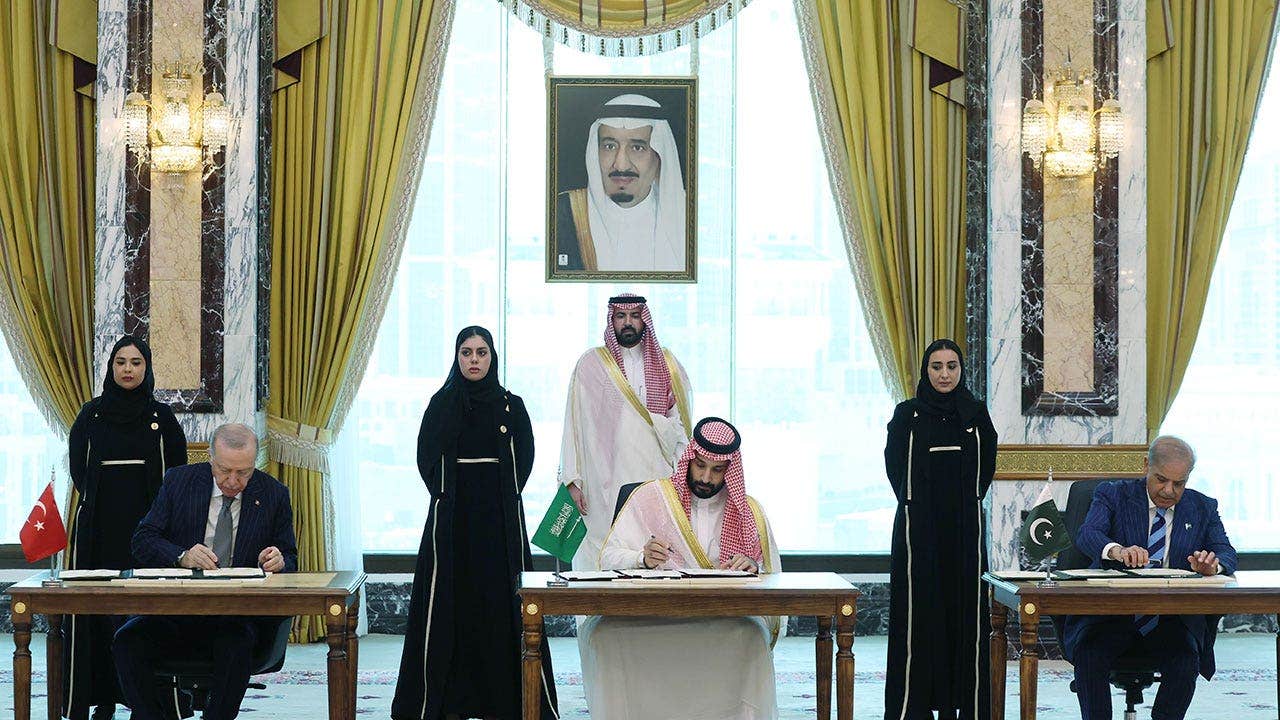
The announcement landed like a stone in a still pond, rippling through the geopolitical landscape with unexpected force. In the sweltering heat of August, three unlikely partners—Saudi Arabia, Turkey, and Pakistan—stepped across a historic threshold, signing the Mecca Joint Defence Agreement. The ink was barely dry before the world’s pundits began a frantic search for labels: Was this a “Muslim NATO”? A nascent counterweight to the Abraham Accords? Or merely a pragmatic insurance policy for three allies who have grown weary of the shifting tides of Washington’s foreign policy? The pact, signed by Crown Prince Mohammed bin Salman, President Recep Tayyip Erdoğan, and Prime Minister Shehbaz Sharif, formally declares that an armed attack on one is an attack on all—language that echoes the Article 5 clause of the Western military alliance. Yet, beneath the dramatic rhetoric lies a tapestry of distinct anxieties and ambitions. Riyadh still chafes from its failure to extract a formal, treaty-level US defense guarantee despite its designation as a major non-NATO ally in November 2025. Ankara dreams of a grand imperial revival and a booming defense industry hungry for markets. Islamabad, meanwhile, seeks a lifeline to escape its spiraling economic woes and to cement its status as a pivotal player in the Gulf’s security architecture. This isn’t just a military document; it is a confession that the old, comfortable reliance on the American superpower no longer feels like a sure thing. For the partners, the pact represents a collective shrug of the shoulders at the unpredictability of global alliances, a gamble that closer ties among regional heavyweights might offer something the US has failed to provide: unshakeable, dependable solidarity.
For Saudi Arabia, this new alliance is a meticulously crafted hedge against the fragility of foreign promises. After years of navigating the volatile Middle East, Riyadh has learned that American security guarantees, while powerful, often come with strings attached—conditions on human rights, restrictions on arms usage, or simply the capricious whims of successive US administrations. The June 2025 Strategic Defense Agreement with the United States was a victory, granting Riyadh advanced weaponry and elevated status, but it conspicuously lacked the ironclad, Article 5-style mutual defense clause the crown prince had so desperately sought. The message was clear: Washington will help, but it will not bleed for the kingdom. This leaves a vacuum that the new pact with Pakistan and Turkey is designed to fill. Pakistan, in turn, offers a unique value proposition. It is a nuclear-armed nation with one of the largest standing armies in the world and a military doctrine built on asymmetric resilience. For Islamabad, the benefits are equally transformative. The kingdom’s petrodollars are a balm for Pakistan’s severe balance-of-payments crisis, while guaranteed energy supplies insulate it from the chaos of global oil markets. But the deeper connection is strategic kinship. Pakistani military brass have long served as trainers and advisors in the Gulf. This agreement formalizes a secretive, decades-old relationship. Whether Pakistan’s nuclear deterrent implicitly extends to its Saudi and Turkish partners remains an open—and deeply frightening—question for regional rivals. Yet, Islamabad is careful to present this arrangement as a matter of economic security and mutual respect, not an open-ended nuclear guarantee. The exchange is intimate: Saudi money and energy for Pakistani manpower and military expertise. Both nations are hedging against catastrophic isolation—Riyadh against a US withdrawal, Islamabad against economic collapse.
Turkey enters this fray with the swagger of a regional kingmaker. President Erdoğan, ever the strategic chameleon, has spent the last decade building Ankara into a defense-manufacturing powerhouse, producing advanced drones, naval vessels, and armored vehicles that have proven their mettle from Libya to the Caucasus. This new pact grants Turkish defense firms an enormous captive market, funneling billions into the national economy. But more than economics, it provides Turkey with a muscular diplomatic flank against Israel, with whom tensions have reached a fever pitch. For Erdoğan, aligning with Saudi Arabia and Pakistan sends a clear signal to Tel Aviv that Turkey’s regional influence cannot be discounted. The mechanics of the pact, however, are where the human reality of politics emerges. Turkish Foreign Minister Hakan Fidan quickly likened it to NATO’s Article 5, yet immediately added a cautionary note: the degree and form of assistance would be determined through consultation. In plain terms, this is not an automatic declaration of war if one of them is attacked; it is a diplomatic agreement to discuss, coordinate, and likely assist, without locking into a suicide pact. The operational details are deliberately vague, left to a new ministerial committee and a general secretariat headquartered in Saudi Arabia. There is also an expansionist ambition bubbling beneath the surface—Erdoğan has already floated Egypt as a potential fourth member. This drive for expansion reveals the underlying insecurity; a clique of three is impressive, but a coalition of four, five, or six would present a far more formidable counterweight to the US-Israel axis. These are men who understand the theater of power, and they are playing it masterfully, crafting a framework robust enough to project strength, yet flexible enough to avoid being drawn into an unwanted war.
The diplomats tasked with selling this pact to the world are working overtime to sand down its sharp edges. Saudi Deputy Minister Rayed Krimly has flatly rejected the “Muslim NATO” label, insisting the agreement has nothing to do with nuclear ambitions or an arms race, and is not directed at any specific country—least of all Iran or Israel. Turkish officials echo this chorus, calling it a purely defensive arrangement. It is a rhetorical tightrope; they want the world to see them as strong enough to resist aggression, but weak enough not to provoke it. Iran’s reaction, however, offers a revealing glimpse into the region’s shifting psychology. Rather than sounding alarms, Tehran shrugged dismissively, noting that the pact merely reflects a trend of states relying on their own capabilities rather than outside powers. This nonchalant reaction is itself a form of warning; Iran understands that this is not a coalition aimed at Tehran, but a coalition that will increasingly demand self-determination in the region, potentially freezing Iran out of certain markets or security arrangements. The denials regarding Israel, however, ring hollow in the context of the timing. As Israeli-Turkish tensions boil over and the Abraham Accords remain a central pillar of US foreign policy, a bloc of powerful Sunni-majority nations cannot pretend its alignment is purely aloof from that dynamic. The pact serves as a quiet, yet forceful, reminder that the path to stabilizing the Middle East no longer runs exclusively through Washington or Tel Aviv. It is a diplomatic statement that these three powers intend to negotiate their own destinies, even if they refuse to admit it publicly. The human reality is that these leaders are masters of plausible deniability, using legal language to shield themselves from accusations of bloc-building while engaging in precisely that act.
Expert opinion on the ground remains sharply divided, reflecting the pact’s ambiguous nature. Sinan Ciddi, a senior fellow at the Foundation for Defense of Democracies, represents the skeptical camp. He questions whether the pact has any “teeth,” noting that calling it a collective defense pact is premature. Ciddi sees the arrangement as far more grounded in economic and commercial ties than substantive military coordination, pointing out that unless they develop joint planning, command structures, and crisis-response protocols, the armed attack clause is merely an aspirational statement. Conversely, Aziz Alghashian of the Gulf International Forum offers a more complementary view. He argues that the pact is not a counterweight to the Abraham Accords but rather a supplement to the US-led architecture. In his eyes, greater cooperation among US partners actually facilitates Washington’s goal of burden-sharing, allowing American forces to focus on grand strategy rather than provincial policing. Raza Rumi from CUNY adds a lens focused on Pakistan, warning that it would be dangerous to take the Article 5 language literally. He sees Pakistan gaining strategic depth and a formal seat at the table in the Gulf, but he argues this is a classic case of hedging rather than definitive bloc-building—states keeping their options open in a volatile environment. The reaction from India, however, introduces a cold dose of strategic realism. New Delhi is watching this new axis with deep concern, formally announcing an examination of its implications for national security. India has growing ties with both Israel and the Gulf states, and a Turkey-Pakistan-Saudi axis represents a potential squeeze on its western flank. The analysts, therefore, paint a picture of a move that is equal parts grand theater, insurance policy, and commercial synergy—a complex dance where the threat of military power is used far more often than the actual force.
Ultimately, the Mecca Joint Defence Agreement is a mirror held up to our contemporary era of multipolar politics. It encapsulates the death of absolute dependence on superpowers and the rise of a world where regional powers build their own escape hatches. Whatever the initial skepticism, the agreement signals a tangible shift in the Middle East’s power calculus. For the United States, this is both a relief and a headache: a relief because these allies are now taking on more of their own security burden, and a headache because they are doing so while carving out potential autonomy from American norms. For the region itself, the pact does not promise immediate peace or unification; if anything, it introduces a new layer of complexity. Ciddi’s warning is poignant—security pacts beget more security pacts. As this trio formalizes its bond, Israel will certainly deepen its cooperation with Greece, Cyprus, and potentially India. The Middle East is not dividing into two fixed camps, but it is certainly rearranging itself into a complex web of overlapping agreements, rivalries, and pragmatic alliances. The true test of the Mecca pact will not be found in its ceremonial signatures but in the practical implementation over the next decade. Will they truly integrate their military command structures? Will they share sensitive intelligence? Or will this become an ornate piece of diplomatic furniture, admired but rarely used? For the leaders who signed it, the pact is a promise to their own citizens that they will not be left standing alone in the tempest of global politics. It is a human attempt to find comfort in numbers, even when the numbers come from very different historical trajectories. As geostrategic tensions ripple across the region, this pact serves as a testament to the simple truth that even the most powerful nations tremble at the thought of being isolated, and they will always seek a shoulder to lean on—even if that shoulder belongs to a rival who is just as uncertain about the future as they are.