




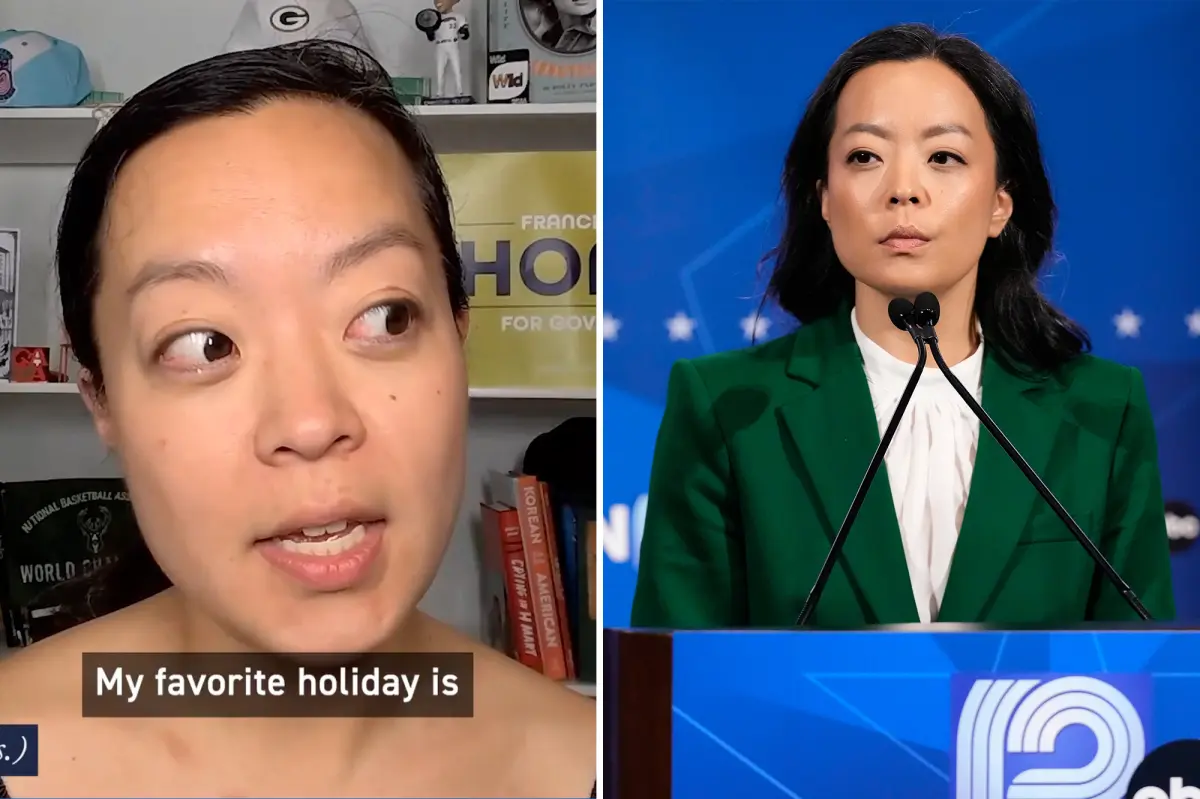
The intersection of food, cultural identity, and political discourse has always been a highly sensitive landscape in American life, but few stories illustrate this tension as vividly as the political journey of Francesca Hong. As a progressive Democrat and former professional chef running for governor of Wisconsin, Hong has recently found herself at the center of a national media storm regarding her changing stance on Thanksgiving. For years, the traditional autumn holiday has served as a cornerstone of American unity, yet it is also a source of historical debate regarding the treatment of Indigenous peoples. Hong, whose public profile has long been defined by her dual identities as a grassroots activist and a hospitality champion, recently made headlines by walking back her previous, highly controversial calls to cancel the holiday. This sudden pivot from sharp ideological critique to a warm embrace of Thanksgiving highlights the complex, often painful tightrope that modern political candidates must walk when attempting to reconcile their activist roots with the broader, traditional expectations of the general electorate.
To understand the origins of this political storm, one must look back to the hyper-charged atmosphere of November 2021, a time when the world was still deeply gripped by the isolation and anxiety of the COVID-19 pandemic. It was during this period of national distress that Hong took to social media to post a blistering critique of Thanksgiving, urging her followers to cancel the celebration entirely. In her post, she argued that the holiday glorified colonialism and referred to the historic interactions between early European settlers and Native Americans as an original “superspreader event” that devastated Indigenous populations with diseases like smallpox. While her choice of words was undeniably polarizing and drew immediate criticism from conservative opponents, it was also a reflection of a wider, raw cultural moment in which many Americans were questioning established historical narratives. Viewed in context, her post was not merely an attack on a holiday, but a passionate, albeit abrasive, attempt to bring attention to the historical trauma and systemic injustices that continue to affect Native American communities to this day.
However, the transition from local activism to a statewide gubernatorial campaign requires a fundamentally different style of communication, a reality that Hong has had to confront under the intense glare of the national media. During a recent media circuit, which included a probing interview on CNN with host Kaitlan Collins and an appearance on Politico’s Playbook podcast, Hong was repeatedly pressed on whether she still believed Thanksgiving should be canceled. Rather than offering a simple, politically expedient binary answer, Hong navigated the questions by explaining that her views have evolved, eventually declaring that Thanksgiving is actually her favorite holiday. For many observers, this dramatic shift was viewed with skepticism, with critics labeling it as a calculated, hypocritical backtrack designed to appeal to moderate voters. Yet, when viewed through a more human lens, her response reflects the very real, often messy process of personal and political growth, demonstrating how a leader must learn to balance their private convictions with the public duty of representing a diverse constituency.
Central to Hong’s defense of her evolution is her deeply rooted background in the culinary arts and the hospitality industry, which she views as her primary vehicle for community building. During her media appearances, she frequently recalled her formative years as a young chef, sharing that the very first community meal she ever prepared at the age of sixteen was a traditional Thanksgiving dinner. For Hong, the act of cooking and bringing people together around a shared table is not just a profession, but a philosophy of life that transcends political divides. She argues that her years of running a restaurant have taught her the invaluable art of hospitality, which is fundamentally about listening, serving others, and creating spaces where diverse individuals can find common ground. By framing her relationship with Thanksgiving through the lens of food and community service, she attempts to show that one can deeply appreciate the warmth of family gatherings while remaining conscious of the historical complexities that surround the holiday.
This nuanced perspective on holidays is not isolated to Thanksgiving, as Hong has historically voiced critical opinions on several other major American celebrations, including Valentine’s Day, Christmas, and the Fourth of July. In today’s highly polarized political climate, these past social media posts are easily weaponized by political opponents to paint her as an out-of-touch contrarian who harbors a disdain for American traditions. However, a more empathetic interpretation suggests that Hong’s skepticism is part of a larger, generational dialogue about the commercialization and superficiality of modern holidays. Many younger Americans share this duality—they value the opportunity to rest and connect with loved ones, yet they feel increasingly alienated by the corporate commercialism of Valentine’s Day or the uncritical patriotism sometimes associated with the Fourth of July. Hong’s willingness to voice these critiques, even if politically risky, speaks to a desire for more authentic, reflective ways of celebrating our shared cultural milestones.
Ultimately, Francesca Hong’s journey from online firebrand to a gubernatorial candidate championing the unifying power of the Thanksgiving table offers a compelling look at the challenges of modern political leadership. Her transition suggests that effective governance requires a willingness to move beyond ideological purity in order to foster genuine connection and dialogue among people with vastly different perspectives. While her critics may continue to view her shifting stances as political opportunism, her supporters see a leader who is willing to acknowledge the pain of the past while still embracing the joy of community in the present. As she continues her campaign, Hong’s message remains centered on the idea that the political arena, much like a busy restaurant kitchen, requires patience, collaboration, and a willingness to invite everyone to the table. In a country deeply divided by culture wars, her story serves as a reminder that our national traditions are not static, but are constantly being renegotiated, redefined, and reclaimed by each passing generation.