




Behind every routine flight itinerary is a deeply personal human story—a collection of hopes, dreams, and a family waiting eagerly at home—but for 32-year-old Eric Fernando Gutierrez Molina, a routine layover in the beautiful, bustling city of Medellín, Colombia, turned into a harrowing nightmare that would ultimately end his life and shatter the hearts of everyone who knew him. As a dedicated, Dallas-based flight attendant for American Airlines, Eric was deeply passionate about his career, possessing a vibrant spirit that allowed him to navigate international cities with the ease, grace, and curiosity of a seasoned global explorer. In March, while preparing for a scheduled return flight to Miami the following morning, Eric decided to experience the local culture during his brief stay, sharing his live digital location from an Airbnb near the José María Córdova International Airport with close friends—a standard safety practice among close-knit flight crews who vigilantly look out for one another across the globe. However, when his digital breadcrumbs suddenly stopped updating and his usually prompt communication went chillingly silent, an immediate wave of panic and dread rippled through his network of colleagues, friends, and anxious relatives back in the United States. The agonizing days of waiting, praying, and posting frantic social media appeals culminated in a devastating announcement by Medellín Mayor Federico Gutiérrez: Eric’s body had been recovered in a remote, rural area near the town of Jericó, southwest of the city. The tragic news sent shockwaves through the aviation community, transforming a desperate search for a missing friend into a grim, heartbreaking realization that a young man celebrated for his warmth, kindness, and professionalism had been targeted, betrayed, and brutally murdered. His untimely death exposed a dark, predatory criminal underbelly operating beneath the vibrant tourism scenes of Colombia, serving as a tragic reminder of the fragile line between vacation adventure and mortal danger.
The trap that ensnared Eric and his unsuspecting coworker was cold and calculated, utilizing the modern illusion of digital intimacy to disarm their natural defenses in an unfamiliar foreign environment. Investigators reveal that Eric had initially connected with someone on a popular dating application, a modern convenience that has unfortunately become a highly lucrative hunting ground for organized criminal syndicates specifically targeting affluent foreign tourists. This digital connection led to an in-person rendezvous at a lively, crowded nightclub in Medellín’s upscale El Poblado neighborhood, a district famous for its glittering nightlife, world-class restaurants, and seemingly safe, cosmopolitan atmosphere. Accompanying Eric was a supportive coworker, another flight attendant, and together they hoped to enjoy a pleasant, safe evening of socializing and local culture. However, the friendly, charming faces they met that night were actually members of a predatory gang known to local authorities as “Los Goteros,” or “The Droppers,” a group that specialized in a terrifyingly precise method of chemical submission. As the evening progressed and the group moved back to a hotel, the unsuspecting flight attendants were covertly drugged with a powerful, fast-acting substance believed by investigators to be scopolamine—a notorious drug colloquially referred to as “Devil’s Breath” or “Dragon’s Breath.” Derived from the native nightshade family, scopolamine is feared worldwide because of its ability to completely strip victims of their free will, leaving them highly suggestible, entirely cooperative, and unable to form memories of their exploitation. For Eric’s coworker, the toxic drug induced a state of helpless, terrifying incapacitation, though they fortunately survived the harrowing ordeal. For Eric, however, the chemical assault escalated into direct physical violence; the criminals, eager to eliminate any potential resistance or witnesses, choked the life out of him, leaving him strangled to death in their ruthless pursuit of material gain.
Once their victims were entirely defenseless and Eric’s life had been cruelly extinguished, the members of “Los Goteros” proceeded with the cold, systematic exploitation of their victims’ financial lives. The criminals gained unrestricted access to Eric’s banking accounts, manipulating his digital devices to drain his hard-earned savings, execute unauthorized money transfers, and seize whatever physical valuables, jewelry, and credit cards they could find on his person. To cover up their heinous crime and delay the onset of a police investigation, the perpetrators loaded Eric’s lifeless body into a vehicle and abandoned it like discarded trash near the distant, mountainous municipality of Jericó, hoping the remote location would buy them enough time to flee the country. While the physical perpetrators fled across international borders to escape the immediate heat of the investigation, the financial network supporting them remained active within Colombia, which eventually led law enforcement to 24-year-old María del Carmen González. Captured separately by police in the northern city of Montería, González was identified by investigators not as a direct participant in the physical assault at the hotel, but as a critical financial operative for the gang. Her specific role within the syndicate was to process, withdraw, and distribute the blood money stolen from foreign victims, acting as the bridge that transformed stolen digital assets into clean, untraceable cash. Her arrest shed a bright light on the sophisticated, multi-layered structure of “Los Goteros,” proving that the gang operated not as a disorganized group of opportunistic thieves, but as a highly coordinated criminal enterprise with distinct divisions of labor designed to hunt, rob, and launder the assets of unsuspecting travelers. Investigators noted that her involvement was crucial to the gang’s survival, as her financial maneuvering allowed the street-level thieves to benefit from their crimes without immediately triggering international fraud alerts, showing a level of systemic planning that deeply alarmed local and international security agencies alike.
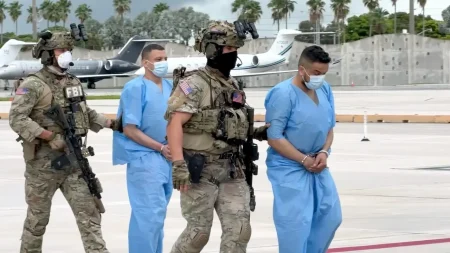
The scale of this heinous crime and the status of the victim as an American citizen operating on an international layover triggered a relentless, multi-jurisdictional manhunt that crossed national borders and united three countries in a shared mission of justice. For months, specialized investigators from the United States Homeland Security Investigations (HSI), Colombian prosecutors, and Peruvian authorities worked in close, secretive coordination, meticulously tracking the digital footprints, financial transactions, and physical movements of the suspects who believed they had successfully escaped the reach of the law. This painstaking international collaboration bore fruit when the two primary suspects, 23-year-old Andrés Felipe Peña Corrales and 31-year-old William Olave Gamboa, were successfully located and captured deep within Peru, where they had gone into hiding to evade Colombian justice. The dramatic arrests of these two men marked a monumental breakthrough in the case, proving that national borders would not serve as safe havens for those who prey on international travelers. Peña Corrales has since been extradited and returned to Colombia under heavy guard, where he must now look his accusers in the eye and answer for the devastating charges leveled against him. Meanwhile, Olave Gamboa remains locked behind bars in Peru, closely watched by Peruvian authorities as he awaits the conclusion of his own formal extradition proceedings to face the grim legal reality that awaits him in a Colombian courtroom, where prosecutors are armed with a mountain of forensic and digital evidence. This successful international sweep sent a clear message to transnational criminals that the global community will unite to protect innocent travelers and bring their victimizers to justice, no matter how far they run. The cooperation between the FBI, HSI, and South American police forces highlights the modern reality of law enforcement, where digital crimes and cross-border flights require an equally agile, borderless response to ensure that fugitive killers cannot simply slip away into the geography of neighboring nations.
Both Peña Corrales and Olave Gamboa now face a battery of severe charges in Colombia, including aggravated homicide and aggravated robbery—charges that carry the potential for decades of imprisonment behind the cold walls of a Colombian penitentiary. The upcoming legal proceedings represent a critical step toward accountability, not just for the grieving family of Eric Fernando Gutierrez Molina, but also as a powerful deterrent against the growing plague of dating-app facilitated crimes targeting foreigners in South America. In a poignant joint statement, the United States Embassy in Colombia praised the unyielding commitment of the American, Colombian, and Peruvian law enforcement teams, highlighting the critical roles played by the Mayor’s Office of Medellín, Colombia’s National Police, and Peru’s National Police in dismantling this dangerous criminal cell. The success of this operation serves as a stark reminder to transnational criminal organizations that the United States government will spare no effort or resource in pursuing those who harm its citizens abroad. As Colombian prosecutors build their case, investigators are aggressively digging deeper into the digital and financial records of “Los Goteros” to identify other potential victims, suspecting that Eric’s tragic death was not an isolated incident but rather the tragic climax of a long, unchecked series of druggings and robberies. Many survivors of such schemes often choose to suffer in silent shame rather than report the crimes to local police, but authorities hope that the high-profile nature of this case will encourage more victims to come forward, helping to permanently dismantle the network and ensure that no other family has to endure the pain of losing a loved one to this deceptive form of violence. By systematically mapping out the gang’s historical operations, police are piecing together a terrifying timeline of crime that reveals just how deeply entrenched “Los Goteros” had become in the local tourism ecosystem, using Medellín’s rise as a global travel hotspot to fuel their deadly enterprise.
As the wheels of justice slowly grind forward, the void left by Eric’s untimely death remains an open, painful wound for his family, friends, and his colleagues at American Airlines, who continue to mourn a man who brought warmth, light, and joy to the skies. In a heartfelt statement, American Airlines expressed their profound heartbreak over the tragic passing of their colleague, extending their deepest support to his family and affirming their active cooperation with international law enforcement to ensure that justice is fully served. Eric’s death has also sparked a broader, urgent conversation about travel safety in an era where digital dating applications can easily be weaponized by local criminal syndicates to lure unsuspecting tourists into highly vulnerable situations. U.S. authorities have issued stark warnings to travelers heading to popular summer destinations, emphasizing the critical importance of remaining vigilant, avoiding isolated meetings with strangers met online, and understanding the devastating potential of chemical agents like scopolamine. While the arrests of Peña Corrales, Olave Gamboa, and González offer a semblance of closure and demonstrate the power of international cooperation, they cannot restore a young life cut tragically short. Eric’s legacy will live on in the hearts of those who flew alongside him, serving as a somber reminder of the need for safety, vigilance, and solidarity in an increasingly interconnected yet sometimes perilous world. Ultimately, his story is a poignant testament to the enduring love of a global community determined to remember him not just as a victim of a cruel crime, but as a beloved friend, a dedicated professional, and a cherished light that was extinguished far too soon. As travelers continue to explore the world, the memory of Eric Fernando Gutierrez Molina will serve as a guiding beacon of caution, reminding us all that while travel expands our horizons, protecting one another and staying vigilant remains our most sacred duty on any journey.