



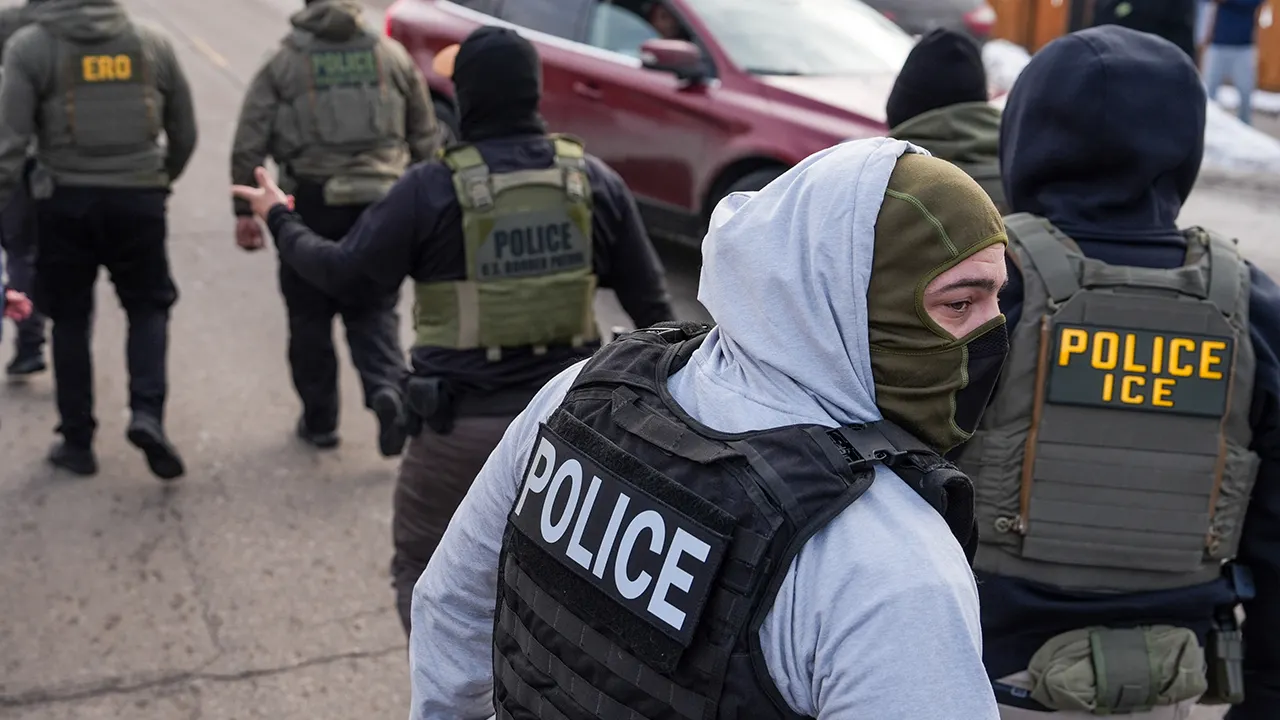
Imagine walking down a quiet residential street in upstate New York on a crisp morning, only to witness a fleet of unmarked vehicles pull up and disgorge heavily armed individuals wearing tactical gear and dark masks, their identifying badges completely obscured from public view. For many immigrant families, neighbors, and local advocates, this haunting image represents a terrifying reality where the lines between legitimate law enforcement and unaccountable intimidation become dangerously blurred. This vivid anxiety was the driving force behind a controversial New York State law aimed at pulling back the veil of anonymity by banning federal immigration agents from wearing masks and requiring them to display prominent, visible identification while operating within the state’s borders. However, this effort to enforce local standards of transparency and community reassurance was abruptly halted on Monday when U.S. District Judge Mae D’Agostino of the Northern District of New York issued a preliminary injunction. The judge’s decision to block these two key provisions of the law has reignited a fierce, nationwide conversation about constitutional boundaries, the safety of federal officers, and the psychological impact of anonymous policing on vulnerable communities. At its core, this legal battle is not merely a technical dispute over uniforms and tactical gear; it is a profound human struggle over who holds the ultimate authority to define what safety looks like in our neighborhoods. The ruling serves as a stark reminder of the perpetual friction between state governments striving to protect their residents’ mental and physical well-being and a federal apparatus determined to maintain absolute control over its nationwide operations. By dissecting this judicial intervention, we can begin to see how the dry, precise language of constitutional law directly shapes the daily lived experiences of ordinary people, law enforcement officers, and policymakers alike who are caught in the crossfire of America’s ongoing immigration debate.
The debate over whether law enforcement officers should be allowed to conceal their faces is deeply emotional, touching on fundamental human desires for accountability, recognition, and safety. Proponents of New York’s law argued that when federal agents from agencies like Immigration and Customs Enforcement (ICE), the FBI, the Drug Enforcement Administration (DEA), and U.S. Customs and Border Protection (CBP) operate with covered faces, it fosters an atmosphere of fear and distrust. To many community members, a masked agent feels less like a public servant and more like an occupying force, making it nearly impossible for witnesses or bystanders to hold individuals accountable for potential misconduct. New York lawmakers sought to humanize these interactions by mandating visible identification, believing that transparency is the cornerstone of any ethical justice system. Yet, from the perspective of federal agencies and the judge who ruled in their favor, these requirements represent a direct threat to the safety and operational integrity of officers who often work in highly volatile, dangerous environments. Judge D’Agostino’s ruling emphasized that the federal government possesses the sole constitutional authority to establish the policies, dress codes, and tactical procedures governing its own agents. In her written opinion, she clarified that New York cannot simply dictate uniform requirements for federal officers because state officials happen to disagree with the political priorities or operational methods of the federal administration. This portion of the decision highlights the cold reality of the Supremacy Clause of the U.S. Constitution, which dictates that federal law trumps state law when the two come into direct conflict. For federal agents, the ability to wear protective masks is often framed as a matter of personal safety—protecting their identities from retaliatory violence by criminal syndicates or hostile actors—while for local residents, those same masks remain a symbol of structural oppression and a barrier to basic human connection and accountability.
This judicial clash in New York does not exist in a political vacuum; it is part of a much larger, escalating “mask war” sweeping across the United States as conservative and liberal states alike attempt to redefine the limits of federal law enforcement. Recently, the Department of Justice went so far as to sue Virginia over laws that federal officials argued were designed to kneecap federal agents by restricting their operational tactics and protective gear. These legal skirmishes reflect a growing trend of states utilizing local statutes as leverage to protest, obstruct, or reshape federal immigration policies that they find objectionable. When a state like New York attempts to legislate what a federal agent can wear, it challenges the very hierarchy of American governance, testing how far a local government can go in asserting its sovereignty. Judge D’Agostino made it clear that allowing states to carve out their own individual rules for federal agents would create a chaotic, unworkable patchwork of regulations across the country, severely compromising the efficiency and safety of national security operations. If ICE agents had to follow one set of uniform rules in New York, another in Texas, and yet another in California, the cohesive execution of federal law would rapidly disintegrate. The court’s decision to grant a preliminary injunction while the broader lawsuit winds its way through the legal system ensures that, for now, the federal government maintains its uniform operational standards. This legal reality, however, does little to soothe the anxieties of local community organizers who feel that the judicial system is prioritizing the convenience and secrecy of federal agencies over the mental health and civil liberties of the people living within those communities.
Unsurprisingly, New York’s top leadership did not take the court’s decision lightly, expressing deep disappointment while immediately signaling their intent to fight back. In a joint statement, Governor Kathy Hochul and Attorney General Letitia James reaffirmed their unwavering commitment to the belief that masked, anonymous federal agents do not make New York any safer. They argued that public safety is inherently tied to trust, and trust cannot exist when the faces of authority are hidden behind tactical masks. From their perspective, the state has a moral and civic duty to protect its taxpayers and residents from the psychological trauma of militarized enforcement actions carried out in broad daylight. The Governor and Attorney General emphasized that they are actively reviewing all available legal options, indicating that this preliminary injunction is merely one battle in a prolonged legal war. Their public stance resonates deeply with a progressive constituency that demands greater oversight of federal immigration enforcement, which many view as overly aggressive and disconnected from local values. By framing the issue around community safety and democratic transparency, Hochul and James are attempting to shift the narrative away from a dry constitutional debate about federal supremacy and toward a more human-centered argument about local self-determination and the right of communities to establish peaceful, open public spaces. Their defiance underscores the political high stakes of the issue, as state leaders seek to demonstrate to their voters that they will not passively accept federal policies that they believe harm their communities, even when facing significant legal hurdles in federal court.
Despite the setback regarding the mask ban, the ruling was not an outright defeat for New York; in fact, the state secured a massive, highly significant victory regarding the limits of local cooperation with federal immigration authorities. Judge D’Agostino declined to block a separate, major provision of the New York law that prohibits local law enforcement agencies from participating in federal civil immigration enforcement under what are known as 287(g) agreements. These voluntary agreements historically allowed local police and sheriff’s departments to be deputized by the federal government to perform immigration officer functions, essentially turning local cops into de facto ICE agents. In her ruling, the judge affirmed that participation in these programs is entirely voluntary under federal law, meaning that New York has every right to forbid its local jurisdictions from cooperating. The judge noted that the state’s refusal to participate in civil immigration enforcement does not constitute unlawful discrimination against the federal government, but is instead a lawful exercise of state sovereignty. This distinction carries immense human significance; it means that local police officers in New York can focus exclusively on community policing, traffic safety, and investigating local crimes rather than hunting down undocumented immigrants. For many immigrant families, this ruling provides a vital sense of relief, ensuring that they can still call local emergency services or report crimes to local police without the paralyzing fear that doing so will result in their immediate deportation.
Governor Hochul and Attorney General James warmly welcomed this portion of the ruling, celebrating it as a triumph for both community safety and fiscal responsibility. They pointed out that New York taxpayers should never be forced to foot the bill for local police departments to collaborate with ICE, arguing that local law enforcement should remain laser-focused on local matters. This duality in Judge D’Agostino’s ruling perfectly encapsulates the complex, fragmented nature of modern American federalism, where victories and losses are often shared, leaving both sides with tools to continue their struggle. As the legal challenge proceeds, the broader questions of trust, identity, and authority remain unresolved in the hearts and minds of the public. Ultimately, the New York case highlights a society searching for a delicate, elusive balance: a system that respects the legal sovereignty and safety of federal agents while simultaneously honoring the dignity, transparency, and peace of mind of the local communities they operate within. Until that balance is found, the battle lines will remain drawn, played out in courtroom filings, political rhetoric, and on the very streets where ordinary people simply want to live their lives without fear.