


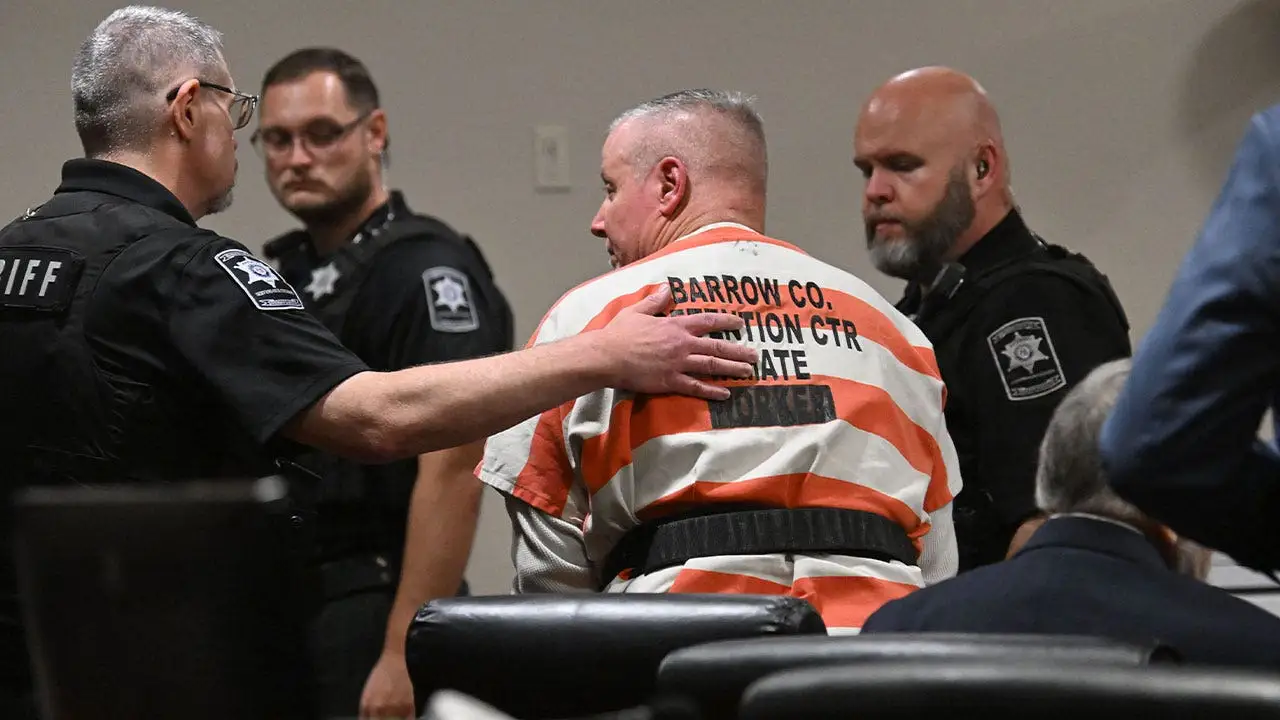
The quiet solemnity of the Barrow County Superior Courtroom was shattered not by an outburst of anger, but by the crushing weight of institutional and familial failure, culminating in a historic legal reckoning that will undoubtedly echo through the halls of American jurisprudence for decades to come. When Judge Nicholas Primm looked across the courtroom at 55-year-old Colin Gray, he did not merely see a defendant facing criminal charges; he saw a father who had systematically dismantled the safety net of his own household, paving the way for one of the most devastating school massacres in recent Georgia history. In sentencing Gray to 15 years in prison following his conviction on 27 counts—including second-degree murder and involuntary manslaughter—the state of Georgia sent an unmistakable, chilling message to parents across the nation: your children’s access to lethal violence is your legal, moral, and human responsibility. The judge’s words were sharp, deliberate, and free of ambiguity, cutting straight to the heart of the tragedy by reminding Gray that the warning lights governing his household had been flashing brighter and brighter with each passing day. Instead of stepping in to shield both his son and the public from a mounting psychological crisis, Colin Gray chose a path of profound, criminal passivity, proving to the world that sometimes the most destructive weapon in a tragedy is not the gun itself, but the deliberate blindness of those trusted to protect us.
The physical and emotional wreckage left in the wake of the Apalachee High School shooting was brought to life in excruciating detail during the hearing, as the families of those lost stepped up to the podium to reclaim their voices. Among the most gut-wrenching testimonies came from Shayna Aspinwall, the widow of beloved teacher and coach Richard “Ricky” Aspinwall, who was gunned down alongside fellow educator Cristina Irimie, 53, and 14-year-old students Mason Schermerhorn and Christian Angulo. Standing before the court, her voice trembling but resolute, Aspinwall painted a devastating picture of a family permanently fractured, describing how she now struggles with profound PTSD while raising her two young daughters in a house haunted by an inescapable silence. Her daughters, she told the court, must navigate life’s milestone moments—birthdays, graduations, and eventually weddings—without the warm embrace, guidance, and steady presence of their father. By articulating this generational pain, Aspinwall effectively bridged the gap between the abstract legal charges of criminal negligence and the visceral, daily reality of gun violence, reminding everyone present that while Colin Gray did not pull the physical trigger on September 4, 2024, his absolute failure as a parent and a gun owner made the horrific mass murder of her husband entirely possible.
To understand the depth of Colin Gray’s culpability is to examine a timeline of missed warnings and active facilitation that defies basic parental instinct and human decency. Prosecutors successfully argued that Gray was fully aware of his son Colt’s rapidly deteriorating mental state, yet chose to feed the fire rather than extinguish it, going so far as to purchase the military-grade, AR-15-style rifle for the teenager despite glaring signs of instability. Judge Primm outlined this shocking lapse in judgment with painful clarity, pointing out that Colin Gray possessed countless opportunities to avert catastrophe by simply taking the most elementary precautions. He could have locked the family’s firearms, secured the ammunition in a separate location, stored the weapons off-site, or actively pursued intensive psychiatric intervention for a child begging for help. By ignoring these flashing signals and opting instead to provide a troubled teenager with the ultimate instrument of death, Gray did not just fail in his domestic duties; he engaged in a form of active criminal negligence that transformed his home into a visual staging ground for violence, ultimately sealing the fates of four innocent souls and injuring nine others.
For his part, the shooter, Colt Gray, who was only a teenager at the time of the massacre, has already pleaded guilty to all 55 charges leveled against him, resulting in a sentence of life in prison without the possibility of parole. The contrast between father and son in this legal saga is stark, showcasing a tragedy of circular failure where a parent’s neglect directly fueled a child’s descent into monstrous violence. Throughout his own hearings, the younger Gray presented a chillingly quiet figure, answering the judge with soft, repetitive confirmations of understanding, a stark manifestation of a young life completely wasted and corrupted. His plea of guilt sealed his fate to die behind concrete walls, a somber end to a childhood that should have been defined by education, growth, and familial support, but was instead derailed by a toxic mixture of access to high-powered weaponry and a total vacuum of parental oversight. This dual tragedy raises profound humanitarian concerns about the invisible decay occurring within American homes, where isolation, untreated mental illness, and a gun culture devoid of responsibility can fester in silence until they boil over into public spaces with catastrophic results.
This landmark verdict marks a turning point in how society views the ecosystem of mass shootings, aligning with a growing national movement to hold the enablers of gun violence just as accountable as the perpetrators. For years, the legal system treated adolescent shooters as isolated, anomalous actors, shielding parents behind a protective shield of domestic privacy and the assumption that a teenager’s choices are entirely their own. However, the conviction of Colin Gray—closely following similar historic prosecutions like that of the Crumbley parents in Michigan—demonstrates that the collective tolerance for parental negligence has expired, signaling a cultural shift toward proactive communal safety. This legal evolution forces a vital, national conversation regarding the boundaries of the Second Amendment and the boundaries of ethical caregiving, asserting that the right to bear arms must be explicitly tied to the non-negotiable duty to secure them. As courts continue to redefine the legal definitions of criminal negligence, the precedent established in this Georgia courtroom acts as a fierce warning to gun-owning parents nationwide: if you arm a crisis, you will share the cage.
As the legal proceedings draw to a close and the headlines begin to fade, the community of Winder, Georgia, is left with the agonizingly slow work of healing and rebuilding. The conclusion of the sentencing coincidentally aligned with the emotional return of Apalachee High School students to their classrooms, marking a bittersweet milestone as teenagers and teachers bravely walked back through the doors of a building once stained by terror. The classrooms may be repaired and the walls freshly painted, but the phantom presence of those lost empty desks, the silent hallways, and the collective trauma of a community forever altered will linger for generations to come. Ultimately, the story of the Gray family is not merely a tale of a broken household or a failure of local vigilance; it is a profound cautionary tale about the absolute necessity of human connection and parental accountability in a modern world where the consequences of raising our eyes from our children’s pain are deadlier than ever before.