



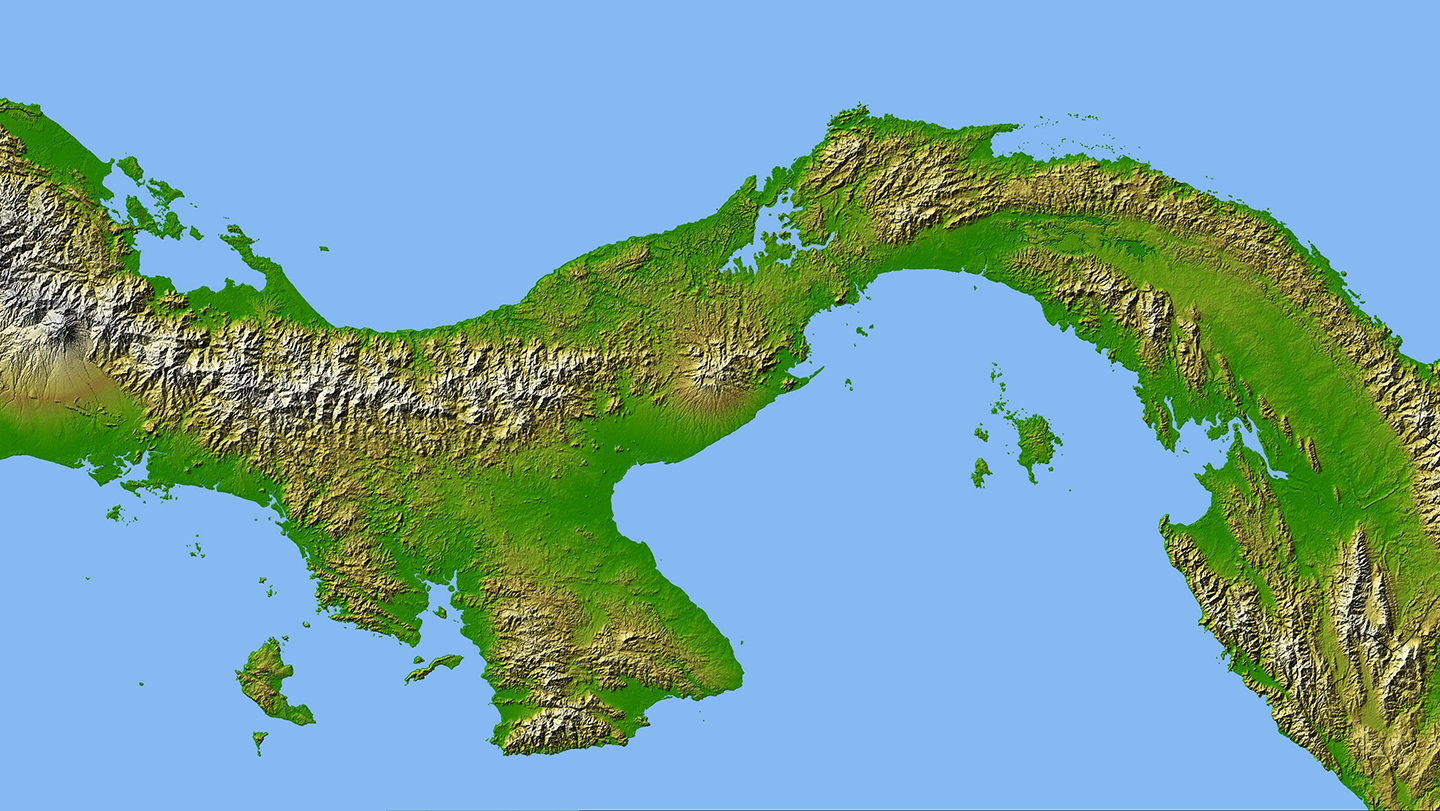
Imagine our world ten million years ago, during the late Miocene epoch, when the physical map of the Americas looked profoundly different from the one we study in classrooms today. A deep, churning marine barrier known as the Central American Seaway completely separated North and South America, leaving the southern landmass suspended in what evolutionary biologists beautifully call a state of “splendid isolation.” In this ecological sanctuary, free from outside disruption, a bizarre and wondrous array of creatures evolved independently, including gigantic ground sloths, armor-plated glyptodonts, and specialized marsupials that filled the niches of apex predators. However, beneath the ocean waves, slow but unstoppable plate tectonic forces were dragging the continents together, gradually raising a narrow strip of land that would alter the course of natural history forever. By approximately 2.8 million years ago, the Isthmus of Panama had fully emerged, acting as a terrestrial bridge that triggered one of the most chaotic, dramatic, and consequential ecological free-for-alls in Earth’s history: the Great American Biotic Interchange. As the gates swung open, a stampede of mammals rushed in both directions, seeking new territories and resources across this newly paved corridor. Yet, as paleontologists looked at the modern distribution of life, they noticed a striking, almost baffling asymmetry in how this migration played out. Today, more than half of the 217 mammal genera roaming the vast plains and dense rainforests of South America can trace their ancestral lineages directly back to invaders from North America. In stark contrast, only a tiny handful of southern mammals—such as the opossum, the armadillo, and the porcupine—successfully clawed their way northward and managed to establish permanent evolutionary footholds. This massive biological conquest suggested that northern species possessed some hidden, overwhelming advantage, a mysterious historical edge that allowed them to colonize an entire continent while their southern counterparts struggled to survive the encounter.
For decades, researchers struggled to explain why the mammalian traffic across the Panamanian land bridge was so heavily lopsided, but a groundbreaking study published in the journal Science has finally illuminated the secret behind the northern species’ remarkable success. The key, it turns out, was not a sudden burst of biological superiority, but rather a prolonged, multi-million-year “vacation” spent in a geographic holding pen. Long before the Isthmus of Panama rose from the sea, northern mammals had begun drifting southward, settling into a sprawling, low-lying sanctuary that encompassed what is now the southern United States, Mexico, and portions of Central America. This subtropical region served as an evolutionary waiting room, a dynamic bottleneck where species could rest, adapt, and diversify in a warm climate that mirrored the environments they would eventually encounter in South America. Led by Jack Tseng, a highly collaborative vertebrate paleontologist at the University of California, Berkeley, scientists have begun to view this ancient Mexican landscape as a critical engine of evolutionary innovation. Previously, paleontologists recognized that some southern species, like giant sloths, had made pit stops in Mexico on their journey north, resting and adapting to cooler temperatures before braving the icy northern latitudes of Canada and the United States. However, Tseng and his team dared to ask a compelling, reversible question: what if this ecological holding pen was actually working both ways, functioning as an intense training ground that pre-adapted northern invaders for their ultimate journey down south? By reimagining Central America not just as a passive transit corridor, but as a hyper-active incubator of life, the researchers opened up a completely new way of understanding how physical geography dictates the destiny of entire animal kingdoms. This conceptual shift suggests that the journey was not just a sudden dash across a newly built bridge, but a slow, multi-generational process of physical preparation.
To transform this compelling hypothesis into undeniable scientific reality, Tseng and his dedicated team had to embark on an ambitious, global treasure hunt for long-lost fossil data. True scientific discovery often relies on looking where others have failed to search, and the team quickly realized that the fossil record of ancient Mexico had been criminally underrepresented in mainstream, English-language scientific literature. Instead of simply packing up shovels and heading into the desert for costly, years-long excavations, the researchers did something far more innovative and deeply humanizing: they decided to decolonize the existing scientific record by diving into neglected archives. They spent months painstakingly translating and cataloging forgotten Spanish-language scientific papers, searching through the back-catalogs of obscure regional journals, and establishing personal connections with curators at local museums in central Mexico. By digitizing and synthesizing these isolated, dusty records, the team managed to nearly double the known fossil record of mammals in the region without ever having to dig up a single new bone. This meticulous, cross-cultural detective work brought to light a vibrant, historically ignored chapter of paleontological history, revealing that ancient Mexico was absolutely teeming with an astonishing variety of prehistoric life. The newly compiled database allowed the researchers to reconstruct complex family trees and track animal migration patterns with unprecedented clarity, showing that both Mexico and South America experienced synchronized bursts of mammalian diversity between ten million and seven million years ago. However, the data also revealed a striking distinction: the diversity spike in Mexico reached a staggering peak that was nearly double that of South America, indicating that the northern holding pen was a literal boiling pot of biological activity. This monumental archival effort demonstrated that science is not just about what we discover in the ground, but how we listen to, preserve, and connect the scattered voices of global researchers who came before us.
Armed with this incredibly rich, newly unified fossil library, the researchers began to paint a vivid picture of the sheer evolutionary chaos that unfolded in ancient Mexico during the late Miocene. This subtropical bottleneck was not a peaceful paradise; rather, it was a brutal, high-stakes evolutionary pressure cooker—essentially a mammalian “cage match.” As countless species from the north migrated downward, they piled into this narrow strip of land, squeezing into the same habitats and igniting intense, relentless competition for limited resources. At the very same time, the global climate began to undergo a dramatic shift, slowly drying out the region and transforming lush forests into arid, punishing scrublands. This combination of overcrowded habitats and resource scarcity forced these animals to adapt at an accelerated rate or face immediate extinction. The mammals of the Mexican holding pen were subjected to a ruthless trial by fire, enduring countless cycles of environmental stress, predatory pressures, and climate fluctuations that systematically weeded out the weak. As Jack Tseng vividly points out, these northern faunas had essentially gone through the ultimate evolutionary test time and time again, emerging from the crucible as highly resilient, generalist survivors. They developed larger brain-to-body ratios, highly specialized teeth for grinding tough, fibrous vegetation, and efficient locomotion styles for traveling long distances across newly formed open plains. Consequently, when the opportunity finally arose to migrate further south, they had already spent millions of years overcoming the very same climate challenges they would encounter on the other side of the equator. By the time the geological clock finally ran out and the land bridge arose, these battle-hardened northern lineages were perfectly engineered, highly versatile ecological machines, ready to face any challenge that lay ahead, having been sharpened to a razor’s edge by the harsh realities of their Mexican training ground.
While the northern invaders were busy forging their survival skills in the fiery, highly competitive crucible of ancient Mexico, the native mammals of South America were living a very different, far more peaceful, yet ultimately perilous existence. Isolated from the rest of the world since the catastrophic extinction of the non-avian dinosaurs some 66 million years ago, these southern creatures evolved in a warm, incredibly stable tropical vacuum. On their side of the sea, the climate remained stubbornly wet, lush, and predictable, which allowed an incredibly specialized, unique, but delicate array of life to thrive without major external threats. Weird and wonderful mammalian groups flourished there, such as the spectacular sparassodonts—carnivorous metatherians that resembled placental wolves and saber-toothed cats—alongside ancient, slow-moving herbivores that had never known the swift, ruthless terror of northern placental predators like wolves and big cats. However, this long-term stability proved to be an evolutionary trap. Because they faced very little outside competition and lived in a highly consistent, humid environment, South American mammals never had to develop the high-stress adaptations or the wild ecological flexibility of their northern neighbors. To make matters worse, as the continents drew closer, the overall diversity of South American mammals was actually on the decline, possibly due to localized climate shifts that they were ill-equipped to handle. When the physical barrier of the ocean finally vanished, these highly specialized, gentle giants and unique marsupials found themselves suddenly face-to-face with an army of highly adapted, aggressive, and highly competitive northern generalists. It was an incredibly unfair matchup; the isolated southern fauna, accustomed to millions of years of tranquil, tropical predictability, were suddenly thrown into the ring with battle-tested survivors that had been hardened by millions of years of intense competition and harsh, aridifying climates.
When the physical connection between the two massive continents was finally cemented 2.8 million years ago, the ecological dam burst, unleashing a relentless southward tide of highly adaptable northern species. Canids, camelids, felids, raccoons, and bears poured across the newly formed Isthmus of Panama in sweeping, generational waves, bringing with them a formidable arsenal of physical and behavioral adaptations. Armed with larger body sizes, more efficient metabolic systems, and a high tolerance for arid, unpredictable environments, these northern wanderers easily outcompeted, displaced, or preyed upon the native South American fauna, quickly diversifying and dominating every major ecological niche on the continent. In reviewing this remarkable study, paleoecologist Jenny McGuire of the Georgia Institute of Technology beautifully noted how this research elegantly flips a long-held scientific paradigm. Historically, scientists only viewed the Central American region as an evolutionary stepping stone for southern plants and animals migrating northward; this new breakthrough turns that assumption completely on its head, revealing that the very same geographic bottleneck served as a launching pad for the northern conquest of the south. At the same time, Alberto Boscaini, a prominent paleontologist at the University of Buenos Aires, emphasizes a deeply humanizing and comforting truth about this dramatic evolutionary saga: we must not look back at these ancient animals and assume that the northern invaders were somehow “biologically superior” or destined for dominance. Instead, their overwhelming success was simply a beautiful, chaotic stroke of geological luck—they simply happened to acquire local pre-adaptations in the Mexican holding pen that became incredibly useful during a moment of profound, world-shaping tectonic and climatic change, reminding us that in the grand, unpredictable theater of life on Earth, survival is always an intricate, fragile, and beautiful dance between preparation, place, and timing.