


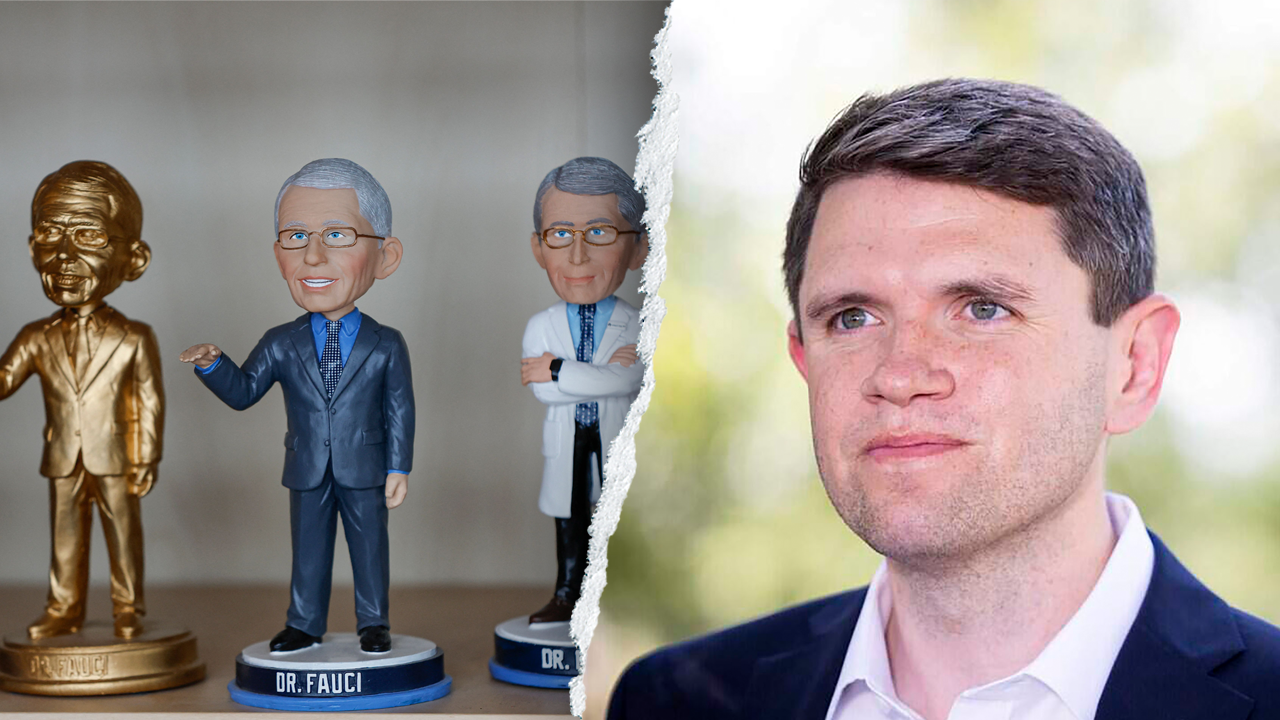
On Christmas Day in 2021, the world was still grappling with the exhausting, polarizing rhythms of the COVID-19 pandemic. It was a holiday season marked by the rapid spread of the Omicron variant, widespread anxiety, and deep societal rifts over lockdowns, masks, and vaccine mandates. In the midst of this tense atmosphere, James Talarico, a rising star in the Texas Democratic Party and a member of the state’s House of Representatives, unwrapped a holiday gift that perfectly captured the surreal cultural moment: a plastic action figure of Dr. Anthony Fauci. Thrilled by the present, Talarico took to social media to share his excitement. “I got the coolest action figure for Christmas!” he wrote, uploading a photo of the toy. He used the moment to pivot to a message of civic duty, adding, “Thank you to all the health care superheroes working today. Let’s help by getting vaxxed and boosted!” At the time, the post was a reflection of a specific cultural phenomenon where public health officials were elevated to the status of pop-culture icons by those who supported federal pandemic guidelines. To Talarico and his supporters, the miniature Fauci was a lighthearted tribute to scientific resilience and a nod of solidarity to medical professionals spending their holidays on the front lines. To his political opponents, however, the post was viewed through a far more cynical lens. It was seen as an act of political performativity, an embrace of what they characterized as authoritarian overreach, and a public declaration of allegiance to a highly controversial figure. Little did Talarico know that this brief moment of holiday cheer, preserved forever in the digital amber of the internet, would resurface years later to become a central flashpoint in his high-stakes political campaign, illustrating how deeply the wounds and divisions of the pandemic era still run in American life.
The passage of time rarely erases digital footprints, and in the arena of modern political warfare, old social media posts are frequently resurrected as precision-guided weapons. Several years after Talarico first shared his enthusiasm for his Fauci toy, the post made a dramatic and hostile comeback on the social media platform X, formerly known as Twitter. The catalyst for this sudden revival was a fresh wave of national headlines surrounding Dr. Anthony Fauci himself. The public health official had recently returned to the congressional spotlight, facing intense scrutiny during heated hearings about the origins of COVID-19 and the federal government’s pandemic response. During these proceedings, reports surfaced that Fauci had repeatedly invoked his Fifth Amendment right against self-incrimination, reportedly refusing to answer questions under oath more than one hundred times. For conservative politicians and commentators, this was the perfect opportunity to link Talarico to what they viewed as a disgraced and evasive establishment figure. Almost overnight, the Texas Democrat’s old Christmas post was thrust back into the public eye, transformed from an outdated holiday update into a liability. The weaponization of this post highlights a broader, highly stressful reality of modern public life: the fact that public figures are constantly forced to litigate their pasts in real-time, matching old statements against new contexts. It demonstrates how political opponents wait patiently for national news cycles to align with historical social media activity, allowing them to construct a narrative of hypocrisy or poor judgment. For Talarico, who is currently running a highly pressurized campaign, the sudden resurgence of his “superhero” doll served as a harsh reminder that in the internet age, no gesture of political enthusiasm is ever truly forgotten or safely buried.
The backlash against Talarico quickly escalated beyond mere policy disagreements, transforming into a highly personalized and gendered critique designed to damage his standing among traditional Texas voters. In a state where political identity is often deeply intertwined with rugged, traditional concepts of masculinity, Republican lawmakers and conservative commentators seized upon the Fauci doll to paint Talarico as weak and unmasculine. Texas Attorney General Ken Paxton, a fierce critic of the Democratic nominee, went so far as to publicly label Talarico as “too low-T for Texas,” using a derogatory shorthand for low testosterone that has become popular in conservative circles to emasculate opponents. Additionally, an artificial intelligence-generated political advertisement, produced by a conservative group, took the attacks a step further by depicting the Democratic hopeful prancing around in a dress. Leading conservative figures like Benny Johnson mocked him openly, while the National Rifle Association chimed in with a stern warning to its followers to “Never trust a grown man that plays with dolls.” Representative Brandon Gill, a Texas Republican, scoffed at the candidate by asking his followers if they believed Talarico still played with the action figure. This coordinated effort to frame Talarico as effeminate is a calculated psychological strategy designed to trigger cultural anxieties and appeal to conservative voters who value traditional norms. By portraying a male politician as someone who plays with dolls and lacks traditional masculine grit, opponents seek to bypass intellectual policy debates entirely, instead attacking his character, maturity, and basic fitness to lead. This kind of mud-slinging reveals the intensely punitive nature of modern political campaigns, where personal hobbies, aesthetic choices, and harmless holiday moments are aggressively pathologized to alienate voters and destroy a candidate’s public image.
To fully understand the weight of this controversy, one must examine the physical object at the center of the storm: a twenty-five-dollar plastic figurine manufactured by a design company called FCTRY. This particular toy, which features a detailed likeness of Dr. Fauci complete with a tiny, removable face mask, is part of a broader commercial line of “real-life action figures.” The series also includes miniature, poseable versions of other prominent progressive icons such as Representative Alexandria Ocasio-Cortez, Senator Bernie Sanders, and Vice President Kamala Harris. The very existence of these toys speaks to a fascinating, modern human impulse: the desire to commercialize, simplify, and idealize complex political and scientific figures, turning them into modern-day secular saints. When citizens buy these action figures, they are not merely purchasing a piece of plastic; they are purchasing a physical manifestation of their values, their hopes, and their tribal identities. It is a form of political fandom that mirrors the way sports fans buy jerseys or comic book enthusiasts collect depictions of fictional superheroes. However, this commodification carries inherent risks. Real human beings—unlike fictional comic book characters—are deeply flawed, subject to shifting political winds, and capable of falling from grace. When a real-life figure like Fauci becomes embroiled in congressional investigations and public scandals, the physical idols created in their honor suddenly become targets of intense derision. For his critics, the action figure is a physical symbol of what they perceive as the left’s blind, almost religious devotion to bureaucratic authority. By mocking the doll, conservatives are not just mocking a piece of plastic; they are taking aim at the entire cultural ecosystem that seeks to elevate controversial government officials to the status of faultless heroes.
The local political storm surrounding Talarico is inextricably linked to a much larger, ongoing national struggle between Dr. Anthony Fauci and key Republican figures, most notably Senator Ted Cruz and Senator Rand Paul. For years, these conservative leaders have engaged in public, often deeply personal feuds with Fauci, accusing him of misleading the public about the origins of the pandemic, funding risky gain-of-function research, and championing economically devastating lockdown policies. When news broke of Fauci’s recent congressional testimony—where he reportedly refused to answer questions under oath over a hundred times—republican politicians saw a golden opportunity to tie this national narrative directly to local races. Senator Ted Cruz wasted no time connecting the national controversy to Talarico’s old Christmas post, writing on X, “James Talarico called Fauci a superhero. Today, Fauci took the Fifth 111 times. Apparently accountability was sold separately.” Cruz later sharpened the barb, joking that if you pushed a lever on the doll, “it pleads the Fifth.” For his part, Fauci has consistently defended his extensive record, dismissing the persistent congressional investigations as the result of Rand Paul’s “unhinged obsession” with him, framing the hearings as politically motivated theater rather than genuine oversight. This high-profile national clash highlights the deep, systemic distrust that has come to define the relationship between conservative lawmakers and the scientific and bureaucratic establishments. By dragging Talarico’s old holiday post into this national arena, Texas Republicans are effectively turning a local Senate race into a referendum on the federal government’s pandemic response, utilizing Fauci as a proxy to rally their voter base and paint the Democratic challenger as an out-of-touch loyalist to a controversial establishment.
As the chorus of mockery and political attacks grew louder, the Talarico campaign chose a path of strategic silence, declining to respond to media requests for comment on the resurrected Christmas post. This reticence is a common defensive tactic in contemporary political communications, based on the assumption that engaging with online bait only feeds the media cycle and prolongs the shelf life of a negative story. By refusing to comment, Talarico’s team likely hopes to starve the controversy of oxygen, shifting the focus back to pressing local issues like education, healthcare, and the economy of Texas. Yet, the silence also underscores the immense exhaustion that many candidates and voters feel when navigating a political landscape dominated by petty internet controversies and personal insults. It raises a sobering question about the future of public service and democratic debate: when the barrier to entry involves enduring deep fakes, intensely personal attacks on one’s masculinity, and the relentless weaponization of harmless holiday moments, what kind of leaders will we attract? The average voter, often fatigued by the constant noise of the culture wars, is left to sort through the theatrical posturing of both sides, searching for substance beneath the layers of political performance. In the end, the controversy over a twenty-five-dollar plastic toy serves as a vivid microcosm of our current political era—a time when policy debates are frequently eclipsed by digital spectacle, and where the line between serious governance and online trolling has become increasingly, and perhaps permanently, blurred.