


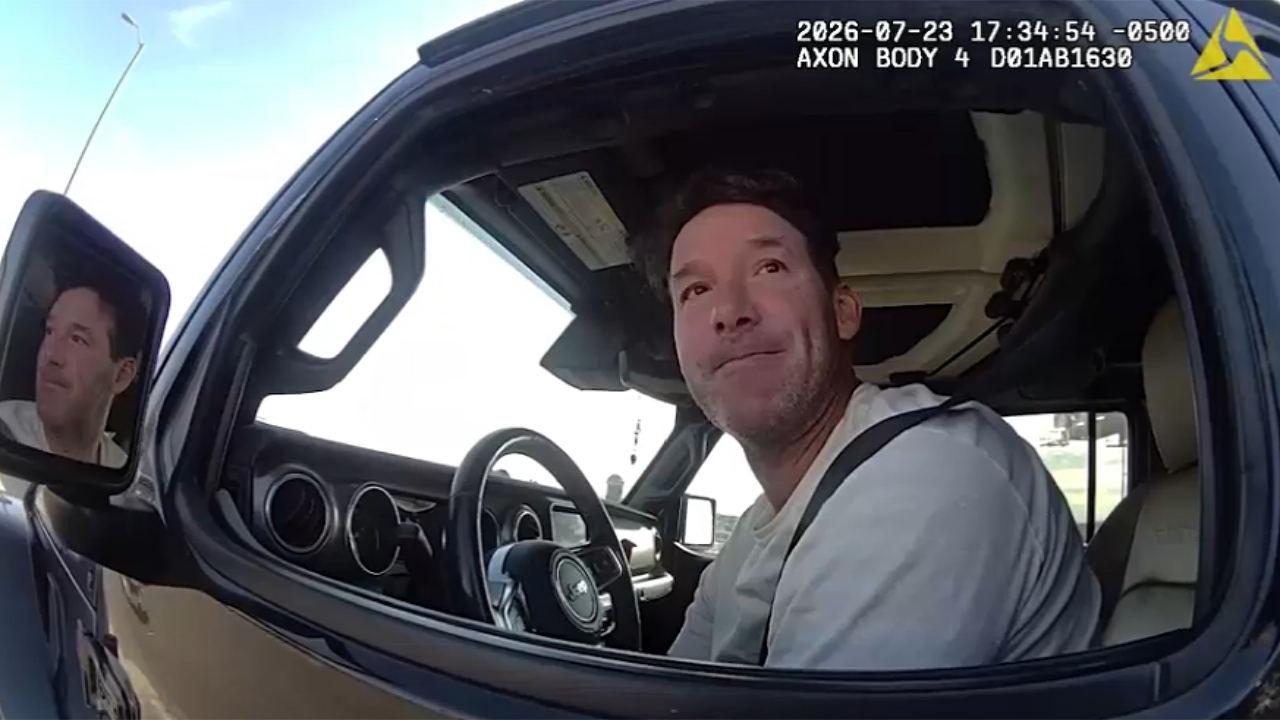
The thin line between the roaring adulation of millions and the stark, quiet reality of a flashing blue light on a lonely highway is a modern tightrope that public figures walk daily. For Tony Romo, the long-time superstar quarterback of the Dallas Cowboys and current voice of NFL Sundays, that line dissolved into the damp Wisconsin night air on July 23. Fresh off the links at the Wisconsin Amateur Golf Championship, Romo found himself pulled over on an interstate, face-to-face with a reality far removed from the climate-controlled comfort of the CBS broadcast booth. Newly released police body camera footage, obtained by Fox News Digital, captured a scene that was both frustratingly human and intensely uncomfortable. There, under the harsh strobe of emergency lights, the former quarterback vehemently questioned the intentions of the arresting officer, struggling to reconcile his public status with his current suburban predicament. When asked to step out of his vehicle, Romo’s voice carried a mixture of disbelief and defensiveness as he asked, “Because I’m coming from a golf course, you think I’m drunk?” He adamantly insisted to the officer that he had consumed “zero” drinks throughout the day, repeatedly trying to steer the conversation toward calling his attorney. This immediate pivot to defensive legal shielding highlighted the panic that often sets in when a highly protected public life suddenly collides with the unyielding mechanics of local law enforcement. For a man accustomed to calling the plays and predicting defenses with uncanny accuracy before they even happen on the field, the inability to control this narrative in real-time was palpable, transforming an ordinary traffic stop into a highly scrutinized public spectacle. This stark roadside confrontation serves as a sobering reminder of how quickly a lifetime of constructed prestige can be challenged in a single moment on the asphalt, leaving even the most celebrated heroes feeling vulnerable and entirely exposed to the cold, objective eyes of the law.
The mechanics of the stop quickly escalated from a routine roadside questioning to a formal detention, as the arresting officer remained unmoved by Romo’s protestations of complete sobriety. According to police reports, the officer noted classic signs of physical impairment, dryly documenting that the former athlete had red, glassy eyes and that a distinct odor of alcohol was emanating from him. Unable to resolve the situation on the shoulder of the busy interstate, officers made the decision to transport Romo to a nearby station to conduct a battery of standardized field sobriety tests under more controlled conditions. It was here, inside the stark walls of the police station, that the gap between Romo’s athletic instinct and legal caution became most apparent. While he complied with the physical coordinates of the field sobriety tests, he drew a hard line when asked to submit to a chemical breath test to measure his blood alcohol content. Channeling advice he had clearly internalized from years of navigating high-stakes business and personal affairs, Romo told the officer, “I’ve heard from all the lawyers don’t ever do that,” choosing to take his chances with the immediate legal fallout of a refusal rather than providing concrete biometric evidence. This calculation resulted in Romo being formally cited for a first-offense operating while intoxicated (OWI) alongside a separate citation for refusing to submit to a chemical test. Though he was eventually released from custody to await his scheduled court appearance on September 21, the legal chessboard had been set, leaving him to deal with the public relations fallout of a mugshot and a narrative that he could not easily audibilize his way out of. Such a refusal, while legally strategic in the eyes of defense attorneys, often compounds the court of public opinion, where the act of turning down a breathalyzer is frequently interpreted not as a constitutional right, but as a silent admission of guilt.
To understand how Romo ended up on that Wisconsin highway, one must understand his obsessive relationship with golf, a sport that has served as his primary competitive outlet since retiring from the physical violence of the NFL. Golf is not merely a hobby for Romo; it is an arena where he attempts to recapture the high-stakes pressure and razor-thin margins of error that defined his youth. He was in Wisconsin specifically to compete in the state’s Amateur Golf Championship, a grueling multi-day tournament that demands intense mental focus and physical execution. However, the tournament did not go as planned, with reports indicating his scorecard before the arrest painted a nightmarish, frustrating picture of his competitive form. The psychological weight of a poor performance on the course, combined with the physical exhaustion of a long day of competitive play, often leaves amateur and professional athletes alike seeking a release, a context that makes the subsequent traffic stop feel tragic in its predictability. Following the arrest, the ripple effects were immediate; Romo quietly withdrew from the M&P Group Texas State Open, a tournament he was scheduled to play in the following weekend, signaling a retreat from the public eye as he began to process the professional and personal damage control required. This withdrawal underscored the reality that when a public figure falters, their entire calendar of commitments—no matter how hard-won or deeply desired—must be sacrificed to appease the demanding gods of corporate optics and personal crisis management. For an athlete whose life has been characterized by the pursuit of perfection, the realization that an imperfect afternoon on the green could lead to a highly publicized legal battle on the highway is a bitter pill to swallow, highlighting the unforgiving intersection of athletic pride and personal vulnerability.
For Dallas Cowboys fans and NFL observers, this latest chapter in Romo’s life carries a familiar resonance of high-profile struggle and intense, unforgiving spotlight. From 2006 to 2015, Romo occupied one of the most heavily scrutinized positions in all of American sports: the starting quarterback for the country’s most polarizing franchise. His story was originally one of pure cinematic triumph—an undrafted free agent out of Eastern Illinois who clawed his way to the top of the depth chart through sheer grit and improvisational brilliance, ultimately throwing for 34,183 yards and 248 touchdowns. Yet, despite his four Pro Bowl selections and a spectacular 2014 season where he finished tied for third in the MVP voting, his football legacy is inextricably tied to moments of painful, near-tragic failure. None are more iconic than his first playoff game against the Seattle Seahawks in 2007, where he dropped the hold on a potential game-winning field goal, picked up the ball in a desperate, lunging run for the end zone, and was tackled just inches short of glory. That single, agonizing play came to define a career that was brilliant but ultimately unfulfilled by a Super Bowl ring, leading to his eventual displacement by a young Dak Prescott after a back injury in 2016. This narrative of a man who climbs to the highest peaks only to face a sudden, public descent makes this Wisconsin arrest feel like a haunting echo of his playing days—a reminder that despite his incredible talents, he has always been vulnerably, deeply human, prone to the kind of sudden mistakes that play out on national television. The quarterback who once shouldered the dreams of millions under the intense lights of Texas Stadium now finds himself carrying a very different, deeply personal kind of burden under the cold gaze of the public.
Yet, Romo’s transition from the field to the broadcast booth in 2017 was praised as one of the most successful second acts in sports media history, making this current legal trouble all the more jarring for his corporate benefactors. Upon signing with CBS, Romo revolutionized sports broadcasting alongside play-by-play icon Jim Nantz, earning widespread acclaim for his enthusiastic delivery and his uncanny, almost psychic ability to predict plays before they happened on the field. This unique analytical brilliance quickly earned him a historic multi-million-dollar contract, cementing his position as the premier voice in football broadcasting and leading the network through three Super Bowl broadcasts, including the recent thrilling overtime victory of the Kansas City Chiefs over the San Francisco 49ers. CBS, which has invested heavily in Romo’s golden-boy, family-friendly image, found itself in a delicate position following the news of his arrest, failing to immediately respond to inquiries from outlets like Fox News Digital. The silence from both CBS and Romo himself speaks volumes about the high stakes involved in modern sports media, where an individual’s personal brand is worth millions of dollars and carries the reputation of entire corporate networks. The contrast between the polished, authoritative analyst who explains the complexities of defensive coverage to millions of households and the video of a defensive driver debating a local police officer on a dark Wisconsin road highlights the deep chasm that exists between our media icons and the flawed human beings who inhabit those roles. In a world where television personalities are built up to be infallible commentators on the mistakes of others, a sudden brush with the law serves as a stark reminder of the fragile nature of celebrity and the unforgiving reality of corporate sponsorship.
As the September 21 court date approaches, the public is left to contemplate the complexity of a man who has lived his life under an intense microscope, experiencing both the heights of athletic adulation and the depths of public embarrassment. Romo’s silence on the matter is a tactical necessity, advised by the very lawyers whose wisdom he invoked on the night of his arrest, but it does little to dampen the ongoing conversation about accountability, celebrity privilege, and the personal struggles of retired athletes. It is easy to reduce this incident to a simple tabloid headline or a punchline on sports radio, but the reality is far more human—a reminder that fame, wealth, and a brilliant analytical mind do not shield an individual from the poor decisions, stress, and vulnerability that affect us all. Whether this first-offense OWI citation will remain a minor bump on his post-retirement road or develop into a more significant roadblock for his broadcasting career remains to be seen. What is certain, however, is that this incident strips away the untouchable veneer of the television superstar and forces us to look at Tony Romo not as a legendary quarterback or a charismatic commentator, but as a husband, father, and citizen who must now navigate the sobering reality of the justice system. In the end, the flashing lights of that Wisconsin interstate served as a harsh mirror, reminding Romo and the public alike that no matter how far you can throw a football or how high you can climb, the rules of gravity, law, and human limitation apply to everyone equally. The road to redemption, much like the winding fairways of the golf courses he loves, is rarely straight, and Romo must now find a way to navigate this difficult hazard with the same resilience that once defined his legendary career.