




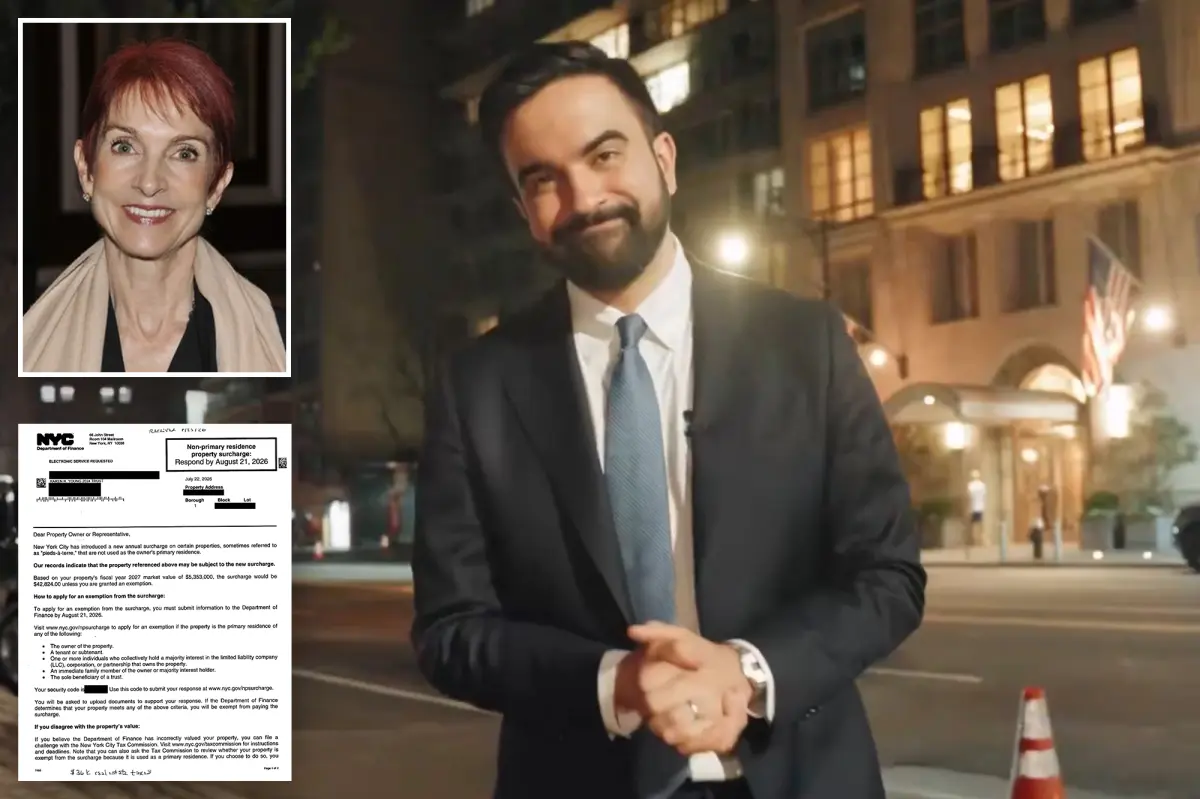
A wave of collective fury swept through the streets of New York City this Tuesday as tens of thousands of everyday residents opened their mail, only to find themselves caught in the crosshairs of a newly implemented municipal tax policy gone horribly wrong. Designed and heavily promoted by progressive Mayor Zohran Mamdani’s administration as a bold, “tax-the-rich” initiative, the state’s brand-new pied-à-terre surcharge was explicitly legislated to extract wealthy contributions from billionaire absentee owners who purchase luxury secondary properties in the city without contributing to its social fabric. Instead, the reality of the rollout has felt like a sudden, punitive attack on the city’s most loyal constituents. Longtime homeowners, many of whom have lived in their single, primary residences for decades, are reeling after receiving unexpected, eye-wateringly expensive five-figure tax bills. These taxpayers have been abruptly cast into a chaotic labyrinth of local bureaucracy, forced to spend their own time and money to prove to an indifferent government that they actually live in their own homes. The aggressive deployment of the tax has ignited a deeper existential conversation among New Yorkers about civic trust, administrative incompetence, and the thin line between progressive taxation and state-sanctioned extortion.
Among those caught in the administrative dragnet is Karen Young, a dedicated entrepreneur and the founder of a successful international beauty marketing firm, who has proudly called New York City home since 1972. Her decades of devotion to the city’s cultural and economic life were met with a baffling blow when she opened a notification from the Department of Finance demanding a staggering $43,000 in pied-à-terre taxes on the West 95th Street brownstone she has shared with her husband for thirty years. Stunned and deeply insulted by the implication that her deeply rooted family home was merely an empty luxury playground, Young described the notification as a hostile, unresearched “witch hunt.” Her frustration compounded when she sought to easily rectify the error on the Department of Finance’s official web portal, only to find a broken, highly complex digital interface that defied her own tech-savvy capabilities. Despite public assurances from city officials that resolving residency errors was as simple as uploading a driver’s license, Young spent three fruitless hours battling the website before admitting defeat and paying her estate lawyer to handle the documentation. For lifelong residents like Young, the experience is not just a financial threat, but a painful, deeply personal betrayal by a city leadership that could not be bothered to cross-reference basic, readily available public records before demanding tens of thousands of dollars.
The structural mechanics of this new legislation reveal a massive disconnect between its intended legislative scope and its real-world implementation by the Department of Finance. Originally passed by lawmakers in Albany and signed by Governor Kathy Hochul, the law dictates that the pied-à-terre surcharge should apply strictly to one-to-three-family homes valued over $5 million, and to condominiums or co-operatives valued at $1 million or more, which are not used as primary residences. For properties mistakenly caught in the net, the city has designed an uncomfortably narrow and unforgiving path to redemption, placing the entire burden of proof onto the citizen. Homeowners disputing their residency classification are given a razor-thin 30-day window from the date of the notice to gather, submit, and hope the city approves their rebuttal. Meanwhile, those attempting to argue that the city has wildly inflated the market value of their property are forced to navigate a separate, slow-moving appeal process with the New York City Tax Commission that drags on until the following spring. This rigid system leaves virtually no immediate recourse for terrified property owners, cementing a “guilty until proven innocent” dynamic that turns the simple act of owning a home in New York into an active legal struggle against the municipality.
The policy has also alienated part-time residents who represent an essential pillar of New York’s cultural and service economies, such as Diane Francis, a prominent Canadian journalist, author, and entrepreneur. Francis, who purchased an apartment near West 57th Street and Eighth Avenue in 2022, serves as a prime example of the high-spending seasonal residents who are now being actively penalized for their association with the city. Pointing out the short-sighted nature of the tax, Francis emphasized that part-time residents like herself are actually major “profit centers” for the city, contributing immense amounts of money through high property taxes, condo fees, local dining, Broadway theaters, and retail shopping without consuming the public services, like schools, that full-time families rely on. She described the new tax as a foolish, poorly policed attempt to scapegoat a demographic that acts as a vital economic engine, warning that treating seasonal residents like a public nuisance rather than a benefit is beneath the intelligence of New Yorkers. By aggressively squeezing those who voluntarily bring capital and energy into the city, the Mamdani administration risks driving away the high-net-worth visitors whose discretionary spending directly keeps thousands of working-class service industry jobs afloat.
The sheer human cost and lack of basic empathy characterized by this bureaucratic breakdown are perhaps most painfully illustrated by the story of an 81-year-old widow living on the Upper East Side. The senior citizen, who had previously divided her time between New Jersey and Manhattan before consolidating her life into her sole, long-term Manhattan home, was horrified to receive a notice demanding a massive $55,048 surcharge under the threat of immediate enforcement if she did not prove her residency. Adding a layer of profound emotional distress to the financial panic, the official letter from the Department of Finance was addressed directly to her late husband, who had passed away six years prior. The city’s failure to update its own records, combined with its aggressive demands, felt like a cruel and invasive violation of her grief and peace of mind. For three decades, she had quietly paid her taxes and maintained her home as her only residence, yet she was suddenly treated as a tax-evading transient. Her experience exposes how the hasty rush to generate municipal revenue can result in a deeply upsetting experience for vulnerable, elderly citizens who lack the digital literacy or resources to easily fight back against systemic government errors.
Ultimately, the scale of this policy failure points to a deeper, more systemic dysfunction within New York’s current administrative state. While the Department of Finance originally claimed the pied-à-terre tax would target a highly selective pool of roughly 31,000 extremely wealthy real estate owners, a public document dump reviewed by reporters revealed that the city had flagged more than 960,000 parcels and residents as potential targets. This massive disparity has created a sense of widespread paranoia, leading long-term residents like Andy Arons—who has lived in his West Village brownstone for nearly three decades—to describe the tone of the administration’s letters as “draconian” and reminiscent of authoritarian regimes. Arons noted that forcing citizens to constantly justify their right to live in their own homes under an unspoken threat of seizure feels deeply performative, designed more to stoke class division than to implement fair urban planning. As the Mamdani administration doubles down on its strategy and directs confused citizens to a broken website, they face a growing crisis of legitimacy. By transforming a targeted luxury tax into a net that entangles almost a million ordinary New Yorkers, the city is rapidly eroding the trust and goodwill of the very people who form the cultural, economic, and historical backbone of the metropolis.