



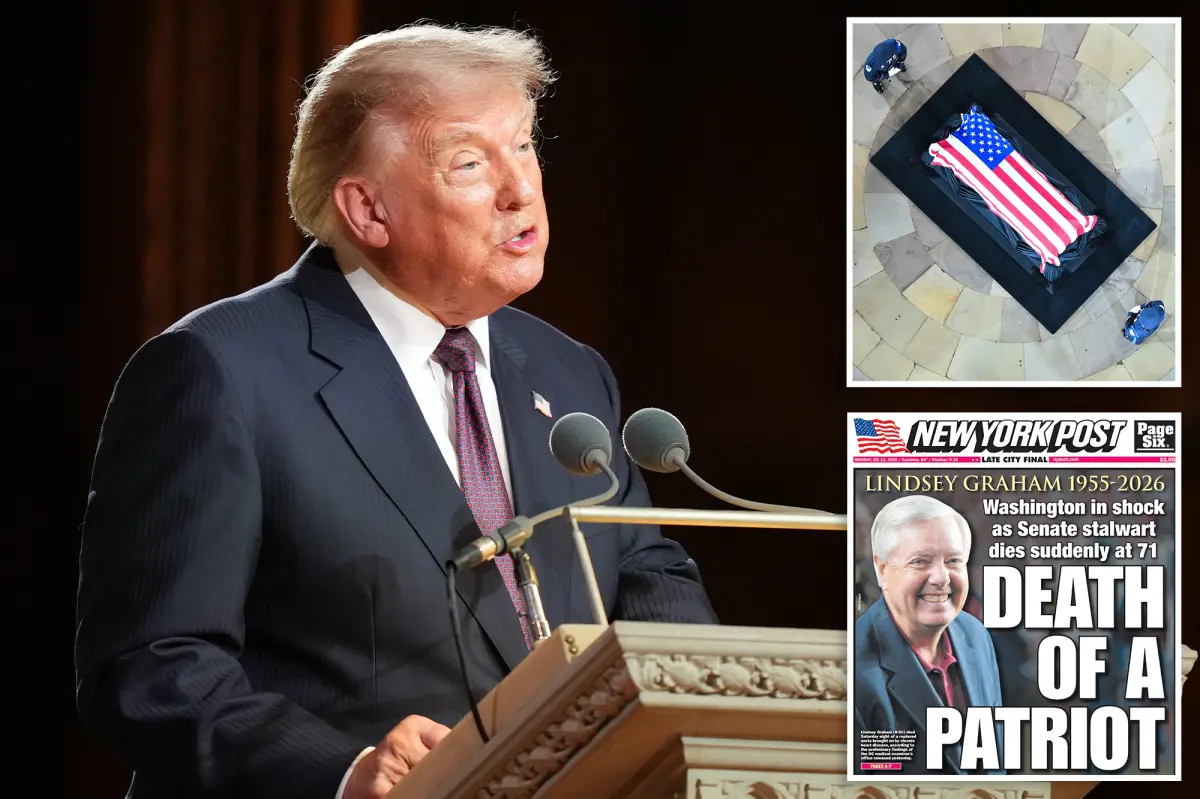
On a warm summer afternoon, beneath the soaring stained-glass windows and vaulted stone arches of the Washington National Cathedral, an extraordinary gathering of political adversaries and allies came together to celebrate the life of Senator Lindsey Graham, who passed away on July 11, 2026, at the age of seventy-one due to cardiovascular disease. The atmosphere inside the grand sanctuary was initially thick with the polite, structured solemnity typical of a high-profile Washington funeral. However, that heavy air of formality was instantly shattered when former President Donald Trump stepped up to the wooden pulpit to deliver a eulogy that was as much a stand-up comedy routine as it was a deeply moving love letter to his “beloved friend.” Standing before a bipartisan audience of Supreme Court justices, cabinet members, and congressional colleagues, Trump immediately set a tone of radical candor and humanizing warmth. He spoke of Graham not as a distant, frozen monument of legislative history, but as an energetic, delightfully frustrating, and fiercely loyal human being who left an indelible mark on everyone he encountered. The core of Trump’s address centered on the profound paradox of their relationship: a bond that began in the radioactive fires of public political warfare but ultimately cooled into one of the most resilient and genuine friendships either man would experience in their twilight years. Trump’s opening remarks acknowledged that they did not exactly get off to the best of starts, an understatement that immediately elicited soft chuckles from a crowd well-acquainted with the turbulent history of modern American politics. By leaning into the very real, unvarnished history of their early animosity, Trump did something rare at a state funeral—he demystified the political theater, presenting a raw, deeply human look at his departed friend. This introduction set the stage for an emotional journey through a decade of shared history, illustrating how two powerful, headstrong men bypassed the superficial grudges of Washington to find true companionship, mutual respect, and a shared love for the country they both sought to lead in their respective ways.
To understand the depth of the affection Trump held for Graham, one had to travel back to the tumultuous arena of the 2016 Republican presidential primaries, a period that Trump recalled with a mixture of nostalgic glee and performative regret. During that heated, highly contentious election cycle, Graham was one of Trump’s most vocal and biting critics, regularly appearing on cable news to lambast his future friend’s qualifications and temperament. In retaliation for an especially sharp television insult, Trump decided to deploy his signature brand of theatrical counter-punching. At a packed campaign rally in South Carolina, Trump stood before thousands of screaming supporters, reached into his jacket, pulled out a piece of paper, and read Graham’s personal cell phone number aloud to millions of people watching around the globe, encouraging them to give the senator a call and voice their thoughts directly. As Trump recounted this legendary piece of political folklore from the cathedral pulpit, he paused, a mischievous grin spreading across his face, and said, “I remember the number—(202) 228-0292—if anybody wants to give it a shot.” The sanctuary erupting in a roar of unrestricted laughter was a testament to the sheer absurdity of that historic moment, bridging the gap between past rivalry and present grief. Trump admitted that while sharing the private contact details of a sitting United States Senator was “something that I shouldn’t have done,” it surprisingly laid the very foundation for their future relationship. Instead of retreating into enduring bitterness, Graham chose a remarkably disarming path, demonstrating the kind of political agility and personal resilience that defined his entire career. Rather than letting the incident fracture their dynamic permanently, Graham leaned into the chaos, turning a moment of public humiliation into a bridge for communication, proving that behind his soft Southern charm lay a shrewd, pragmatic operator who knew that in politics, as in life, today’s enemy can easily become tomorrow’s most valuable ally.
Indeed, as Trump fondly remembered, it was Graham who ultimately had the “last laugh” in their famous cell phone saga. While Trump may have successfully blown up Graham’s phone for a single day, causing the senator to iconically destroy his flip phone in a viral campaign video, the gesture backfired in the most heartwarming way imaginable. In the years following that initial conflict, Graham converted the database of Trump’s attention into a direct line to the presidency, embarking on a decade-long spree of daily phone calls, strategy sessions, and casual check-ins. “Lindsey did not stop calling me for the next ten years,” Trump told the audience, sparking another wave of warm amusement throughout the congregation. This persistent, unyielding pursuit of connection transformed their relationship from a temporary truce into a deep, foundational friendship. The two men became near-constant companions, spending their weekends far away from the rigid structures and prying eyes of Washington, D.C. They found solace on the pristine fairways of Trump’s golf clubs, from the rolling green hills of Bedminster in New Jersey to the sun-soaked, palm-fringed lawns of Mar-a-Lago in Palm Beach. In these informal settings, riding side-by-side in golf carts, the two men forged an alliance that transcended mere political convenience. Behind closed doors, Graham became one of Trump’s most influential advisers, a trusted sounding board who could deliver hard truths wrapped in self-deprecating humor and Southern wit. Trump’s description of these private moments humanized both figures, stripping away the polished armor of their public personas to reveal two aging statesmen who genuinely enjoyed each other’s company, finding in one another a rare intellectual equal and a loyal friend who was always there to offer counsel, share a joke, or simply enjoy a quiet afternoon on the golf course.
Much of Trump’s eulogy focused on this lighter, deeply personal side of Graham—a man who possessed an infectious sense of humor, a quick-witted conversational style, and a stubborn refusal to conform to the grueling, early-morning schedule of the nation’s capital. Trump brought the congregation to tears of laughter as he affectionately mocked Graham’s legendary aversion to waking up before 10:00 AM, detailing how the late senator’s daily routine was practically sacred. To illustrate this humorous stubbornness, Trump shared a beloved anecdote involving Senator Tim Scott, whom Trump described as “a great gentleman in his own right.” As the story went, Scott had once extended an invitation to Graham to attend a prestigious, early-morning prayer breakfast scheduled for 8:30 AM. Upon hearing the time, Graham turned to his colleague and drawled, “Tim, if Jesus himself comes back before 10:00 AM, I ain’t going.” This line, delivered with Trump’s trademark comedic timing, filled the grand cathedral with a warmth that felt entirely authentic to Graham’s spirited personality. Trump also shared how Graham’s playful glass-shattering irreverence extended to the highest diplomatic levels, recalling an incident where the senator met the Dalai Lama and, with his characteristic lack of a filter, casually asked the spiritual leader if he could levitate. Despite his aversion to early mornings, however, Graham always ended up showing up when it truly mattered, a point Scott had previously confirmed, highlighting that Graham’s devotion to his friends always triumphed over his personal comfort. These stories painted a vivid picture of a man who brought a much-needed sense of joy, humanity, and levity to a city that often takes itself far too seriously, utilizing humor not just as a defensive shield, but as a masterful tool to disarm opponents, forge connections, and build lasting bridges across seemingly insurmountable divides.
Yet, for all his humor and lighthearted charm, Trump made sure to remind the assembly that Graham was a formidable political force, famously straying from his written script to call him a “tough cookie.” With a knowing wink to the bipartisan crowd, Trump observed that “no matter how heated things got in Washington, virtually everyone, Republican or Democrat, liked Lindsey,” before pausing to add, “Well, not everybody, but it sounds good. Not everybody.” This off-script moment of honesty perfectly captured Graham’s complex identity within the Senate, where he was a sharp-tongued debater, a fierce defender of his party’s ideals, and a relentless foreign policy hawk who was never afraid to ruffle feathers. Trump traced Graham’s remarkable trajectory from a small, rural town in South Carolina—where he rose from modest beginnings to become an indispensable giant of American statecraft—to the absolute pinnacle of global influence. Over his twenty-three years of dedicated service in the United States Senate, Graham established himself as an inescapable institution in his own right, navigating the shifting tides of his party and the country with unmatched political survival instincts. Trump emphasized the sheer scale of Graham’s influence, noting that nothing of consequence took place in Washington without the senator knowing about it, and no major bill became law in the United States without Graham having a significant say in its drafting. His voice carried a tone of profound respect as he described how Graham traveled the world, meeting with foreign dictators and democratic allies alike, ensuring that American power and values were felt in every corner of the earth, proving that behind the late-morning jokes and golf-course banter was a brilliant, tireless legislator who dedicated his entire life to the high-stakes game of global diplomacy.
As the eulogy drew to a close, the laughter in the National Cathedral gently gave way to a deeper, more reflective silence, as Trump offered his final, poetic thoughts on Graham’s enduring legacy. He used a series of powerful, heartfelt phrases to summarize the senator’s life, calling him a “force of nature” and a “great figure in Senate history” who truly lived his life to the absolute fullest, squeezing every drop of joy, influence, and purpose from his seventy-one years on earth. In a poignant concluding remark that resonated deeply with everyone in attendance, Trump observed that Graham was “a man who gave America the full measure of his good and mighty heart until that heart itself just gave out.” This beautiful, humanizing reference to Graham’s sudden passing from cardiovascular disease served as a powerful reminder of the physical and emotional toll of a lifetime spent in public service, fighting for the future of the nation. The tribute was a remarkable moment in modern political history, presenting a rare pause in the hyper-polarized theater of contemporary America to honor a complex man who was loved, criticized, and ultimately deeply respected by a grateful nation. In delivering this warm, hilarious, and emotionally resonant address, Trump did not just honor a political ally; he humanized a friend, proving that even in the cutthroat arena of Washington, D.C., genuine love, laughter, and loyalty can still prevail. As Trump stepped away from the podium, leaving behind a crowd that was both weeping and smiling, it was clear that while Lindsey Graham’s seat in the Senate would eventually be filled, the unique, vibrant spirit of the boy from South Carolina who conquered Washington with a flip phone and a smile would never be forgotten.