



The Battle for the Future of Global Settlement: How Ripple is Re-Engineering Cross-Border Payments
By [Your Name], Senior Financial Technology Correspondent
The global financial machinery that powers our everyday lives is, beneath its glossy digital surface, surprisingly archaic. Every day, trillions of dollars flow across borders to facilitate international trade, corporate acquisitions, and family remittances. Yet, the plumbing that connects our global banking institutions remains shockingly outdated, relying on a patchwork of legacy systems designed in the mid-20th century. While we can send a high-definition video across the globe in milliseconds, sending fiat currency from New York to Tokyo still takes days, incurs exorbitant fees, and frequently gets lost in a labyrinth of correspondent banks. In a digitized world where efficiency is paramount, the traditional financial system is increasingly being criticized for being cumbersome, time-consuming, and prohibitively expensive. This friction has created a multibillion-dollar problem—one that digital assets and blockchain technology are actively trying to solve. But as the debate rages over which technology will ultimately win the race to modernize global finance, Ripple CEO Brad Garlinghouse is steering his company toward a highly specific, institutional solution that could redefine how money moves forever.
Speaking at a recent industry event, Garlinghouse demystified the underlying pathology of our current financial bottlenecks, arguing that the core issue with modern payment applications is not necessarily their technological complexity, but rather their fundamental inability to communicate with one another. We live in an era of digital silos; a payment app in Europe cannot natively “talk” to a payment app in Southeast Asia without relying on multiple intermediary banks to bridge the gap. This lack of interoperability, Garlinghouse notes, manifests most painfully when individuals and corporations attempt to execute international wire transfers. These cross-border transactions are notoriously slow, heavily taxed by administrative fees, and highly prone to human and systemic errors. It is not uncommon for vital business capital to get stuck in transit for weeks at a time, forcing accounting departments to manually track down funds through a chain of foreign institutions. For Ripple, this systemic inefficiency is not just a market vacancy—it is the very reason for the company’s existence, serving as the blueprint for their enterprise-grade settlement protocols.
To address these deep-seated systemic failures, Ripple has positioned its native digital asset, XRP, as the ultimate liquidity bridge for the global banking sector. During his address, Garlinghouse highlighted the stark contrast between legacy wire transfers and XRP-fueled transactions, emphasizing that a settlement utilizing XRP takes approximately four seconds to complete, regardless of where the sender and recipient are located on the globe. Beyond sheer velocity, the ultimate disruptor is the negligible cost associated with these ledger transactions. Sending millions of dollars across borders via XRP costs an incredibly small fraction of a cent per transaction—a reality that fundamentally challenges the fee-heavy business models of traditional remittance giants and SWIFT networks. This paradigm shift addresses the core demands of the modern market, as speed and cost-efficiency have become the dual pillars of value for institutions and consumers who actually rely on transaction technology daily. Rather than trying to rebuild the entire consumer banking experience, Ripple has focused its engineering efforts on optimizing this foundational, back-end transactional layer.
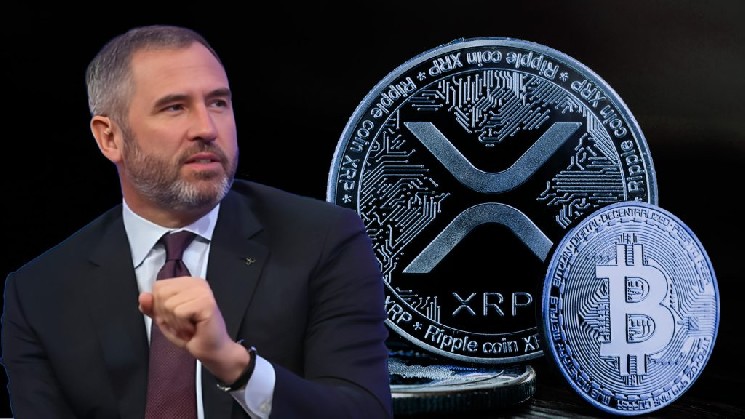
In a move to further contextualize XRP’s distinct utility within the broader digital asset ecosystem, Garlinghouse drew a clear distinction between Ripple’s token and Bitcoin, the world’s largest cryptocurrency. While Bitcoin has successfully captured the global imagination as a decentralized store of value and a digital alternative to gold, its underlying proof-of-work architecture is not optimized for rapid, high-throughput microtransactions or enterprise settlement. A typical Bitcoin transaction can take anywhere from ten minutes to several hours to finalize, with network congestion occasionally driving transactional fees upward of $10 or more. Garlinghouse was quick to clarify that this comparison was by no means a criticism of Bitcoin’s monumental achievements; rather, it was a educational comparison designed to highlight XRP’s specific, highly targeted role as a high-speed utility engine. While Bitcoin functions beautifully as a long-term asset to be held, XRP is engineered to move, serving as a frictionless vehicle for real-time liquidity.
This deliberate design philosophy underscores a fundamental truth about Ripple’s corporate strategy: the company is not chasing the speculative retail crypto market, but is instead laser-focused on institutional integration. Garlinghouse reiterated that XRP was built from the ground up to solve the liquidity and settlement challenges faced by banks, central banks, and multinational financial institutions rather than individual retail investors. Under the traditional pre-funding model, banks must maintain Nostro and Vostro accounts filled with local currencies in foreign countries just to facilitate cross-border payments—a practice that traps trillions of dollars of idle capital worldwide. By utilizing XRP as an on-demand liquidity bridge, these financial giants can free up this capital, drastically reducing operational overhead and eliminating the settlement delays that have plagued international trade for decades. By focusing on solving this multi-trillion-dollar institutional pain point, Ripple is targeting the very plumbing of global commerce.
Ultimately, Ripple’s technological ambitions represent a pragmatic bridge between the revolutionary promises of decentralized ledger technology and the highly regulated reality of global banking. By designing enterprise-grade solutions that address real-world frictions rather than attempting to bypass or dismantle established financial institutions, the company is carving out a sustainable path toward mainstream blockchain adoption. The future of global finance will likely not be defined by a total rejection of the banking system, but rather by its systematic optimization. As Ripple continues to deploy its high-speed ledger technology to eliminate the delays, errors, and high costs of international money transfers, the line between traditional finance and digital assets will continue to blur, paving the way for an era where money moves as seamlessly and instantly as information itself.
Disclaimer: The information provided in this article is for informational and educational purposes only and should not be construed as investment, financial, or legal advice.