




As Atlanta prepares to host the highly anticipated World Cup semifinal match between England and Argentina at Atlanta Stadium, the skies above the city are becoming just as active as the pitch below. In a massive, coordinated security effort, the Federal Bureau of Investigation (FBI) and the Atlanta Police Department (APD) have joined forces to secure the venue from potential aerial threats. Recognizing that modern technology presents unique security challenges, both agencies are deploying advanced drone surveillance and monitoring systems to scan the ground and sky. A primary focus of this operation is enforcing the Federal Aviation Administration’s (FAA) Temporary Flight Restrictions (TFR) around the stadium, ensuring that unauthorized aircraft do not disrupt the historic match or endanger the thousands of fans gathering in the city.
The threat of unauthorized drone activity is a very real puzzle for federal authorities, who have already confiscated more than 600 drones across the country since the World Cup tournament began. In Atlanta alone, federal agents have seized 86 drones violating airspace rules. Marlo Graham, the Special Agent in Charge of the FBI’s Atlanta Field Office, explained that the bureau utilizes a sophisticated detection mechanism to identify unauthorized drones entering restricted zones. Once a rogue drone is detected, agents work quickly to neutralize the threat, often taking remote control of the aircraft to land it safely. While every unauthorized drone is treated as a potential danger, Graham noted that the level of concern escalates depending on the vehicle’s size and its proximity to the stadium, adding that Atlanta’s closed-dome stadium offers some protection against a hobbyist’s drone accidentally interrupting a crucial, game-defining goal.
Fortunately, local authorities are playing a vital role in tracking down the operators behind these unauthorized flights. The Atlanta Police Department’s Drone Unit works hand-in-hand with the FBI to locate individuals piloting drones in restricted areas. According to APD Sergeant Kindu Franklin, most of the operators they encounter are simply passionate soccer fans and hobbyists rather than bad actors. Many have recently purchased drones specifically for the World Cup, hoping to capture stunning aerial footage to share on their social media accounts. However, because these devices can easily be modified or weaponized, police must remain proactive. By quickly tracking down these well-meaning but negligent pilots, the APD helps educate the public on airspace safety while keeping the perimeter secure.
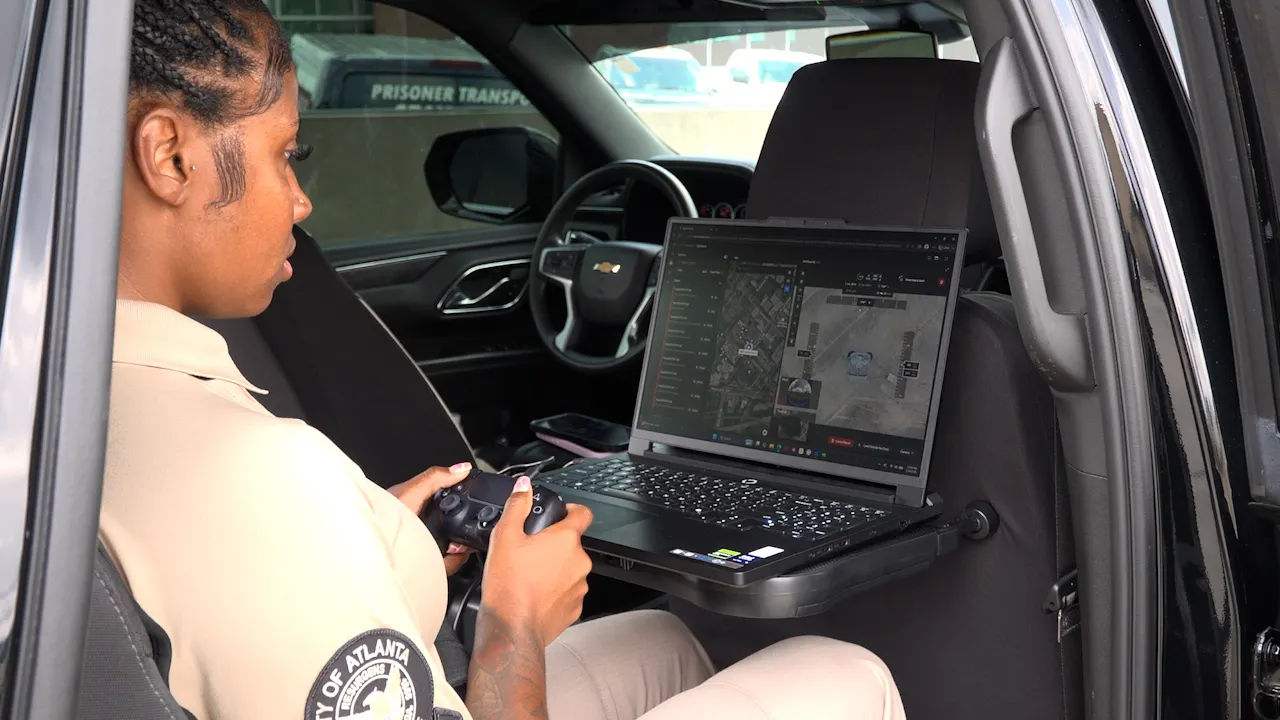
To keep a watchful eye on the entire operational area, the APD’s drone mission focuses heavily on high-tech aerial surveillance. Sergeant James Cunningham of the APD Drone Unit emphasized that these eyes in the sky provide command staff with invaluable perspectives that are impossible to get from the ground, helping monitor everything from suspicious activity to traffic bottlenecks. While some of these tactical drones are launched manually using handheld controllers, others are deployed from automated docking stations strategically placed throughout Atlanta. Inside specialized mobile command SUVs, officers can pilot these docked drones using a computer setup paired with a standard PlayStation controller, transforming state-of-the-art surveillance into a highly intuitive operation.
These innovative drone docks are not just temporary additions for the tournament; they are used year-round to give Atlanta’s first responders a head start during emergencies. The system’s advanced software maps out the real-time locations of police vehicles and officer body cameras, allowing the drone pilot to coordinate seamlessly with ground units before they even arrive at a scene. For the World Cup, this infrastructure translates into faster response times and a significantly broader visual reach. Cunningham pointed out that the APD Drone Unit has been incredibly active, logging more than 550 flight hours and completing over 1,400 flights since early June—a milestone that many police drone units across the nation take years to achieve.
As the countdown to the semifinal match begins, police and federal agents are pleading with the public to respect the strict airspace rules. APD pilot Anais Paredes expressed confidence in the team’s preparation, noting that because they live and train in Atlanta, they know exactly what to expect. To keep the skies clear, the FBI is urging all hobbyist drone pilots to familiarize themselves with local flight restrictions before takeoff. During the tournament, a strict one-mile flight restriction is enforced around World Cup stadiums on non-match days, which expands to a three-mile restriction on game days. By keeping their drones grounded, local hobbyists can play their own small part in ensuring a safe, historic, and uninterrupted match for players and fans alike.