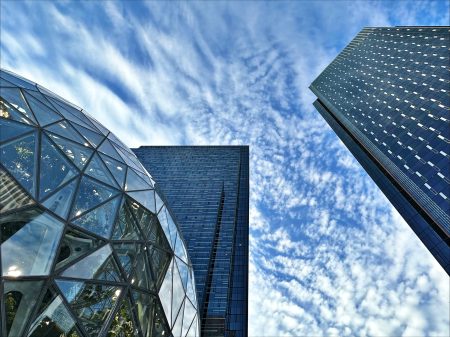



Back in 1992, Seattle’s legendary grunge scene was a beautifully gritty, analog universe. It was an iconic era defined by flannel shirts, sweaty mosh pits, and basement venues—all thriving long before the internet and social media arrived to overexpose and commercialize every raw moment. While MTV and high-fashion designers eventually tried their best to capitalize on the movement, they were nothing compared to the disruptive force of modern artificial intelligence. Today, Seattle is the very epicenter of the global tech boom, making it a biting irony that AI is now being used to digitally resurrect the historic, low-tech counterculture that the city once birthed.
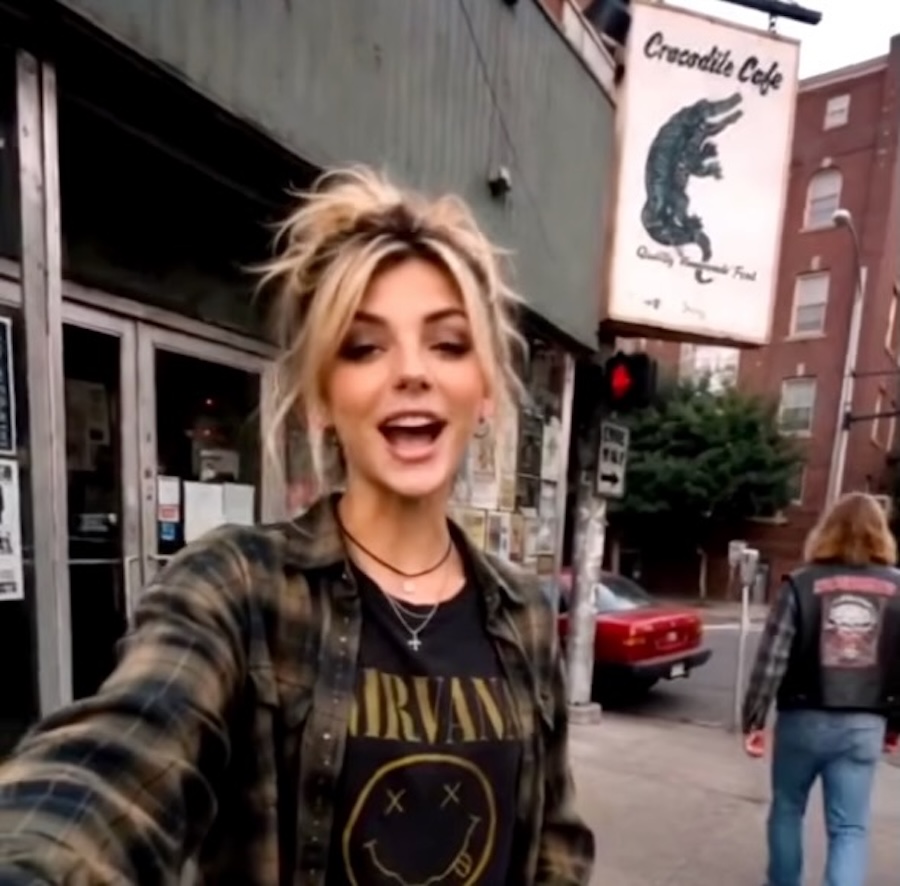
The collision of these two eras recently went viral with the debut of “Roxy,” an AI-generated time-traveling vlogger on Instagram who “visited” Seattle at the height of its musical renaissance. Dressed in the classic 1992 uniform of a flannel shirt, a Nirvana graphic tee, ripped denim, and combat boots, Roxy takes viewers on a digital tour of the city’s golden age. Created by sophisticated algorithms, the digital influencer represents a fascinating, albeit polarizing, intersection of technology and history. This exercise highlights how modern software can reconstruct a nostalgic era that took place more than a decade before smartphones, cloud computing, and Amazon forever reshaped the Pacific Northwest’s geographic and cultural identity.
Roxy’s fictional itinerary is a nostalgic love letter to genuine Seattle landmarks. Her adventure begins with a trip to Easy Street Records in West Seattle to browse physical vinyl and CDs, followed by stops at historic music hubs like The Central Saloon and the OK Hotel in Pioneer Square. The AI successfully captures the general aesthetic of the decade, populating the streets with long-haired musicians carrying guitar cases, and crowded coffee shops where patrons actually chat or read physical newspapers instead of staring blankly into laptop screens. The video culminates at Belltown’s famous Crocodile Cafe, where Roxy waits in line to see Mudhoney and is surprised by a secret opening act called “Pen Cap Chew,” which she soon realizes is actually Nirvana playing under an alias.
Despite the impressive nostalgia trip, the video serves as a glaring showcase of generative AI’s current artistic limitations. The technology struggles running into the classic “AI hallucinations” when dealing with text, rendering the flyers on telephone poles and venue signs like the Comet Tavern into a jumbled, illegible mess of scrambled letters. Similarly, the neon signage and record dividers at Easy Street Records warp into incoherent shapes under closer inspection. These visual flaws expose the artificial nature behind the vintage filter, proving that while AI can mimic the general vibe of the Nineties, it still lacks the precision to seamlessly recreate its physical reality.
The creation of virtual influencers like Roxy—who has also “traveled” to a Prohibition-era speakeasy in 1929 and the 1987 Sunset Strip—provokes a passionate debate online. To some, these videos are harmless, highly educational, and creatively whimsical history lessons. To critics, however, this trend represents a wave of “AI slop” that threatens to pollute social media feeds and dilute genuine human artistry. Many fear that normalized synthetic content will eventually replace human creators and musicians altogether, while others are deeply concerned by how easily these convincing digital fabrications could be used to deceive the public in more malicious ways.
Ultimately, the video’s most poignant moment is a quiet nod to how much our daily lives have changed since the dawn of the internet. As Nirvana takes the stage at the crowded, sweaty Crocodile Cafe where no one in the room has ever even heard of a smartphone, the digital vlogger decides to sign off early. Acknowledging the sacredness of the live experience, Roxy says, “I’m putting this thing away, I’ve gotta watch this.” It is a bittersweet ending, highlighting a level of presence and undivided attention that is virtually extinct in our hyper-connected modern world.