

In a highly charged confrontation at the United Nations General Assembly, Cuba’s Foreign Minister, Bruno Rodríguez, launched a fierce diplomatic assault against the United States, accusing Washington of committing an “act of war.” This dramatic escalation came immediately after a catastrophic collapse of Cuba’s national electrical grid, which plunged nearly 10 million citizens into complete darkness. The blackout marked the third nationwide system failure of the year and the eighth since October 2025, laying bare the profound vulnerability of the island’s crumbling infrastructure. While utility workers scrambled to restore power to parts of central Cuba and Havana, vast swaths of the country remained entirely offline, leaving families to grapple with spoiled food, dark hospitals, and silent phones. Seizing the international stage, Rodríguez claimed that the U.S. government has unleashed a “multidimensional, non-conventional war” that has grown increasingly cruel, arguing that American restrictions on fuel shipments constitute a virtual blockade and an aggressive energy siege designed to choke the Cuban economy.
The American response was swift, unyielding, and deeply personal. U.S. Ambassador to the United Nations Mike Waltz firmly rejected the accusation of a naval blockade, calling the Cuban government’s narrative a flat-out lie designed to deflect responsibility. Addressing the assembly with fierce conviction, Waltz clarified that there are no U.S. Navy warships surrounding the island to block trade or humanitarian aid. Instead, he argued that the only true, devastating embargo is the one the Cuban government has mercilessly imposed on its own citizens for decades. Waltz accused Havana’s ruling elite of hoarding resources to keep military compounds and state propaganda channels fully powered while ordinary citizens suffer in the dark. He challenged the regime to “turn the lights back on” and look inward for the root causes of their systemic collapse, emphasizing that blaming Washington has simply become the dictatorship’s sole remaining economic survival strategy.
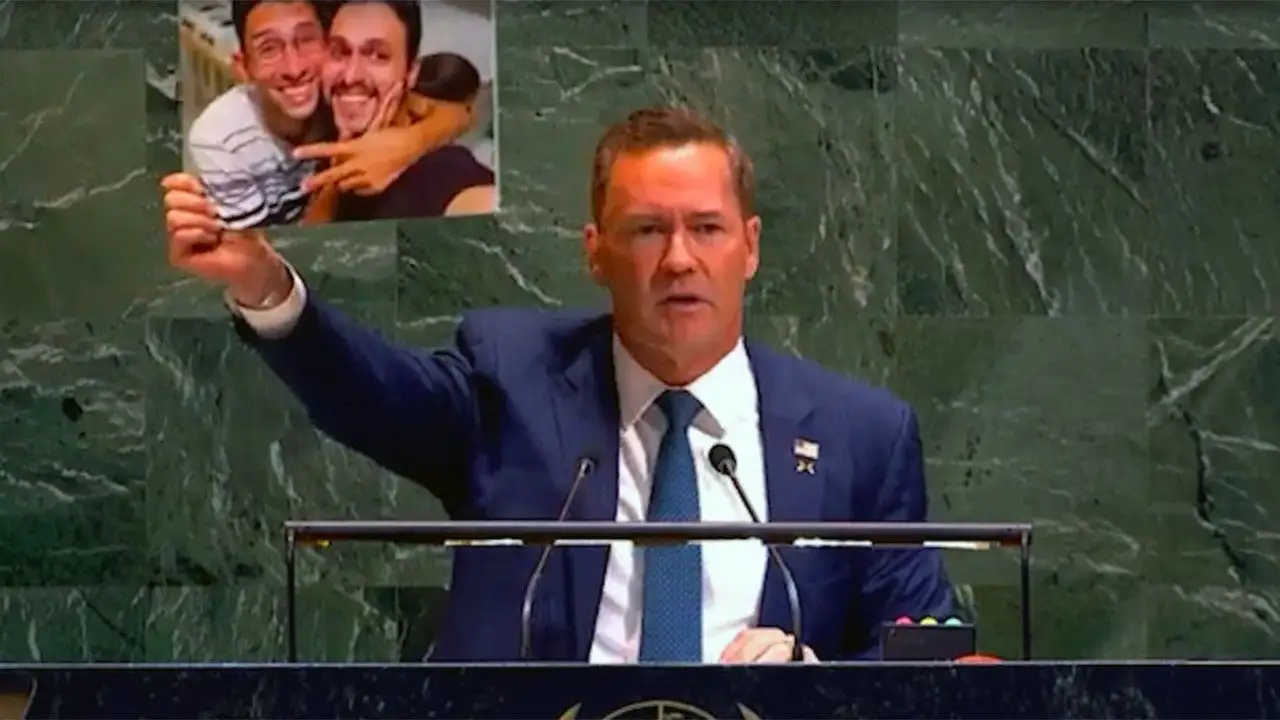
The tension in the chamber reached a boiling point as Cuban diplomats attempted to disrupt the American speeches. While Ambassador Waltz was speaking, members of the Cuban delegation began pounding loudly on their tables in an attempt to drown him out. Refusing to be intimidated, Waltz paused to deliver a stinging rebuke, reminding the chamber that they were standing in New York, not Havana. He declared that the United States and the United Nations would not be silenced by the same heavy-handed intimidation tactics the regime uses to terrorize its own populace. The ambassador then held up photographs of jailed Cuban artists, musicians, and activists, reading their names aloud to the assembly. He highlighted the plight of dissidents who were beaten and imprisoned simply for carrying flowers and writing poetry. This powerful moment underscored the human cost of the regime’s authoritarian grip, illustrating that behind the economic statistics are real people suffering under state-sponsored violence.
Beyond the humanitarian tragedy, the debate exposed the massive financial disparity between Cuba’s ruling class and its impoverished citizens. Waltz drew attention to GAESA, the secretive, military-run conglomerate that exerts control over nearly half of Cuba’s economy and holds an estimated $18 billion in assets. This concentration of wealth in military hands stands in stark contrast to the desperate poverty of the general public. Additionally, the U.S. delegation debunked the myth of absolute isolation by pointing out that Cuba regularly receives significant humanitarian and commercial assistance from international partners, including China, Russia, Mexico, Canada, Spain, the European Union, and the United Nations. Furthermore, the Ambassador revealed that the United States itself remains a vital lifeline for the Cuban people, providing over $100 million in direct aid this year alone alongside roughly $500 million annually in essential agricultural and food commodities.
The financial and procedural absurdity of the U.N. session was also called into question by U.S. Representative Jeffrey Bartos, who objected to the meeting altogether. Bartos pointed out that the three-hour debate would cost approximately $84,000—funds that could have been directly used to purchase urgently needed food, medical supplies, and solar lanterns for suffering Cuban families. When the Cuban delegation tried to interrupt him with the same rhythmic table-banging, Bartos sarcastically encouraged them to keep going, calling their performance “very effective” before continuing his remarks. He accused Havana of stage-managing the event to produce a cynical propaganda clip rather than seeking genuine structural solutions. Bartos noted that with over 800 political prisoners still languishing in Cuban jails for daring to demand basic rights, the regime’s claim of being a victim of external aggression rings incredibly hollow to the international community.
Ultimately, the clash at the United Nations illuminated two entirely incompatible worldviews regarding the ongoing tragedy in Cuba. On one side, the Cuban regime continues to weaponize the narrative of American imperialism to justify its domestic failures, claiming that U.S. sanctions are the sole engine of its economic misery. On the other side, the United States and international human rights observers point to a bloated military state, rampant corruption, and an ideological refusal to allow basic economic and political freedom. As the diplomatic dust settles in New York, the stark reality remains unchanged for those on the ground in Cuba. With an aging, poorly maintained power grid fueled by a bankrupt government, millions of ordinary people are left waiting in the heat and dark, caught between the high-stakes theater of international diplomacy and the exhausting struggle of daily survival.