


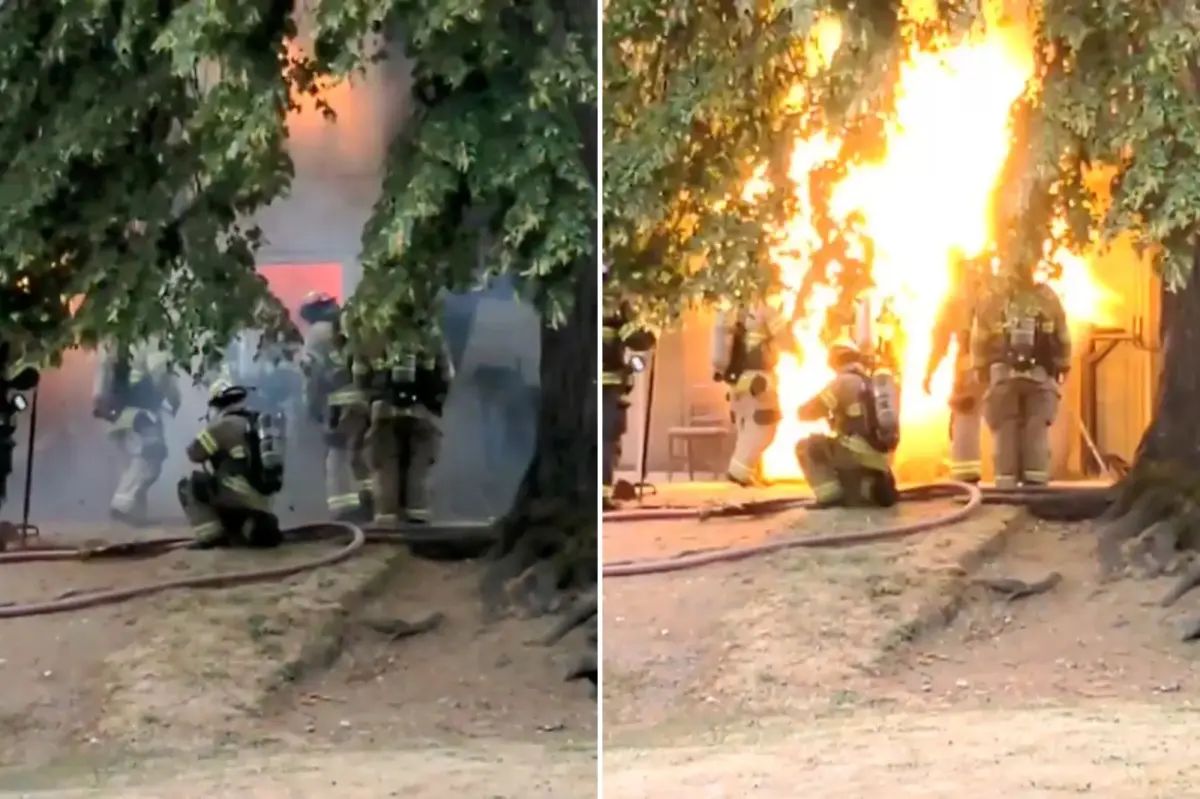
On what began as a routine, damp Sunday afternoon in the Pacific Northwest, the quiet peace of a Tacoma, Washington neighborhood was suddenly and violently shattered by an incident that could have easily turned fatal. Within the walls of an apartment complex located at 6400 South 12th Street, a crisis was quietly brewing beneath the surface of everyday life, culminating in a dramatic, heart-stopping explosion that was captured on a now-viral video. The footage, shot by an observer who happened to be at the scene, opens with a deceptively simple image: a crew of heavily geared Tacoma firefighters standing in a narrow corridor, preparing to force open the metal door of the building’s electrical room. They had been dispatched around 5:37 p.m. to investigate reports of visual smoke rising mysteriously from an electrical conduit. As the firefighters applied pressure to breach the door, a plume of thick, heavy, jet-black smoke began to billow outward, rolling along the ceiling like a dark storm cloud—a classic indicator that a highly pressurized, superheated environment lay just on the other side. Within a fraction of a second, the atmosphere shifted from tense anticipation to absolute terror. A massive, brilliant orange fireball erupted violently through the newly created opening, throwing a powerful shockwave, jagged debris, and shattered window glass directly toward the retreating first responders. The force of the blast was so intense that it blew vertical window blinds completely out of their tracks, sending them flying like streamers through the air. The startled videographer briefly lost their footing and turned the camera away as the concussive boom echoed through the courtyard, capturing the visceral chaos of a moment where life and death hung in a delicate, terrifying balance.
When the camera lens finally refocused through the swirling gray haze and floating ash, it revealed a profoundly human scene of relief and brotherhood that highlights the unique psychological reality of first responders. Instead of panicking or fleeing the scene entirely, the firefighters instantly transitioned from escaping a blast to ensuring the survival of their teammates. In the video, they can be seen stumbling backward out of the smoke-filled alcove, immediately reaching out to touch one another’s shoulders, checking for injuries, and shouting over the din of screeching car alarms and building sirens to confirm that everyone was accounted for. This immediate display of camaraderie and systematic concern is a testament to the rigorous, specialized training that prepares firefighters to keep their heads in moments of sheer terror. To stand inches away from an electrical detonation—where temperatures can reach thousands of degrees in a millisecond—and walk away physically unscathed is nothing short of a miracle. The Tacoma Fire Department later confirmed that, incredibly, no firefighters or civilians sustained injuries during the blast. This outcome is a powerful validation of the thick, flame-resistant turnout gear they wear and the split-second instincts developed through years of training, which allowed them to read the warning signs of the billowing smoke and begin their retreat just a moment before the volatile environment reached its flashpoint. It highlights the unspoken contract these men and women sign every day: to place themselves between the public and unthinkable hazards, relying on their training and each other to make it home safely at the end of their shift.
While the dramatic face-off at the electrical room door was unfolding, a parallel crisis of equal urgency was taking place inside the surrounding residential quarters. Sunday evenings are traditionally a sacred time for families—a time of preparing meals for the upcoming workweek, washing school clothes, and winding down in the safety of one’s home. This domestic tranquility was instantly shattered when the smell of burning copper and ozone began to filter through the vents. Crucially, the disaster was mitigated by the quick thinking of a vigilant resident who, upon noticing the thick smoke and sensing the growing danger, made the decisive choice to pull a wall-mounted fire alarm. This simple act of civic responsibility set off a cascade of life-saving events, alerting neighbors across the sprawling complex to danger long before the explosion occurred. First responders, recognizing that electrical fires can travel silently and unpredictably through hidden conduits behind drywall, immediately initiated a sweeping, precautionary evacuation of eight separate buildings. The scene quickly transformed into a chaotic but orderly exodus, as parents clutched frightened children, neighbors helped elderly residents down stairwells, and pet owners hurried out into the chilly air holding dogs and cats. The sudden, forced eviction of hundreds of people from their homes highlighted the profound vulnerability of human communities when critical infrastructure fails, turning comfortable living spaces into hazardous zones in a matter of minutes.
Behind the physical devastation and the dramatic footage lay a complex, volatile engineering failure that presented a unique challenge to both firefighters and utility experts. Technical investigations later revealed that the incident began with a severe malfunction in an electrical transformer, which began pushing high-voltage electricity and superheated thermal energy through the complex’s internal conduit systems. In a highly unusual and ironic twist, the primary explosion actually occurred after Tacoma firefighters had successfully isolated and shut down the main power supply to the building. This paradox of an explosion happening after the power was cut off illustrates the highly unpredictable physics of industrial-scale electrical systems. When high-voltage lines fail, they can create localized pockets of superheated gases, vaporized metals, and extreme pressure that remain trapped within enclosed conduits and junction boxes. When the firefighters breached the door, introducing a sudden rush of fresh oxygen into a room already saturated with volatile, unburned carbon gases and electrical heat, they inadvertently completed the chemical recipe for a backdraft or an arc-flash explosion. Solving an emergency of this technical scale required a seamless, highly coordinated effort between the tactical rescue crews of the Tacoma Fire Department and the specialized, high-voltage technicians of Tacoma Public Utilities. Together, they worked in the dark, utilizing specialized diagnostic tools and thermal imaging sensors to trace the path of the electrical surge, ensuring that no smoldering embers remained trapped within the complex’s walls to spark a secondary blaze.
As the smoke slowly cleared and the immediate physical danger of an active, spreading fire was brought under control, the focus of the emergency response shifted from tactical suppression to human compassion and crisis management. The displacement of eight entire apartment buildings left hundreds of weary, frightened residents stranded in the cold darkness of a Sunday night. Recognizing the urgent need for shelter, city officials and school district administrators quickly mobilized to open the doors of nearby Hunt Middle School, transforming its brightly lit gymnasium into a temporary sanctuary. Volunteers worked quickly to set up cots, distribute warm blankets, and hand out hot drinks and snacks to families who had been forced to flee with nothing but the clothes on their backs. This transition from a scene of terrifying destruction to a communal space of safety and care allowed the displaced neighbors to rest, share stories, and comfort one another during a highly stressful night. Fortunately, as the night progressed and Tacoma Public Utilities crews successfully isolated the damaged electrical lines, safety officials were able to clear residents to return to seven of the eight evacuated structures. However, for those living in the “600 building”—the structure directly adjacent to the decimated electrical room—the news was far more difficult to bear. Due to the extensive structural damage and complete lack of power, these families were told they could not return home indefinitely, prompting the American Red Red Cross to step in, providing emergency lodging and recovery resources to help them navigate the painful, disorienting process of displacement.
In the final analysis, the Tacoma apartment explosion stands as a powerful testament to the resilience of a community and the indispensable systems of safety that protect modern city life. What could have easily been a tragedy of historic proportions—resulting in severe injuries or loss of life—ended without a single scratch to a civilian or a firefighter, an outcome that is nothing short of extraordinary. The incident remains under active, meticulous investigation as experts dissect the charred remains of the electrical room to understand the precise mechanics of the transformer failure. Yet, beyond the technical post-mortems and the viral internet video, the true story is one of human coordination and quiet heroism. It is visible in the resident who pulled the alarm, the firefighters who absorbed the force of the blast and immediately checked on their comrades, the utility workers who labored through the night to restore power, and the compassionate volunteers who offered shelter to displaced families. This event serves as a stark reminder of how fragile our daily comforts can be and how heavily we rely on the bravery and professionalism of our local first responders. As the displaced residents of the 600 building begin the slow, challenging process of rebuilding and waiting for their homes to be deemed safe, they are supported by a community that proved its strength when it mattered most, showing that even in the face of sudden, explosive danger, human care and systematic preparation will always prevail.