


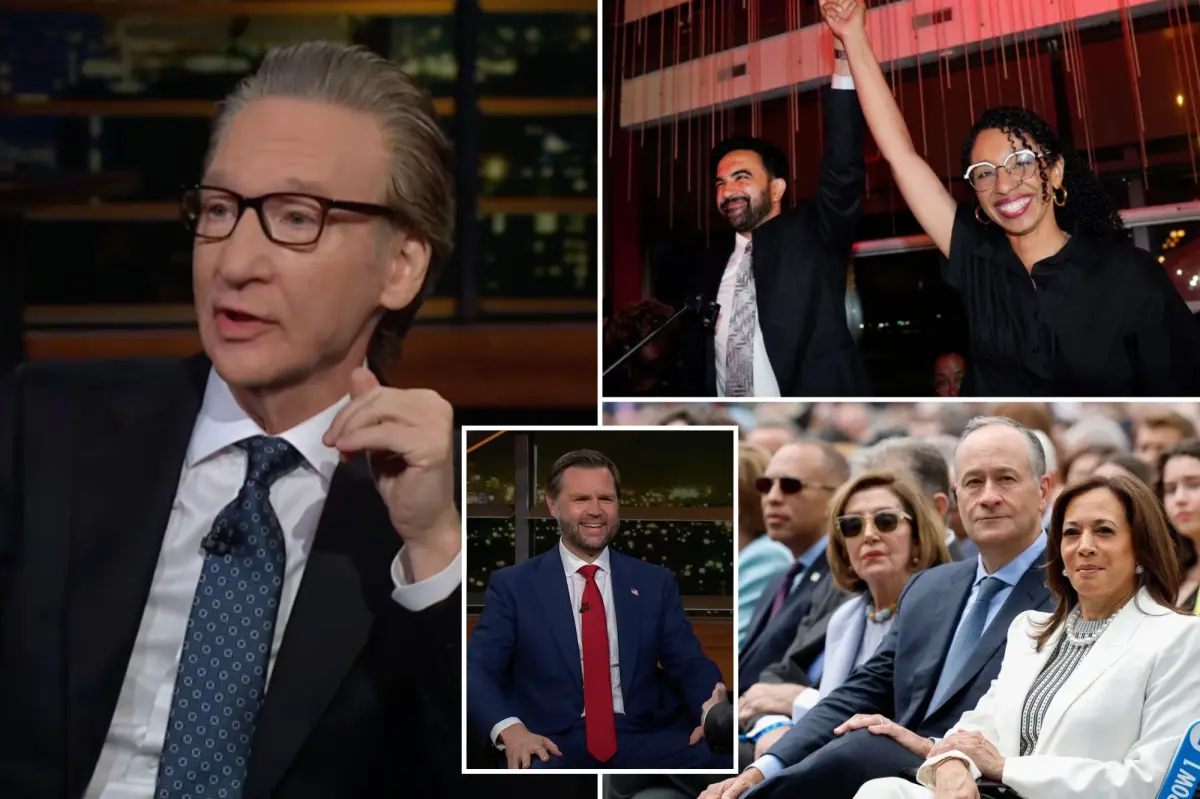
The traditional boundaries that long defined American politics are shifting in fascinating ways, and nowhere was this more apparent than on a recent episode of HBO’s Real Time. Host Bill Maher, a long-standing bellwether of pragmatic, common-sense liberalism, delivered a striking revelation directly to Vice President JD Vance: his vote is officially in play for the 2028 presidential election. This was not just a provocative soundbite designed to generate viral clips, but a genuine, heartfelt expression of a voter feeling increasingly alienated by the party he has supported for decades. Maher made it clear that while he has historically voted Democrat—always concluding after careful reflection that the Democratic platform was the superior option—he is deeply alarmed by the trajectory of the modern left. He warned Vance that if the Democratic Party continues along its current path of democratic socialism, characterized by what he sees as an unhealthy obsession with Israel, disturbing undercurrents of antisemitism, a rejection of fundamental capitalist principles, and a radical push to abolish prisons, he will no longer offer them his automatic allegiance. This honest admission highlights a broader, systemic anxiety shared by millions of moderate, old-school liberals who suddenly find themselves politically homeless, trapped between a progressive movement that looks unrecognizable to them and a conservative party they have traditionally opposed.
The conversation quickly pivoted to a deeper, more humanized exploration of the intense polarization within our modern political media ecosystem. Maher warmly praised Vance for having the courage to appear on the show, pointing out the stark contrast between how Republicans and Democrats engage with dissenting opinions. While Vance was met with surprisingly warm applause from the studio audience, Maher noted with a mix of humor and frustration that conservative guests consistently show up to “take their beating like a man,” while the very Democrats he votes for routinely avoid his program. This survival-of-the-fittest attitude from conservative politicians stands in sharp contrast to the defensive cocoons constructed by high-ranking progressive figures. Maher revealed a list of political stars who refuse to sit on his stage, highlighting how Representative Alexandria Ocasio-Cortez, NYC mayoral candidate Zohran Mamdani, and even Vice President Kamala Harris have consistently declined invitations to appear on his show. For Maher, this is not just a logistical headache; it is a worrying symptom of a Democratic establishment that has grown fragile, risk-averse, and unwilling to subject its ideas to rigorous, unscripted debate, leaving him to joke that it took an exhaustive eight years of pressure just to secure an interview with former President Barack Obama.
This ideological divide isn’t just an abstract debate happening in elite television studios; it is playing out in real-time across municipal and national election booths, creating structural shifts within the Democratic Party. Vance and Maher discussed how this intra-party struggle is manifesting on the streets of New York, referencing the startling victory of Darializa Avila Chevalier. Chevalier, a committed member of the Democratic Socialists of America (DSA) who was actively backed by the socialist New York Assembly Member Zohran Mamdani, recently pulled off a massive upset by defeating long-term incumbent Representative Adriano Espillat in a crucial Democratic primary. For traditional liberals like Maher, victories like Chevalier’s are flashing warning signs that the progressive agenda is successfully capturing the machinery of local governance. This shift toward democratic socialism represents a philosophical worldview that breaks sharply from traditional American liberalism, prioritizing systemic restructuring, the dismantling of standard law enforcement frameworks, and a deep skepticism of private market capital. When moderate voters watch these progressive organizers dismantle established, business-friendly coalitions in favor of experimental socioeconomic theories, it naturally triggers a sense of profound alienation, making Maher’s warning about a shifting vote feel less like an outlier and more like a predictive trend.
Looking toward the fast-approaching geopolitical horizon of 2028, Maher and Vance shared a remarkably candid dialogue about the future leadership of the Republican Party, offering a moment of analytical clarity amid the usual partisan noise. With Donald Trump’s constitutional term limits eventually necessitating a new standard-bearer for the conservative movement, Maher joked about the inevitability of the transition before offering a sharp assessment of the GOP’s path forward. In Maher’s estimation, the Republican succession is highly predictable and remarkably stable compared to the fractured, identity-driven power vacuums plaguing the Democrats. He pointed directly to Vance and Florida Senator Marco Rubio as the dual pillars of the post-Trump conservative future. Both politicians represent a new breed of populism that has successfully bridged the gap between traditional corporate conservatism and a multi-ethnic, working-class base. The friendly, respectful rapport between the progressive elder statesman of late-night television and the young, sharp-witted Vice President underscored a unique human element to the interview, proving that even in a heavily divided nation, leaders of opposing ideological factions can engage in serious, good-faith forecasting about who will shape the future of American governance.
Beyond the fascinating party politics, the sit-down also ventured into critical matters of international security and foreign policy, particularly focusing on the United States’ adversarial relationship with Iran. Vance, who has traveled to key international summits like those in Switzerland to handle sensitive discussions with high-level foreign officials, brought a highly strategic and confident perspective to the table regarding Iran’s nuclear program. He argued that the current administration’s pressure campaign has backed Tehran into a corner, creating a geopolitical scenario where America is poised to win regardless of the ultimate diplomatic outcome. According to Vance, even if a formal, comprehensive deal is never struck to permanently halt Iran’s nuclear ambitions, the heavy sanctions and persistent military deterrence ensure that their nuclear architecture remains severely degraded and their national economy severely weakened. This assertive, pragmatic doctrine represents a significant divergence from the multilateral, agreement-heavy diplomacy favored by previous democratic administrations. By prioritizing raw deterrence and structural containment, Vance demonstrated the administration’s commitment to projecting robust, uncompromising American power, a posture that resonates strongly with voters who are weary of endless, inconclusive foreign treaties.
In the end, this compelling face-to-face interaction between Bill Maher and JD Vance serves as a vital microcosm of the contemporary American political landscape and the deep-seated cultural shifts currently underway. It reminds us of the profound value of open, unrestricted dialogue in a society increasingly fragmented by digital echo chambers and rigid societal loyalty. Maher’s public declaration that his vote is up for grabs acts as a powerful, necessary warning to the Democratic Party that it cannot take its moderate, free-thinking base for granted, especially if it continues to isolate the broadcasters and commentators who have historically championed its cause. Conversely, Vance’s willingness to walk into a traditionally liberal space, engage with tough questions, and speak directly to a skeptical audience shows how the modern Republican party is actively attempting to expand its reach. As the nation marches steadily toward future electoral contests, this interview stands as a testament to a growing truth: the most critical divide in America today may no longer be between the traditional left and right, but between those who are willing to sit down and talk, and those who remain safely cloistered in ideological silence.