



The Weight of the Bear: Ethereum Struggles Under Systemic Market Pressures
The global cryptocurrency market remains trapped in a prolonged phase of uncertainty, and Ethereum ($ETH), the world’s second-largest digital asset by market capitalization, is currently bearing the brunt of this systemic stagnation. After a sequence of unsuccessful attempts to break above key historical resistance barriers, the asset has succumbed to intense selling pressure, forcing its price back into a critical multi-month demand zone. This downward trajectory highlights a broader structural weakness within the digital asset ecosystem, where institutional appetite remains cautious and retail participation continues to lag. As the broader macroeconomic environment poses persistent challenges—ranging from restrictive monetary policies by central banks to lingering regulatory ambiguities—Ethereum find itself locked in a defensive battle against aggressive short-sellers. While speculative traders have attempted to find a temporary floor near immediate support levels, the overall market structure remains overwhelmingly dominated by sellers. This prevailing bearish sentiment is further reinforced by the asset’s inability to maintain momentum above its primary moving averages, leaving market participants to wonder whether the current stabilization efforts are merely a brief consolidation before another major leg down or the slow foundation of an eventual market recovery.
              [Major Resistance Zone: $1.72K - $1.78K]
                               ▲
                               │  (Heavy Selling Pressure / Rejection)
                               │
                     [Descending Trendline]
                               │
                               ▼
              [Current Trading Range: Consolidation]
                               │
                               ▼
              [Major Demand Support Zone: $1.46K - $1.56K]
                               │
                               ▼  (If Broken)
                [Potential Downside Target: ~$1.20K]
Deciphering the Daily Chart: Crucial Technical Levels and Trendline Rejections
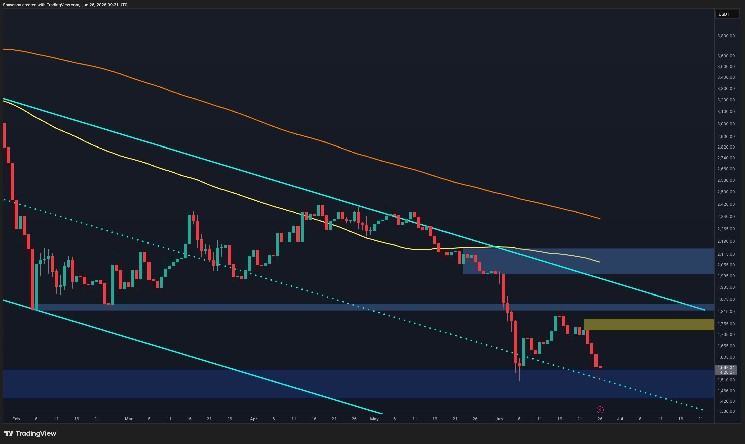
A technical examination of Ethereum’s daily chart reveals a highly defensive market structure characterized by a clean sequence of lower highs and lower lows. For several months, the asset has traded beneath its 100-day and 200-day exponential moving averages (EMAs), which have acted as dynamic overhead resistance barriers that continuously cap upward price movements. This bearish alignment is further reinforced by a long-term descending trendline that has historically neutralized every major relief rally of the past year. The most recent recovery attempt saw buyers drive prices toward the major supply zone between $1.72K and $1.78K, a region heavily congested with historical sell orders and liquidity pools. The swift and decisive rejection at this level underscored the lack of sustained buying conviction, rapidly reversing the price back into the critical $1.46K to $1.56K demand zone. This support range is of paramount structural importance; it has historically served as a launching pad for major accumulation phases, and a daily close below it would signal a profound shift in market dynamics. While buying interest has naturally emerged to defend these multi-month lows, the recovery off this support has lacked the volume and velocity necessary to suggest a genuine trend reversal. Consequently, until Ethereum can decisively reclaim the $1.72K level and break free from its descending trendline, any short-term upward progress is highly likely to be interpreted by institutional desks as a corrective bounce designed to trap late-stage long positions.
Inside the Lower Timeframes: Volatility and Range-Bound Consolidation on the 4-Hour Chart
Zooming in to the 4-hour timeframe offers a more granular perspective on the localized order flow and the intense bidding battles taking place within the current trading range. Following the sharp drop from the $1.78K local peak, Ethereum has established a tight consolidation range, fluctuating primarily between the lower support boundary of $1.50K to $1.53K and an upper localized resistance near $1.75K. This range-bound behavior reflects a temporary state of equilibrium between short-term scalp buyers looking for oversold bounces and dominant trend-followers reloading their short positions. Despite several brief intraday spikes, each recovery attempt on the 4-hour chart has yielded progressively lower peaks, a classic sign of administrative distribution where sellers gradually lower their exit targets. The $1.50K psychological support remains the absolute line in the sand for short-term traders; a confirmed break beneath this floor could trigger a cascade of stop-loss liquidations from leveraged long positions, accelerating the downward momentum toward deeper liquidity pools. Conversely, if buyers can successfully build a base of accumulation within this range and push the price past the local lower highs, it would likely set off a short-squeeze, forcing derivative market-makers to buy underlying spot assets to hedge their positions and giving the market a much-needed breathing room.
On-Chain Intelligence: Rising Exchange Netflows Signal Escalating Distribution Pressures
Beyond purely technical chart patterns, fundamental on-chain metrics paint a sobering picture of the underlying supply-and-demand dynamics driving Ethereum’s price action. The Exchange Netflow indicator, which tracks the net volume of $ETH moving in and out of centralized trading platform wallets, has recently undergone a major shift. The 14-day moving average of this metric has turned sharply positive, demonstrating a steady, continuous migration of tokens from private cold-storage wallets to exchange deposit addresses. Historically, an influx of tokens onto exchange platforms suggests that large-scale holders, often referred to as “whales,” and institutional pool operators are preparing to liquidate assets, hedge their portfolios, or deploy capital into derivatives to mitigate downside risks. This spike in exchange inflows has directly coincided with Ethereum’s descent toward the $1.5K range, implying that market participants are showing a growing preference for liquidity over long-term holding. While high exchange inflows can occasionally indicate preparation for collateral allocation in derivatives trading rather than outright spot selling, the lack of corresponding buying volume on spot order books suggests that distribution remains the dominant theme. Until these netflows begin to moderate and stabilize back into negative territory—which would indicate that investors are once again moving their assets back to secure, long-term storage—the on-chain environment will likely remain a significant headwind against any sustained bullish recovery.
Exchange Inflows (Positive Netflow) ──► Greater Selling Pressure on Exchanges
Exchange Outflows (Negative Netflow) ──► Accumulation and Long-Term Holding
Macro Headwinds and Order Book Battles: The Psychology and Liquidity Behind the $1.5K Floor
The current market struggles for Ethereum cannot be decoupled from the macroeconomic factors and regulatory crosscurrents shaping the broader global financial landscape. As central banks worldwide, led by the U.S. Federal Reserve, maintain elevated interest rates to combat persistent inflationary pressures, risk-on assets such as cryptocurrencies have seen a contraction in speculative capital. For institutional investors, the risk-free return offered by government bonds has reduced the appeal of high-beta tech assets and crypto tokens, leading to lower trading volumes and thinner order book depth across major exchanges. Furthermore, regulatory scrutiny surrounding decentralized finance (DeFi) protocols and secondary market trading has created a climate of compliance anxiety, dampening the utility-driven demand that historically propelled Ethereum during previous market expansion phases. At the $1.5K psychological floor, we are witnessing a fierce battle of market psychology: retail buyers are attempting to buy the dip based on the protocol’s long-term utility, while institutional market makers use advanced algorithmic models to strip liquidity from over-leveraged retail positions. This dynamic has resulted in heightened volatility around key support areas, where sharp liquidity sweeps often run stop-losses before a temporary stabilization occurs, leaving average investors with little room for error.
Roadmaps to Recovery or Capitulation: What Lies Ahead for Ethereum’s Structural Trend
As Ethereum continues to hover at this pivotal juncture, the road ahead is divided into two distinct structural paths, each carrying significant implications for the wider cryptocurrency ecosystem. In the bearish capitulation scenario, a decisive daily and weekly close below the $1.46K demand zone would confirm that the distribution phase is complete, likely opening the door for an accelerated descent toward the next major psychological support region near $1.20K. Such a breakdown would validate the long-term descending trendline and likely trigger a wider market sell-off, resetting valuations across the layer-2 scaling ecosystems and broader altcoin markets. On the other hand, the bullish reversal roadmap requires a period of quiet accumulation within the current $1.46K to $1.56K demand zone, accompanied by a significant drop in exchange inflows and a return to negative netflow regimes. The first real indication of micro-structural healing would be a daily candle close above the $1.78K resistance level, which would break the pattern of lower highs, shift the daily market structure back to neutral-bullish, and set the stage for a retest of the critical 200-day moving average. Ultimately, while Ethereum’s long-term fundamental role as the primary settlement layer for decentralized applications remains intact, the near-term outlook demands a highly disciplined approach, as the technical and on-chain indicators suggest that patience and risk management remain the order of the day.