


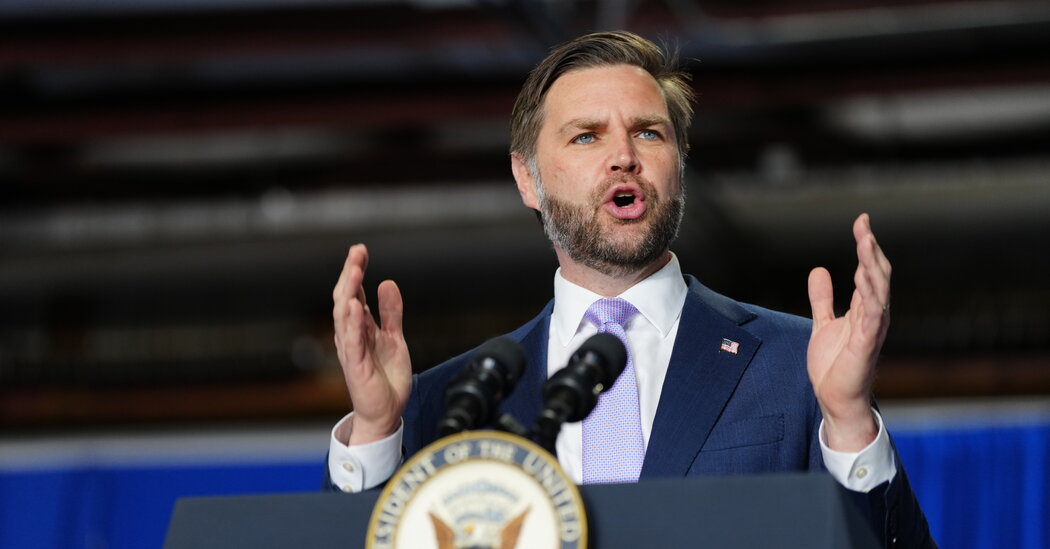
On a warm, sunny Thursday afternoon in Yorba Linda, California, Vice President JD Vance stood within the hushed, reverent confines of the Richard Nixon Presidential Library and Museum, delivering a speech that sought to systematically dismantle one of the most defining political narratives of the twentieth century. Speaking to an audience gathered to honor the legacy of the nation’s only president to resign in disgrace, Vance did not merely pay polite respects; instead, he launched into a breathtakingly bold reassessment of the Watergate scandal that ultimately brought down the Nixon administration. With an easy, almost conversational demeanor, Vance shrugged off the historical gravity of the June 1972 break-in at the Democratic National Committee headquarters and the subsequent executive cover-up, suggesting that if such an event occurred within today’s hyper-frenetic, highly polarized media landscape, it would barely register as a blip on the public’s radar. “The idea that it would have taken down a presidency is crazy,” Vance declared to the crowd, revealing with a chuckle that he had been lightheartedly joking about the absurdity of the historical reaction to the scandal backstage before his formal appearance. By framing one of the greatest constitutional crises in American history as a fleeting “12-hour news story” by modern standards, Vance signaled a profound shift in how the contemporary political vanguard views institutional accountability. His comments were not merely casual remarks, but a deliberate provocation designed to minimize the severity of executive misconduct in the public consciousness. In Vance’s view, the complex web of wiretapping, political sabotage, and abuse of power that once shocked the conscience of a nation would today be effortlessly swallowed up by the relentless, chaotic cycle of cable news and social media notifications, rendering the ultimate political punishment of presidential resignation an outdated relic of a simpler, more naive era.
Beyond merely raising a defense of a fallen predecessor, Vance’s speech at the library took on an intensely personal and reflective tone, as he drew a direct, unapologetic parallel between his own rapid political ascent and the early career of Richard Nixon himself. Addressing the audience with a sense of shared grievance and shared ambition, the vice president traced the biographical threads that he believes bind his destiny to that of the controversial thirty-seventh president. “Young senator, vice president, writes some best-selling books, is hated by the media,” Vance mused aloud, pausing to let the comparison sink into the minds of the listeners before adding, “It kind of sounds like JD Vance. I’ve always liked Richard Nixon.” Through this calculated self-portrait, Vance sought to humanize both himself and Nixon, painting them not as figures of institutional power, but as embattled, self-made outsiders who clawed their way to the highest echelons of American government despite the relentless hostility of the cultural and media establishments. This comparison was particularly timely, as Vance was visiting California in part to promote his highly anticipated new memoir, “Communion: Finding My Way Back to Faith,” a book that explores his personal spiritual journey, his intellectual development, and his return to religion. Just as Nixon’s early career was defined by his navigation of class anxieties and his self-styling as a champion of the forgotten “silent majority,” Vance’s public identity is deeply rooted in his journey from the economic struggles of the Rust Belt to the halls of Ivy League elitism and, ultimately, the White House. By linking his literary achievements and political career with Nixon’s legacy of defiance against elite criticism, Vance reframed the historical narrative of political isolation as a badge of honor, transforming Nixon from a cautionary tale of hubris into an inspirational archetype of resilience for a new generation of conservative populists.
This effort to rehabilitate Nixon’s tarnished reputation went far beyond simple biographical kinship, as Vance pivoted to a highly conspiratorial and politically charged theory regarding the structural forces that engineered Nixon’s downfall. Rather than attributing Nixon’s resignation to his documented abuses of executive office, the cover-up, or the systematic subversion of justice, Vance accused a murky, unelected network of government officials and institutional actors of orchestrating a political coup. “If you look at the story of how the deep state took down Richard Nixon,” Vance argued, “it’s not all that different from what the same groups of people, the same institutions, tried to do to Donald Trump in the first Trump administration.” This striking assertion sought to merge two vastly different historical eras into a single, continuous struggle between democratically elected populist leaders and a hostile shadow government. By invoking the concept of the “deep state”—a modern political shorthand used to describe intelligence agencies, career federal bureaucrats, and mainstream journalists working in tandem to protect their own power—Vance cleverly rewrote the history of the 1970s through the lens of modern conservative grievance. In this revised telling, Nixon’s exit from the Oval Office was not a triumph of the American constitutional system, a demonstration of congressional oversight, or a victory for the rule of law, but rather the first successful campaign by an unaccountable bureaucracy to overturn the democratic will of the voters. By framing both Nixon and Trump as sympathetic victims of the same institutional conspiracy, Vance offered his audience a powerful, unifying narrative. This narrative effectively transforms historical wrongdoing into a continuous, noble defense of the American presidency against institutional overreach, presenting both leaders as embattled warriors fighting against a corrupt establishment that seeks to preserve its own unelected authority at any cost.
The boldness of Vance’s rhetoric is particularly striking when viewed against the backdrop of his own remarkable political journey and the broader ideological efforts of the modern Republican Party. Once an outspoken critic of Donald Trump during the early stages of the 2016 presidential campaign, Vance has undergone a profound personal and ideological transformation, evolving from a skeptical outsider into one of the most fierce, intellectually rigorous defenders of the former president’s expansive vision of executive power. This dramatic evolution reflects a wider structural shift within American conservatism, which has increasingly abandoned past anxieties about an “imperial presidency” in favor of a robust, combative executive branch designed to take on entrenched bureaucratic systems. By standing steadfastly by Trump through countless legally and politically fraught controversies, Vance has consistently cast the former president as the primary victim of an unjust, highly weaponized political system rather than an instigator of constitutional norm-breaking. His defense of Richard Nixon in Yorba Linda follows this exact same modern political playbook, attempting to systematically rewrite the historical consensus of a scandal-scarred presidency so that the leader is remembered as the target of an institutional witch hunt instead of the perpetrator of executive wrongdoing. This historical revisionism serves a vital contemporary purpose: by eroding the moral and legal consensus that led to Nixon’s disgrace, Vance and his allies seek to preemptively dismantle the very legal and institutional guardrails that might otherwise limit the power of future administrations. In doing so, they prepare the American public to accept a highly assertive model of presidential authority, one where the executive operates largely unchallenged by conventional checks and balances, and where past standards of presidential conduct are dismissed as nothing more than political weapons used by partisan opponents.
While his historical and philosophical arguments at the Nixon Library engaged the intellect of his supportive audience, Vance’s trip to California quickly transitioned from theoretical defenses of executive power to the gritty, high-stakes financial realities of modern American presidential politics. Shortly after wrapping up his talk and promoting his memoir, the vice president traveled northward to Palo Alto, California, where he demonstrated his formidable capability as a political fundraiser and a powerful bridge to the nation’s economic elite. Serving in the historic, precedent-shattering role as the first sitting vice president to act as the finance chair of the Republican National Committee, Vance held a highly exclusive, closed-door dinner that succeeded in raising a staggering $4.2 million in a single evening. The event, which was held under tight security and described by a person briefed on the private gathering on the condition of anonymity, was an elite affair where select wealthy donors paid an astonishing $250,000 per person just to secure a seat at the table. This extraordinary fundraising haul highlights the fascinating duality of Vance’s modern political identity: even as he cultivates a deeply populist, anti-establishment brand that rails against powerful institutions and defends historical outsiders like Richard Nixon against the “deep state,” he simultaneously operates with immense efficacy within the highest circles of corporate and venture capital wealth. His background as a venture capitalist allows him to speak the language of Silicon Valley with native fluency, transforming him into a unique political figure who can merge working-class grievances with high-finance resources. By successfully courting these ultra-wealthy donors in Palo Alto, Vance has positioned himself as an indispensable financial asset to the Republican National Committee, building a powerful, loyal base of financial backers who could prove absolutely vital to his political future.
As the dust settled on his high-profile California tour, the broader implications of JD Vance’s actions became increasingly clear, painting a compelling picture of a highly disciplined political strategist who is masterfully positioning himself to inherit the future of the conservative movement. Widely and increasingly regarded as a potential frontrunner for the 2028 presidential nomination, Vance’s multi-faceted activities—ranging from his intellectual defense of a disgraced president at the Nixon Library, to the promotion of his highly personal faith-centered memoir “Communion: Finding My Way Back to Faith,” to his jaw-dropping fundraising prowess in the heart of Silicon Valley—reveal a highly coordinated effort to consolidate his status as the undisputed heir to the “America First” coalition. By humanizing and rehabilitating Richard Nixon, Vance did not merely engage in an eccentric academic exercise; rather, he offered a bold preview of a political future where traditional standards of scandal, political shame, and institutional accountability are systematically discarded in favor of raw executive authority, collective grievance, and absolute personal loyalty. His highly publicized journey through California demonstrated that the modern political battlefield is no longer won by adhering to old procedural norms, but by actively redefining those norms to suit the emotional and structural needs of a populist era. Although a spokesman for Vance did not immediately respond to requests for comment regarding his provocative statements, the vice president’s words stand on their own as a powerful testament to his vision of the presidency. Ultimately, Vance’s defense of Nixon, combined with his unmatched ability to bridge the gap between working-class narrative appeal and multi-million-dollar corporate fundraising, establishes a formidable blueprint for his own potential path to the presidency in 2028, ensuring that he remains a central, highly influential architect of American political culture.