


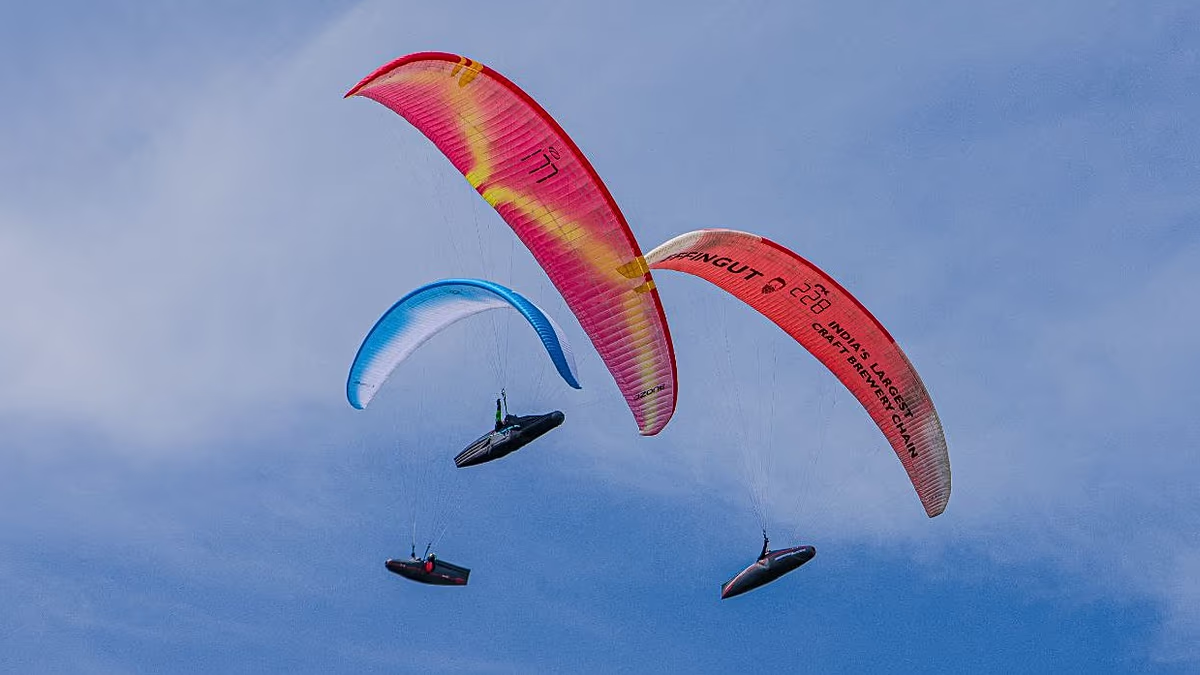
The sky above Kazakhstan’s Zhetysu region, normally a quiet canvas of deep blue, is currently alive with a kaleidoscope of vibrant, billowing paragliders drifting on invisible thermal currents. For generations, the southwest of this vast nation has been known for its breathtaking landscapes, but today, those sweeping vistas are serving as the backdrop for an unprecedented sporting milestone. For the first time in history, Central Asia is hosting the prestigious Paragliding World Cup, an event that has transformed these ancient skies into a bustling international arena. Approximately 150 elite pilots hailing from 33 different nations have descended upon this rugged territory to test their skills, patience, and courage against the elements. This monumental gathering represents much more than a mere high-stakes athletic tournament; it marks the global debut of a region that has long flown under the international tourism radar. As these pilots launch themselves from high ridges into the vast, open sky, they are not only competing for points but are also charting a new course for Kazakhstan’s place in the global outdoor sports community. This landmark event has successfully bridged the gap between adventure tourism and world-class athletics, proving that the wind-swept valleys of Zhetysu are uniquely suited for the global stage.
At the very heart of this airborne revolution lies the deeply inspiring story of the Virshki family, whose unwavering dedication has shaped the paragliding landscape of Kazakhstan over the last fifteen years. The dream began with Igor Virshki, a visionary who recognized the raw, untapped potential of the winds sweeping through the mountains near the city of Tekeli. Igor put his heart and soul into building the Tau Zhetysu tourism complex, carving out a sanctuary for flyers in a region that had previously seen little extreme sports infrastructure. His passion for the skies was contagious, passing naturally to his son, David Virshki, who grew up watching paragliders float above his childhood home. Today, David is not only a world-champion paraglider but also the driving force behind bringing the World Cup to his hometown. For David, standing on the very ridges where he first strapped into a harness as a youngster, watching the world’s best pilots prepare to fly, is a surreal and deeply emotional milestone. He speaks of this event not just as an achievement of logic and logistics, but as the realization of a lifelong dream—a testament to what can happen when a family’s intimate love for a sport aligns with a grand vision to share their home with the world.
Bringing an event of this magnitude to a fresh destination is an immense undertaking that requires passing a gauntlet of rigorous international standards. Before the first pilot could take off, global experts spent months meticulously evaluating the Zhetysu region’s safety protocols, emergency services, wind consistency, and overall infrastructure. Goran Dimishkovski, the President of the Paragliding World Cup Association, pointed out that finding a new location that balances high athletic criteria with proper economic and organizational capacity is exceptionally rare in the modern era. After three decades of scouring the planet for suitable flying coordinates, Dimishkovski and his team recognized a rare gem in the Kazakh highlands. The natural thermal updrafts created by the unique topography of Zhetysu offer pilots the perfect physical laboratory for cross-country flying, where they can sustain altitudes for hours over long distances. The successful organization of this World Cup is not merely a temporary spectacle, but rather the foundation of a permanent, top-tier international flight base. By establishing these safety nets, launch pads, and landing zones, the region has permanently elevated its standing, ensuring that the global paragliding community will return to these ridges for decades to come.
Beyond the points and podiums, the World Cup is defined by the profound personal journeys of the pilots who travel to this remote corner of the world, none more moving than that of Canadian flyer Jimmy Giroux. Years ago, Jimmy suffered a catastrophic accident while training in Europe, fracturing his back without initially realizing the true severity of his injury. By the time he embarked on his grueling, two-day journey to Kazakhstan, his body began to fail him, leaving him completely unable to move his leg upon his arrival in Taldykorgan. It was here, far from home in a local Kazakh hospital, that a skilled surgeon named Almaz performed a crucial, life-saving operation that restored Jimmy’s mobility and saved his athletic career. For Jimmy, returning to Zhetysu to fly in this World Cup is a powerful homecoming filled with gratitude, a chance to conquer the very skies that witnessed his lowest moment. He views the vast, undulating landscape of Kazakhstan not just as a playground for wind, but as a healing sanctuary. To him, the openness of the terrain represents a physical and emotional liberation, offering a forgiving environment where there are no dense forests to trap a falling pilot, allowing both veterans and novices to push their limits with a deep sense of peaceful security.
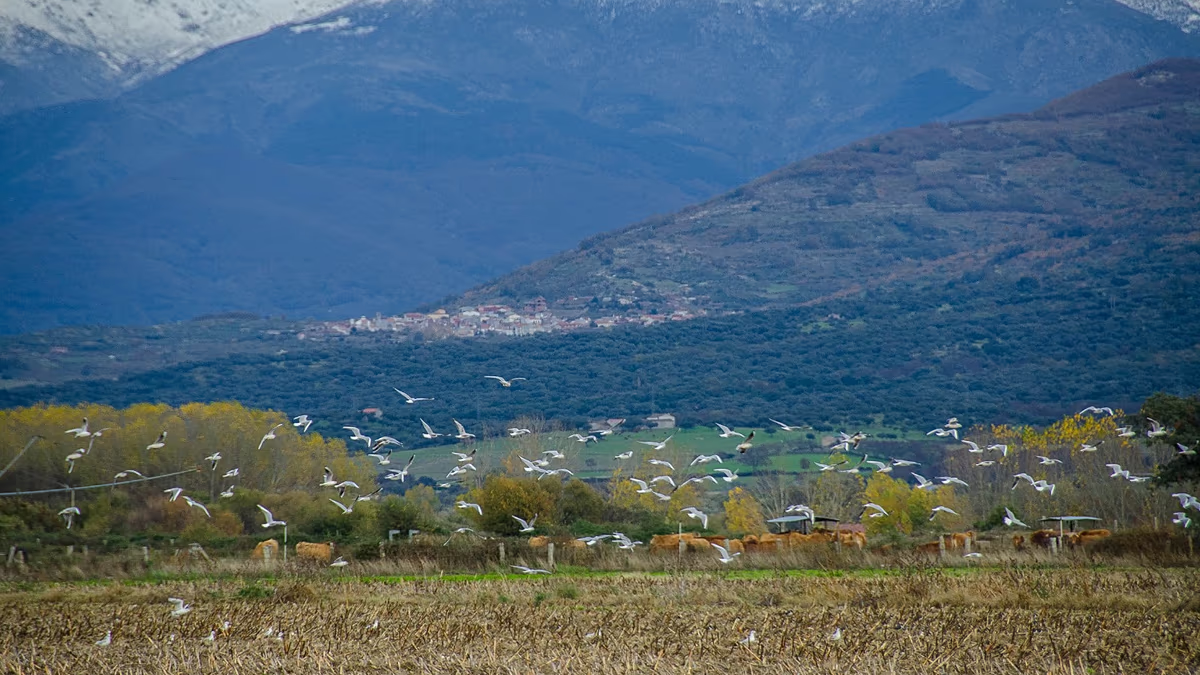
The allure of Kazakhstan for international pilots often boils down to a stark and liberating contrast between the wild, pristine nature of Central Asia and the highly managed landscapes of Western Europe. Many pilots, accustomed to the crowded skies of the Alps where luxury hotels, cafes, and cable cars claim virtually every square kilometer, find themselves deeply refreshed by the endless, uninterrupted horizon of Zhetysu. David Virshki notes that international pilots are consistently awestruck by this element of raw wilderness, which has largely vanished from the Western European paragliding circuit. The Zhetysu region offers sweeping valleys, dramatic ridges, and dependable thermals that allow for pure, unadulterated exploration without the constant worry of navigating restricted airspace, major power lines, or congested mountain villages. In this vast terrain, the relationship between the pilot and the wind is restored to its most ancient, simple form. This absence of over-commercialization, paired with the legendary hospitality of the local Kazakh communities who welcome landing pilots with open arms and warm mugs of tea, turns every cross-country flight into an authentic adventure rather than a predictable, manicured tourist excursion.
The success of the Paragliding World Cup has ignited a powerful vision for the future of tourism and economic development in the region, warmly championed by local authorities. Yersin Ibrashev, the Head of the Tourism Department of the Zhetysu region, views the global spotlight on Tekeli as a launching pad for broader international-scale initiatives. Observing pilots from global hubs like Canada, Australia, the United States, and across Europe has convinced local leaders that their natural landscape is one of their greatest economic assets. Looking ahead, the region is already planning to diversify its aerial offerings, with exciting proposals to test acro paragliding over the dramatic waters of Lake Balkhash using advanced winch systems to launch pilots into the air without the need for mountains. This momentum will carry the nation forward to 2028, when Kazakhstan is slated to host the Asian Cross-Country Paragliding Championship for the very first time. By blending ecological conservation with high-adrenaline sports tourism, the country is proving that its wild borders are not barriers to be feared, but open gates to be explored, promising a bright future where the skies of Central Asia remain forever open to those who dare to dream of flight.