



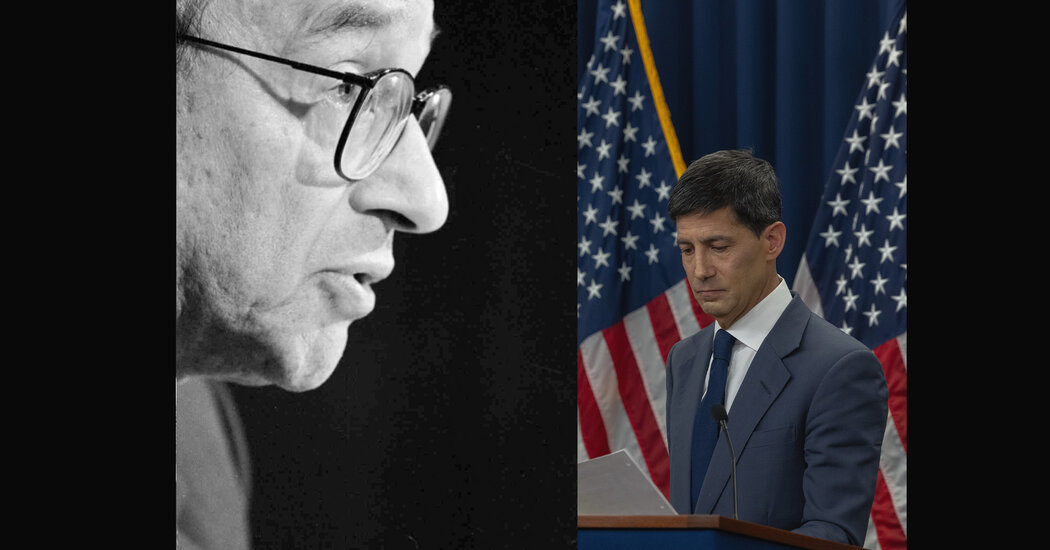
In the wake of Alan Greenspan’s passing at the exceptional age of one hundred, the world of central banking find itself at a historic crossroads, seeking to decipher the complicated legacy of its most legendary architect while preparing for a highly uncertain future. During his campaigning efforts to secure the nomination of President Donald Trump to lead the Federal Reserve, Kevin Warsh repeatedly returned to a singular, defining epoch of his predecessor’s long career: September of 1996. It was during that pivotal month that Greenspan chose to champion a highly unorthodox strategy, successfully resisting intense pressure from his colleagues to raise interest rates despite a rapidly expanding economy that conventional economic models suggested was on the verge of dangerous overheating. That decision, arguably the most celebrated masterstroke of Greenspan’s long tenure, became the foundation of a prolonged period of non-inflationary high growth in the United States, cementing his reputation as a modern-day monetary oracle whose sagacity delivered years of prosperity. Yet, as Warsh steps into the formidable role of Fed Chair today, an essential concern arises: the temptation to uncritically replicate historical decisions can blind a policymaker to the unique and volatile realities of their own time. By presenting Greenspan’s 1996 decision as a simple, repeatable template for the current era of artificial intelligence, Warsh risks oversimplifying a highly complex historical chapter, converting what was once an exercise in deep empirical evaluation into a mere political justification for persistent monetary ease. To humanize the legacy of Greenspan is to recognize that his success was not born of pre-packaged dogmas about technology, but of an incredibly rigorous, often agonizing process of questioning his own assumptions in real-time.
The true intellectual foundation of Greenspan’s 1996 decision lies not in a simplistic enthusiasm for new technology, but in a profound appreciation for economic history and the complex timeline of human industrial adaptation. Greenspan’s thinking was famously guided by the groundbreaking scholarship of Stanford University economic historian Paul David, who studied the protracted transition from steam engines to electric motors at the turn of the twentieth century. David’s research clearly demonstrated that the invention of a breakthrough technology does not automatically nor immediately spark a massive rise in societal productivity. Instead, it took nearly an entire generation for manufacturers to figure out how to reorganize their physical factories, transition from multi-story mills powered by a single steam axle to horizontal assembly lines powered by individual electric motors, and train their workforces to optimize the new technology. Only after this long, painful, and largely silent process of institutional reconfiguration did the United States experience the monumental productivity boom of the 1920s. This historical dynamic beautifully explained the famous paradox articulated by Nobel laureate Robert Solow, who observed in the late 1980s that computers could be seen everywhere except in the official productivity statistics. Greenspan possessed the rare intellectual agility to connect David’s historical insights to his own contemporary observations of the mid-1990s microchip revolution. He recognized that since companies had spent nearly a decade investing heavy capital into high-tech hardware, those investments were finally beginning to pay quiet, structural dividends that the slow-moving government statistics simply failed to capture yet.
To fully appreciate the human and institutional drama of this moment, one must look at the intense debates that unfolded during the September 1996 Federal Open Market Committee meeting. Greenspan stood in stark opposition to a formidable wall of academic orthodoxy represented by his Fed colleagues and Ph.D. economists. These critics looked at the traditional, time-tested indicators—including a falling unemployment rate, booming domestic growth, and an inflation rate hovering above their preferred internal target—and concluded that raising the federal funds rate above 5.25 percent was an urgent necessity to prevent a devastating inflationary spiral. Yet Greenspan, drawing on his decades of experience as a bespoke business consultant who routinely scrutinized raw, disaggregated industry data, saw a different picture. He listened closely to actual corporate leaders who explained that although wages were steadily rising, fierce global competition and newfound technological efficiencies stopped them from raising the prices of their final goods. Through persuasion, dialogue, and a masterful use of empirical data, Greenspan managed to cultivate consensus among his skeptical peers, arguing successfully that the digital revolution had fundamentally altered the speed limit of the American economy. His gamble proved to be a spectacular triumph: inflation continued to fall, growth persisted, and official productivity measures eventually caught up to confirm his hypothesis. However, the often-overlooked companion piece to Greenspan’s 1996 prudence occurred just three years later in 1999. When aggregate demand threatened to outpace even this newly expanded productive capacity, Greenspan did not hesitate to raise interest rates sharply, demonstrating that his primary loyalty was not to technology-driven optimism, but to the unyielding preservation of price stability.
As Kevin Warsh begins his stewardship of the Federal Reserve in 2026, he faces an existential question that directly tests his own interpretation of history: is the contemporary economic landscape a rerun of 1996, or is it actually on the precipice of 1999? The rise of artificial intelligence has ignited a wave of optimism mirrored closely by the internet boom of three decades ago, prompting claims that we are on the verge of an AI-driven productivity miracle that will automatically render inflation a concern of the past. However, a sober analysis of current capital expenditure reveals a far more complex and potentially inflationary reality. Rather than quietly boosting the efficiency of daily business operations, the current phase of the AI revolution is characterized by an immense, resource-intensive construction boom. Companies are pouring hundreds of billions of dollars into building massive, energy-hungry data centers, purchasing scarce hardware, and competing fiercely for specialized talent by offering extraordinarily high wages. This immense initial demand for physical infrastructure, labor, and energy acts as a powerful stimulus that threatens to drive prices upward in the short term, long before the ultimate software-driven productivity gains can materialize for the broader economy. Thus, while the long-term potential of AI may indeed resemble the productivity explosion of the 1920s or the late 1990s, the intermediate period is highly vulnerable to classic demand-pull inflation, making a simplistic policy of monetary ease based on future technological promises incredibly risky.
This reality explains the visible shift in Warsh’s public posture as he transitioned from an ambitious political challenger to the actual custodian of the world’s most powerful financial institution. During his public campaign to win Trump’s backing, Warsh spoke with the confident certainty of an innovator, heavily leaning into the Greenspan analogy to signal that he would support a low-interest-rate environment fueled by the promise of technological expansion. But the heavy responsibility of the office has a remarkable way of tempering campaign rhetoric with the cold reality of stubborn inflation. In his very first press conference, when pressed on whether he still believed that the immediate introduction of artificial intelligence justified keeping interest rates low, Warsh offered a markedly cautious and bureaucratic response: “We have a task force for that.” This subtle yet profound shift in tone highlights a universal truth about the Federal Reserve chairmanship: the view from inside the temple of monetary policy is fundamentally different than the view from the campaign trail. Once confronted with the daily realities of persistent price pressures, a fragmenting global supply chain, and the immense consequences of any policy error, Warsh has been forced to quickly abandon his ideological declarations. The comforting certainty of campaign soundbites has been replaced by the heavy, pragmatic burden of institutional stewardship, showing that the realities of economic data will always triumph over the most polished political narratives.
Ultimately, the true lesson that Kevin Warsh must learn from Alan Greenspan’s historic tenure is not that technology provides an all-access pass to lower interest rates, but rather that effective central banking demands absolute intellectual flexibility and a rejection of pre-conceived dogmas. Greenspan’s legendary success did not stem from a generic, unwavering belief that technology would always solve inflation; it came from his relentless commitment to testing his hypotheses against a mountain of real-time empirical evidence, consulting a wide spectrum of experts, and maintaining the courage to change his mind when the data shifted. If Warsh wishes to successfully navigate the hazardous waters of the modern global economy, he must emulate Greenspan’s deep curiosity and intellectual humility rather than just his policy outcomes. This means resisting the political temptation to pre-commit to a specific monetary course just because it aligns with campaign promises or popular technological narratives. The global financial system does not require a cheerleader for artificial intelligence, but a cautious, deeply analytical guardian who respects historical parallels, actively courts contrasting viewpoints, and possesses the wisdom to realize that true economic progress is built on a foundation of careful observation rather than speculative optimism.