


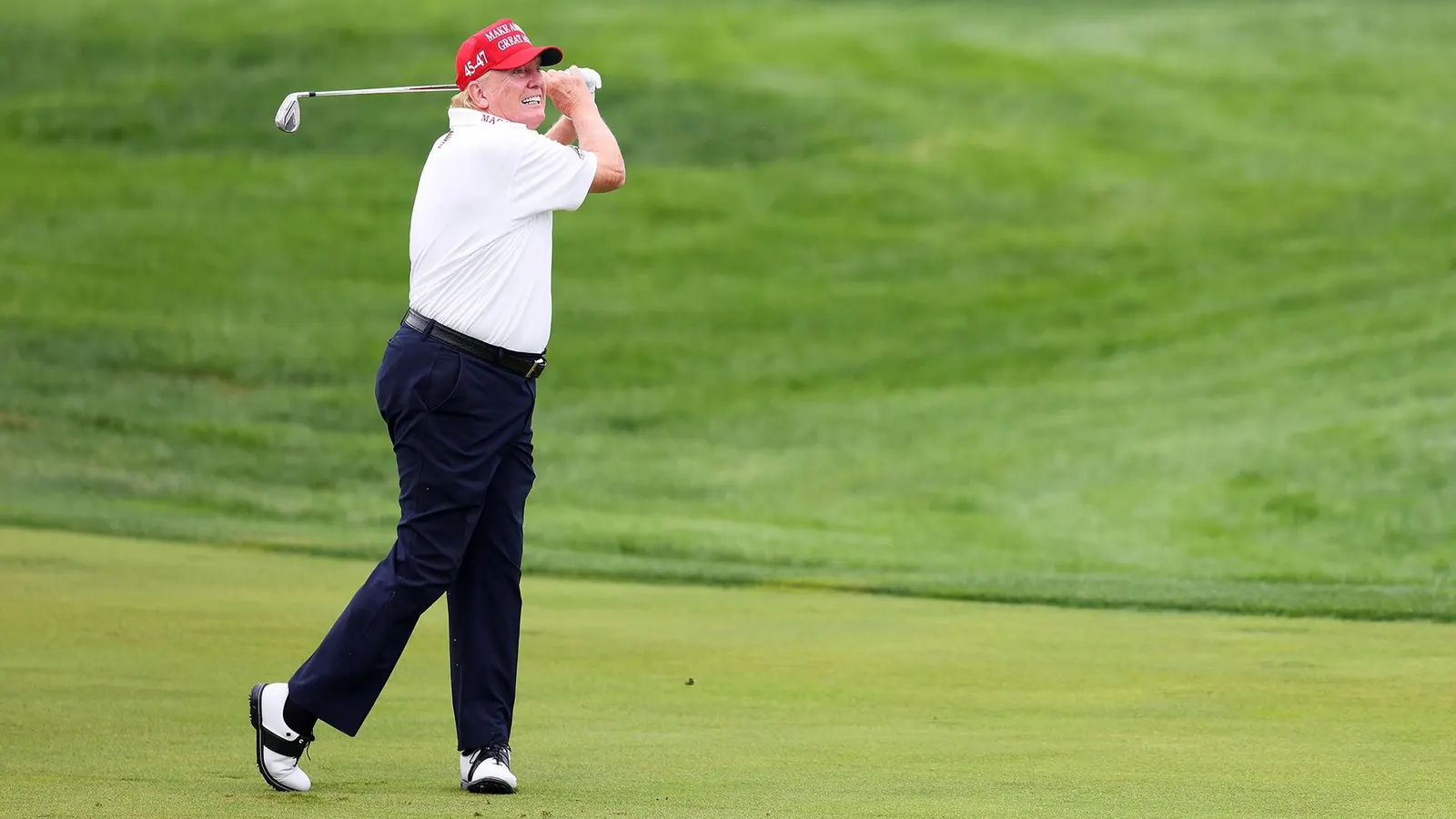
Donald Trump’s lifelong connection to his personal wealth has long resembled a grand theater piece, a colorful dance where the lines between documented reality and self-made legend are famously blurred. For many decades, the former president has acted as his own most enthusiastic press agent, occasionally adopting the nostalgic pseudonym John Barron to call media outlets and lobby for higher positions on global rich lists. He has routinely stretched truths like rubber bands on a par five, exaggerating property boundaries, inflating penthouse square footage, and treating financial declarations as creative exercises. Yet, when we strip away the theatrical showmanship and examine the hard numbers of his actual holdings, a fascinating truth emerges: Trump’s golf empire does not actually need exaggeration to be recognized as a formidable commercial success. Together, his portfolio of fifteen premium golf courses forms a sprawling luxury empire that pulled in over three hundred and fifty million dollars in estimated revenue in twenty twenty four. Industry experts estimate this collection of fairways and country clubs at roughly one billion dollars, representing nearly a sixth of his six point one billion dollar net worth. At the very heart of this empire lies Trump National Doral, a massive historic Florida resort valued at two hundred and fifty five million dollars net of debt, ranking as the second most valuable asset in his entire real estate portfolio, trailing only his five hundred and sixty four million dollar Mar a Lago estate. This shows that despite administrative errors or court scrutiny regarding overstated holdings, the physical soil underneath Trump’s flags remains exceptionally valuable. Golf has always served as his ultimate combination of branding, prestige, and real estate, demonstrating that his operational engine can produce massive real-world returns. Even when complicated public filings offer little transparency on his underlying valuation methods, the sheer economic market power of these massive properties continues to successfully secure his prominent financial place among the global wealth elite. This dynamic ensures his prestige remains intact across the international golfing fraternity.
To appreciate the robust momentum behind this golden portfolio, one must observe how neatly Trump’s political trajectory and commercial ventures have integrated into a single, self-sustaining financial machine. Even as legislative and judicial pressure in New York forced him to surrender his long-held lease on a public golf course in the Bronx in late twenty twenty three, Trump managed to turn this apparent political setback into an extraordinary, historic financial triumph. He walked away with sixty million dollars from the initial transaction, and a specialized contract provision went on to trigger an additional one hundred and fifteen million dollars when Bally’s was subsequently awarded a casino license on that precise site. This pattern of turning regulatory challenges into cash windfalls is reflected in his clubs’ domestic and international performance. Operating profits across ten of his primary American golf courses escalated from nineteen million dollars at the end of his first term in twenty twenty to sixty-six million dollars in twenty twenty four. Simultaneously, the Trump brand is actively expanding its international footprint by licensing and developing new courses in Oman, Qatar, Saudi Arabia, and Vietnam, along with major luxury resorts planned for Bali and Java in Indonesia. These foreign ventures are brilliant financial plays, collecting high upfront fees long before construction begins, followed by long-term management royalties. Back home, these courses serve as personal escapes for the president, a passionate golfer who played finished rounds an estimated two hundred and sixty-one times during his first term. This combination of presidential security and travel expenses has cost taxpayers over one hundred million dollars during his public service. In the expansive canvas of Trump’s world, golf is clearly not just an enjoyable weekend sport; it represents an active boardroom, a secure luxury sanctuary, and a highly visible platform for complex international diplomacy where high stakes dealmaking never stops, serving as a powerful engine for both financial prestige and political consolidation. This unique fusion has allowed him to build a legacy that transcends traditional American politics.
Among these iconic properties, none capture the massive scale and dramatic history of his portfolio quite like Trump National Doral in Miami and Trump National Bedminster in New Jersey. Trump acquired Doral out of bankruptcy in twenty twelve for one hundred and fifty million dollars, which translates to roughly two hundred and twenty million dollars today. He subsequently poured an estimated two hundred and thirteen million dollars into intense modern renovations to restore its reputation. While the Florida property features four eighteen-hole courses, his company has moved toward high-density real estate, securing preliminary approvals to construct fifteen hundred luxury residential units on the site. Since the pandemic, Doral has experienced a significant financial revival, posting twenty-five million dollars in operating income for twenty twenty-four, while hosting both LIV Golf events and the Cadillac Championship on its famous Blue Monster course. Further north, the pastoral landscape of Trump National Bedminster serves as his summer White House, a thirty-six hole escape where family milestone events are deeply integrated into the private acreage. Purchased as an incomplete project for a bargain price, Bedminster has hosted major events such as the twenty seventeen U.S. Women’s Open, though it was stripped of the twenty twenty-two PGA Championship following the Capitol riots. In response, Bedminster pivoted to find a lucrative partner in the LIV Golf tour, pocketing around eight hundred thousand dollars for its first event. To optimize his financial performance, Trump has famously taken advantage of local agricultural tax programs to save two hundred and forty thousand dollars annually on Bedminster’s property taxes, replacing his former herd of goats with hay farming to maintain the lucrative exemption. Bedminster remains a symbol of how Trump successfully mixes personal pleasure, extreme power, and financial efficiency, and it is also where his first wife, Ivana, was buried in twenty-two. This peaceful, private burial site underscores the complex, deeply personal, and sometimes eccentric relationship Trump maintains with his most cherished assets, blending corporate operations directly with intimate family memories and legacy building projects.
The story of his Florida and California properties highlights a similar blend of prestige, commercial maneuvering, and volatile legal battles. Trump International West Palm Beach, opened in nineteen ninety-nine as his absolute first golf venture, sits on land leased from Palm Beach County for over eighty-eight thousand dollars a month, a deal struck after settling a lawsuit over noisy flight paths from nearby Mar-a-Lago. This course, notably the site of a tense twenty-twenty-four assassination attempt, features rolling hills engineered by moving enormous quantities of soil and currently commands initiation fees of three hundred and fifty thousand dollars. Just thirty minutes away lies Trump National Jupiter, a majestic Jack Nicklaus-designed club acquired in twenty-twelve for five million dollars in upfront cash alongside the assumption of forty-one million dollars in member liabilities. This club was later targeted in the New York Attorney General’s lawsuit, which accused Trump of overstating its value at sixty-two million dollars. Although a judge initially penalized the Trump Organization for fraudulent valuations, the monetary fines were tossed on appeal, showcasing the continuous financial litigation surrounding his real estate empire. On the West Coast, Trump National Los Angeles in Rancho Palos Verdes tells a dramatic tale of physical and financial instability. Poised beautifully on Pacific cliffs, the course suffered a massive landslide in nineteen ninety-nine before Trump bought it out of bankruptcy for twenty-seven million dollars. Though Trump claimed construction costs reached two hundred and sixty-four million dollars, making it the world’s most expensive course, his representatives told tax assessors a very different story, valuing the entire property at just ten million dollars. The club was later abandoned by the PGA of America for its prestigious tournaments following his controversial political statements about immigrants, highlighting the constant and volatile risk of combining commercial assets with highly polarized national politics. This intricate dynamic demonstrates that in his empire, controversy, sportsmanship, and corporate risk are perpetually linked with his broader pursuit of brand value and global prestige across all of his luxury properties.
Across the Atlantic, his deep appreciation for the historic roots of the sport is written across the rugged, wind-swept coastlines of Scotland and Ireland. His most prestigious international acquisition is undoubtedly Trump International Turnberry in Scotland, an iconic seaside links resort that has hosted four historic British Opens and which Trump purchased for sixty-five million dollars in twenty-four. Despite receiving eighty million dollars in extensive modern upgrades and navigating consistent operational losses, Turnberry’s fortunes have rebounded significantly, with twenty-twenty-four revenues climbing by fifteen percent to thirty million dollars as organizing bodies cautiously open the door for major championships to return to the historic property. Further north along the rugged shores of Aberdeenshire, Trump opened another spectacular course in twenty-twelve on a fourteen-hundred-acre parcel, famously battling local offshore wind farm developments before recently expanding the site to include a second eighteen-hole course. Although Trump values this Aberdeenshire property at over fifty million dollars, independent valuations from Forbes place its true economic worth closer to twelve million dollars based on its gradual, difficult climb toward operating profitability. Meanwhile, across the Irish Sea in County Clare, Trump International Ireland at Doonbeg offers guests an authentic, oceanfront links experience designed by Greg Norman. Purchased for sixteen-and-a-half million dollars in twenty-four, the twenty-nine-million-dollar Doonbeg resort features a massive hotel and is slated to host the Irish Open, proving its elite status on the global stage. Yet, even in this quiet Irish paradise, Trump’s signature battle with regulators flared up when his plans to construct a massive coastal sea wall to prevent fairway erosion were firmly denied by environmental authorities seeking to protect a rare, endangered species of snail that calls the dunes home. This dramatic clash vividly captures the perpetual, complex tension that exists between Trump’s uncompromising approach to aggressive, luxury-driven commercial development and the strict, protective mandates of local ecological conservation efforts. Ultimately, these European links show that even a global billionaire developer must occasionally bow to the intricate economic and legal realities of local environmental preservation bureaus.
Rounding out this vast portfolio are several regional, suburban properties alongside a lucrative Middle Eastern brand partnership. In North Carolina, Trump National Charlotte sits nestled within a quiet residential community on Lake Norman, where Trump totally rebuilt Greg Norman’s original course design. In New York, the exclusive Trump National Westchester and the rustic, scenic former bison farm of Trump National Hudson Valley anchor his firm presence in the lucrative suburban market, catering to elite local clientele. Westchester was notably featured in local tax appeals when Trump claimed the heavily utilized facility was worth just one point four million dollars to lower his tax obligations, despite listing it at fifty million in financial disclosures. Meanwhile, Trump National Colts Neck enjoys equestrian-adjacent New Jersey tax breaks, boasting a private heliport installed over the vocal objections of local municipal officials, alongside an imposing clubhouse housing five-hole short courses. Just outside the capitol, Trump National Washington, D.C. offers high-profile players sweeping views of the Potomac River, complete with a highly disputed civil war memorial plaque commemorating a battle that apparently never happened. In New Jersey, Trump National Philadelphia sits on a high ridge in Pine Hill, where Trump boldly proclaimed his course as superior to the legendary adjacent Pine Valley. Globally, Trump International Dubai licenses his name to a luxury developer, yielding five million dollars in licensing fees and another million in management fees in twenty-twenty-four, weathering historical controversies regarding his proposed ban on Muslim immigration. Today, even with geopolitical concerns like drone activity near the Dubai course, these clubs remain highly successful emblems of elite branding. Ultimately, Trump’s golf empire represents much more than manicured fairways and luxurious clubhouses; it is the physical manifestation of his larger-than-life corporate identity, where sportsmanship, political theater, global dealmaking, and real estate merge. By successfully blending high stakes business with personal leisure, Trump has woven the historic and timeless game of golf into the very structural DNA of his lasting, complex, and highly influential global legacy worldwide, ensuring his continuous presence.