



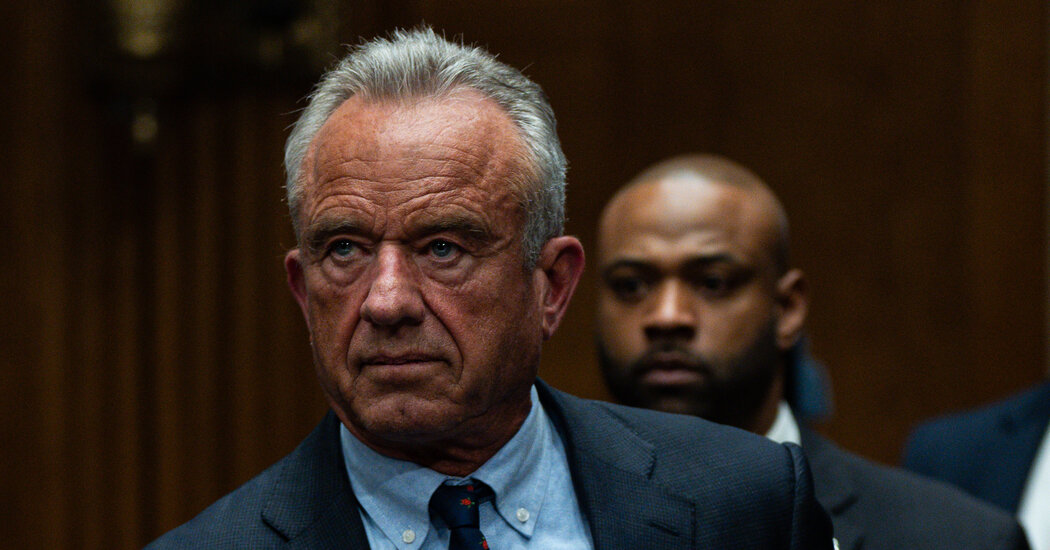
Every single morning across the country, millions of dedicated parents of children with special needs experience a quiet, deeply hopeful ritual: they carefully pack school backpacks, adjust specialized communication devices, and wave goodbye as their children board the yellow school bus. For these families, the local classroom represents a vital sanctuary of personal growth, socialization, and future independence. However, a profound sense of anxiety has recently swept through this close-knit community following the Trump administration’s controversial decision to hand the stewardship of federal special education programs to the newly appointed Health Secretary, Robert F. Kennedy Jr. This unprecedented administrative reshuffling has ignited a fierce, deeply emotional backlash among disability rights advocates, educators, and parents alike, who fear the systemic consequences of this transition. The core of their alarm lies in a fundamental question of identity and human dignity: should a child with special needs be perceived first and foremost as an active student capable of learning, or as a clinical patient waiting to be treated? To many advocates, removing special education from the Department of Education and placing it under the jurisdiction of the Department of Health and Human Services (HHS) feels like a devastating regression. It threatens to dismantle decades of hard-won progress, transforming classrooms from vibrant hubs of diverse learning into clinical spaces of medical containment. For Katy Neas, the chief executive officer of The Arc, a prominent national support group for people with intellectual and developmental disabilities, this policy change is deeply distressing. She notes that the underlying philosophy driving this transition reveals a profound lack of understanding regarding who these children are, how they can be successful in school, and how their futures can be truly bright. Instead of fostering an environment where children can thrive alongside their peers, this structural shift risks reducing unique individuals to their medical diagnoses, signaling a troubling departure from a holistic, educational worldview. They deeply believe children require robust opportunities to flourish normally rather than clinical healthcare intervention plans.
The anxiety gripping the disability community is further intensified by previous public statements made by Secretary Kennedy regarding children with developmental and cognitive differences. Earlier this year, Kennedy sparked intense outrage when he publicly claimed that children diagnosed with severe autism would never be able to hold a job, play baseball, or go on a romantic date. Although he quickly attempted to walk back those remarks, claiming he was referring only to the most extreme cases, he doubled down on his policy vision the very next day by insisting that special education programs belong within his health department because they are health-related programs rather than particularly educational programs. This rhetoric has touched a raw, personal nerve for families who have spent lifetimes proving that their children are capable of achieving fulfilling, productive, and joyful lives. The debate strikes at the heart of disability policy, drawing a sharp, unmistakable line between the outdated medical model of disability and the modern educational model. Edward M. Kennedy Jr., a highly respected civil rights advocate for people with disabilities and a cousin of the Health Secretary, expressed deep worry in a public response, emphasizing that shifting these programs to the Health and Human Services Department marks a regressive philosophical turn. He argues that this transition views children with disabilities as sick individuals in constant need of healthcare, rather than as capable young minds who have an inherent right to be integrated into general classrooms. When a child’s educational journey is filtered through a purely clinical lens, their strengths, creativity, and unique potentials are overshadowed by what scientific checklists deem to be their deficits. This philosophical regression threatens to alienate students from their peers, erecting artificial barriers based on their medical profiles rather than bringing them together under a shared, supportive banner of growth, development, and community learning in our local public schools. Disabled students have a fundamental right to exist outside medical categories, celebrating their unique strengths and achievements inside every local neighborhood public classroom they attend each school day.
To appreciate why this shift is viewed as such a betrayal, one must understand the grueling, multigenerational struggle that disabled advocates fought to secure equal access to public education. For most of the twentieth century, children with physical limitations, hearing or visual impairments, and neurodevelopmental conditions like autism were systematically excluded from public schools, locked away in isolated institutions, or hidden at home. It took decades of grassroots protests, legal battles, and tireless lobbying to convince local school boards, state governments, and federal lawmakers that every child deserves to learn. This relentless advocacy culminated in crucial legislative milestones, most notably the 1998 reauthorization of the Individuals with Disabilities Education Act (IDEA), which federally guaranteed that children with disabilities must receive a free, appropriate public education in the least restrictive environment possible. This landmark law transformed schools into inclusive communities where children of all abilities could study side-by-side, learning empathy and resilience from one another. Now, advocates fear that moving the offices that monitor and enforce IDEA into the labyrinthine bureaucracy of HHS will weaken these legal protections and dilute their educational focus. Stephanie Smith Lee, who directed the Office of Special Education Programs during the George W. Bush administration, warns that the relocation creates unnecessary layers of bureaucracy that will ultimately harm students. She forcefully asserts that children with disabilities are not merely a collection of diagnoses, but rather individual students who deserve to be educated alongside their general education peers. Dismantling the specialized educational infrastructure that oversees these rights threatens to unravel the delicate tapestry of school inclusion, leaving vulnerable families to navigate a fragmented, clinical bureaucracy without the robust educational support systems they have relied on for generations. Converting simple education programs into clinical healthcare treatment designs threatens to take children away from the communal classroom, erasing decades of hard-won progress. Disabled pupils belong in dynamic, communicative spaces where their minds are cultivated, not in therapy clinics where their potential is severely limited by narrow medical standards that ignore their developmental potential entirely.
This administrative restructuring is not happening in a vacuum; it is part of a broader, highly controversial effort by the Trump administration to completely dismantle the federal Department of Education. For decades, conservative policymakers have expressed a desire to shutter the agency, arguing that doing so would eliminate federal overreach, improve governmental efficiency, and return educational decision-making to local communities. During these transitions, critics have highlighted a noticeable lack of expertise, pointing to moments like when Secretary Linda McMahon, a professional wrestling executive, failed to recall the special education law’s name on Fox News. However, completely dissolving a department requires explicit congressional approval, which has remained elusive due to legislative gridlock and shifting priorities. In the absence of a legislative mandate, the administration has resorted to transferring tens of billions of dollars in educational programs to six different federal executive agencies, with HHS receiving a massive portion of these responsibilities. Representatives for the health department, including spokeswoman Courtney Parella Spencer, have stepped forward to reassure the public that this shift is designed to improve administrative efficiency rather than diminish children’s rights. Spencer insisted that Secretary Kennedy strongly agrees that a child’s disability should never be viewed as a medical condition requiring clinical cure, claiming that HHS experts will use their combined clinical and administrative knowledge to ensure that student needs are met while preserving all legal protections guaranteed under federal law. Yet, these reassurances have done little to pacify critics across the political spectrum. Margaret Spellings, who served as the secretary of education under President George W. Bush, expressed deep skepticism regarding the administrative chaotic nature of scattering vital public education services across the federal apparatus. Spellings questioned the underlying logic of the move, wondering if the dissolution of the department is merely a political photo opportunity rather than a genuine effort to enhance student achievement, emphasizing that creating confusion across federal agencies rarely translates into better outcomes for children in classrooms. She remains wholly unconvinced that this convoluted organizational transfer will improve learning outcomes.
Beyond the administrative challenges of dividing educational resources, there exists a deep, personalized concern regarding Secretary Kennedy’s historically public stances on medical and developmental science. Kennedy has spent years promoting widely debunked theories linking childhood vaccines to autism, championing alternative medical treatments, and challenging mainstream pediatrics. For parents of neurodivergent children, the prospect of having a federal health secretary with these unconventional views overseeing their children’s education feels like an existential threat to their academic and physical well-being. Maria Town, the president of the American Association of People with Disabilities, has spoken openly about her apprehensions, noting that Kennedy’s public statements on autism, ADHD, and mental health raise alarming questions about the future of special education curriculum and resources. Town, who, living with cerebral palsy, benefited directly from federal educational accommodations as a young student, worries that children with autism could be forced to undergo unproven, non-evidence-based treatments rather than receiving structured educational accommodations. She points out that children with disabilities already receive necessary, professional medical care from their trusted pediatricians and healthcare practitioners outside of school hours; what they require inside the school building is the space to be students, to read, to play, and to engage with their peers on equal footing. When the leader of the agency tasked with managing special education views these conditions through a lens of alternative medicine, the line between evidence-based education and unverified therapy becomes dangerously blurred, leaving families in a position of perpetual defense against experimental policies that could set their children’s educational development back by years, replacing standard academic support. Children deserve to be treated as students first, navigating the beauty of social learning without being subject to unscientific, experimental health interventions. Their developmental growth depends on being in classrooms where they are stimulated mentally and given the tools to thrive, rather than being handled as patients with neurological defects that need clinical fixing from doctors who do not naturally understand standard, inclusive classroom pedagogy or child education psychology in public school buildings each day.
As the transition looms, the legal and political battle over the future of special education is moving into the halls of Congress, where some lawmakers are attempting to mount a defense. While many congressional Republicans have shown little interest in directly challenging the Trump administration’s executive maneuvers, a bipartisan pocket of resistance has emerged within the Senate Committee on Health, Education, Labor, and Pensions. The panel’s chairman, Senator Bill Cassidy, a Louisiana Republican, has publicly stated his firm opposition to transferring special education programs out of the Department of Education, fearing the operational chaos it will cause for local school districts. Cassidy has committed to working alongside Democratic Senator Tim Kaine of Virginia to draft targeted legislation aimed at blocking the transfer of these educational programs to HHS, with plans to introduce the measure during a committee markup session in July. However, Cassidy’s political leverage is limited; having recently lost his Republican primary to a challenger backed by the president, he is a short-timer in the Senate, which raises questions about the long-term viability of this legislative block. Despite these daunting political odds, families, educators, and disability advocates refuse to abandon their fight, holding onto the hope that lawmakers will prioritize the well-being of vulnerable children over partisan loyalty. Ultimately, the controversy surrounding this policy shift highlights a universal human truth: a child’s value cannot be measured by a medical diagnosis, nor can their educational aspirations be neatly filed away in a health department folder. As the debate continues to rage in Washington, the families of children with disabilities remain steadfast in their mission, determined to ensure that their sons and daughters are seen, heard, and cherished as students first, with every opportunity to learn, grow, and build a bright, independent future. Their collective resilience serves as a powerful reminder that education is not a clinical treatment, but a timeless promise of inclusion, belonging, and boundless human potential that society must protect at all costs, ensuring no single child is ever left behind.