




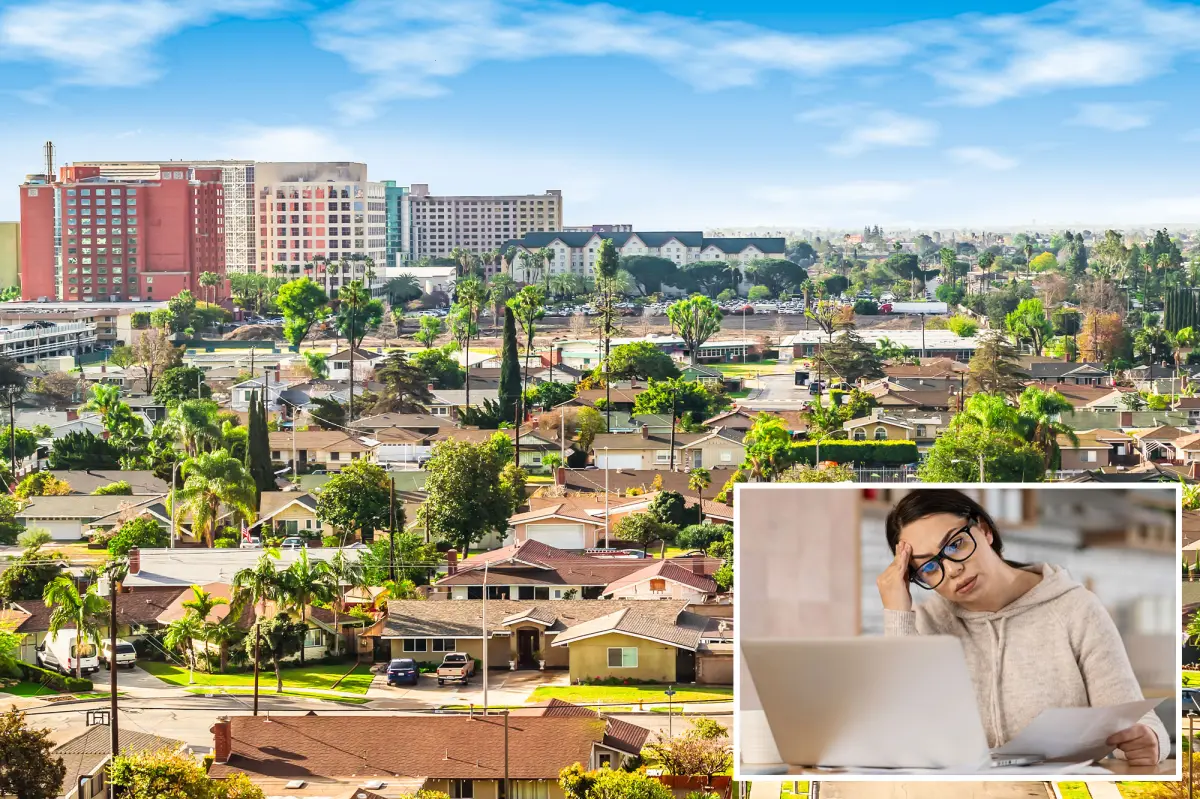
For generations of hard-working Americans, achieving a six-figure salary was the ultimate, undisputed milestone of financial security—the distinct moment of transition from mere survival to true prosperity. It was a golden gateway that promised a comfortable suburban home with a manicured front lawn, a couple of reliable family cars in the driveway, annual vacations, and a steadily growing retirement nest egg. To earn over one hundred thousand dollars a year meant you had officially “made it,” possessing enough of a financial safety net to live without the constant, grinding anxiety of checking your bank balance before buying groceries or paying utility bills. Today, however, that iconic economic dream has not only faded; it has been completely rewritten by an unforgiving real estate market in California. In the sun-drenched, picturesque coastal landscapes of modern Orange County, a single professional who reaches that historic $104,200 milestone is no longer classified as wealthy, upper-middle class, or even financially secure. Instead, according to official state documents, they are now formally classified as “low income.” This startling designation strips away the prestige of the six-figure mark, leaving many educated, hard-working individuals in a state of quiet bewilderment as they realize that their professional success can barely keep pace with the soaring cost of basic survival in one of the nation’s most expensive regions.
The jarring reality of this economic shift is officially recorded in the newly released income limits published by California’s Department of Housing and Community Development. These figures are not mere statistics; they are legally binding numbers that dictate applicant eligibility for state-subsidized, income-restricted housing, rent control caps, and taxpayer-funded assistance programs. Just last year, the low-income threshold for a single person in this wealthy Southern California enclave was already a jaw-dropping $94,750, but the latest update has pushed that number past the six-figure mark to $104,200. Family dynamics offer no relief from this compounding financial pressure, as the low-income ceiling for an Orange County household of four has ballooned to an astronomical $148,850. While state officials clarify that these designations do not automatically mean a family is living in destitution, they serve as a stark, institutional admission of how impossible it has become for average people to afford life in their own neighborhoods. It reflects a culture where the daily grind of working a demanding job, budgeting meticulously, and making responsible financial choices no longer yields the traditional rewards of homeownership and peace of mind, but rather a exhausting race just to stay afloat.
This intense economic pressure is not confined within the borders of Orange County; it is a symptom of a larger, systemic affordability crisis that is reshaping the entire map of the Golden State. Orange County’s new thresholds have officially surpassed those of neighboring Los Angeles County, where an individual is considered low-income at $93,300, and a family of four at $133,250—figures that would be considered luxury wages in almost any other part of the country. Further north, the crisis intensifies as several affluent northern counties, including Marin, San Mateo, Santa Clara, Santa Cruz, and San Francisco, also report six-figure low-income limits driven by the tech boom and a chronic, decades-long shortage of housing construction. This widespread inflation of living costs has created a profound sense of geographic displacement, forcing long-time residents, multi-generational families, and young graduates to make heartbreaking choices. Many are forced to relocate to inland desert communities, enduring brutal daily commutes of several hours, while others are abandoning the state entirely, taking their talents, families, and dreams to more affordable states like Texas, Arizona, or Nevada, leaving California’s communities increasingly economically segregated.
However, the cruelest irony of this housing crisis is that qualifying for housing assistance on paper does not translate to actually receiving it in real life. For the middle-class professional earning $104,000, they find themselves trapped in a frustrating bureaucratic purgatory: they are technically deemed “low income” enough to qualify for help, yet they make far too much money to be prioritized over those in absolute poverty. The safety net is already tearing under its own weight, as evidenced by a devastating report from the Orange County California Housing Partnership, which reveals that a staggering 119,785 low-income renter households in the county currently do not have access to an affordable home. Waitlists for subsidized apartments and housing vouchers can span several years, if they are even open to new applicants at all. Consequently, those earning six figures are left to fend for themselves in an aggressive market where average rents for modest apartments eat up more than half of their take-home pay, leaving very little money for health insurance, student loans, gas, child care, or healthy food, turning their hard-earned success into a mirage of prosperity.
The absurdity of these state-defined thresholds becomes even more painful when contrasted with the reality of those keeping the local economy running on a daily basis. A full-time minimum-wage worker in California earns approximately $35,000 a year before taxes—a mere fraction, less than one-third, of the $104,200 now required for a single person to step out of the “low-income” bracket in Orange County. This massive, yawning chasm exposes a deeply troubling societal divide, begging the question of how the essential workforce—baristas, restaurant servers, retail clerks, preschool teachers, grocery stockers, and medical assistants—is supposed to survive. These individuals, who form the cultural and operational backbone of the community, are subjected to extreme survival strategies, including crowding multiple families into small, substandard apartments, working two or three jobs without sleep, or sleeping in their vehicles. The rapid inflation of housing costs has effectively turned these essential workers into an invisible economic subclass, highly valued for their labor but systematically priced out of the very neighborhoods they serve, clean, feed, and protect.
Ultimately, these startling income limits serve as a powerful warning about the future of our communities and the true cost of an unchecked housing market. When earning over $100,000 soundly places a citizen in the low-income category, it challenges the fundamental belief that hard work and professional dedication are enough to build a stable life. Yet, amidst the frustration, the human spirit in California remains incredibly resilient, with grassroots advocacy groups, young professionals, and local families increasingly organizing to demand systemic changes, such as zoning updates, streamlined housing construction, and realistic wage protections. Resolving this crisis will require more than just adjusting the income figures on official state documents; it demands a collective realization that housing is a basic foundation of human dignity, rather than a speculative wealth-building asset. If California is to preserve its vibrant identity and remain a true land of opportunity, it must build a future where a hard day’s work guarantees a safe, affordable place to call home, ensuring that the promise of the Golden State remains accessible to all, and not just the exceptionally wealthy.