


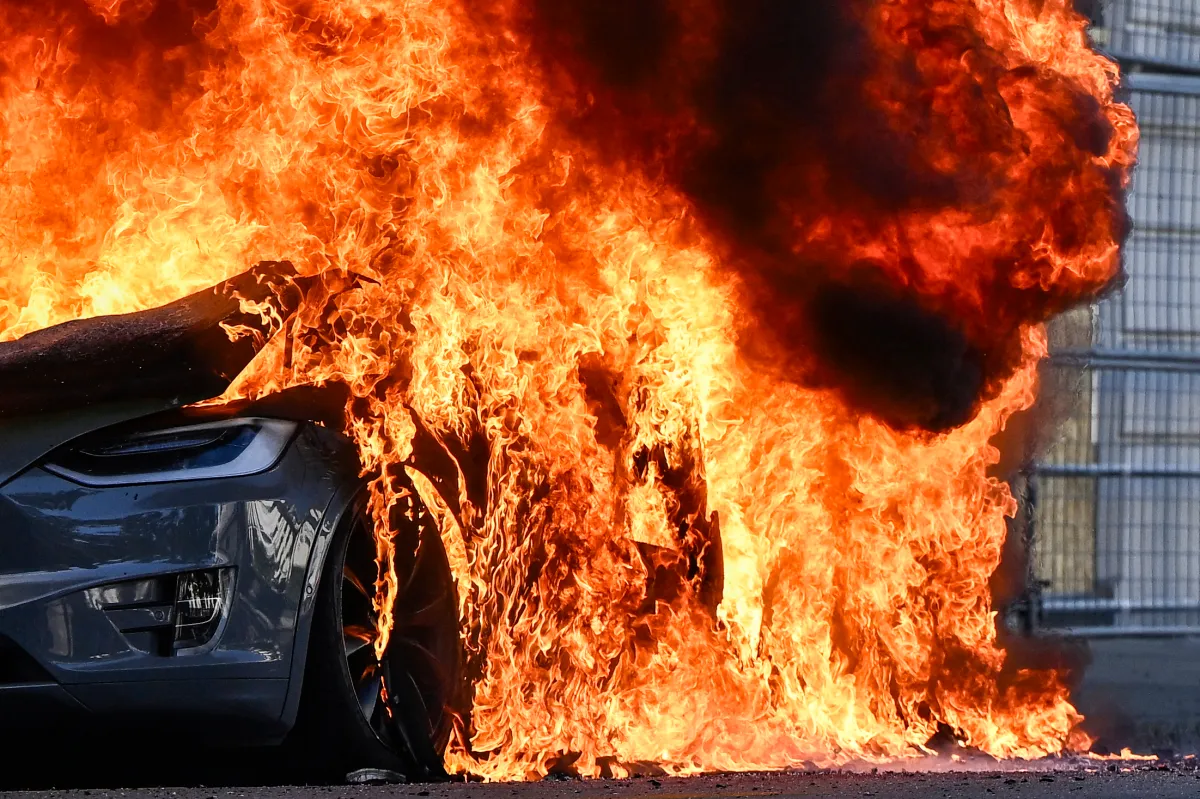
Underneath the serene, picturesque facade of downtown Geneva, a Sunday that began with civic unity and peaceful demands for global reform abruptly dissolved into a chaotic battleground of tear gas, shattered glass, and thick, suffocating black smoke. At the heart of this sudden, violent upheaval was a parked Tesla, engulfed in roaring orange flames near a central bus terminal, its burning frame serving as a stark, cinematic beacon of the systemic rage simmering just below the surface of the quiet Swiss city. What had started as a largely peaceful, highly organized march of over twenty thousand citizens quickly fractured as the afternoon wore on, transforming into a desperate clash between tactical riot police and radicalized demonstrators. Brick by brick, the historic streets were torn up from the ground, weaponized by splinter groups who hurled heavy debris and stones at law enforcement officers dressed in full combat gear. As the stinging mist of tear gas drifted through the cobblestone alleys and public squares, families, local shoppers, and bewildered bystanders were forced to flee the central district, coughing, weeping, and shielding their small children from the encroaching violence. The destruction was not random; businesses and buildings connected to international organizations, including the United Nations itself, found their windows smashed and facades defiled, making it clear that this was a targeted assault on the institutional symbols of global governance. For a city usually defined by diplomatic poise, quiet wealth, and international cooperation, the scene was a jarring, terrifying reminder of the deep-seated grievances that currently divide the modern world, transforming a local street into a vivid illustration of global unrest on the eve of a major summit.
To truly understand the raw, volatile fury that transformed a peaceful Sunday walk into an urban riot, one must look closely at the human faces in the crowd who feel utterly abandoned by the relentless march of modern capitalism and globalization. For many of the demonstrators, the upcoming Group of Seven summit is not a forum for global progress or diplomatic troubleshooting, but an exclusive, closed-door club where the wealthy decide the fate of the vulnerable without their consent. Local protester Pippa Saugy captured this pervasive, heartbreaking sentiment of betrayal and economic disenfranchisement, noting to reporters that gatherings like the G7 are merely “a meeting of the rich that shows once again how the rich can become even richer while the poor are left behind.” This sense of profound economic alienation was supercharged by recent, staggering financial headlines: just days prior to the march, Tesla CEO Elon Musk—already a deeply controversial figure due to his extensive wealth and his past political ties as an adviser to President Donald Trump—officially became the world’s first trillionaire following the momentous stock market debut of SpaceX at one hundred and fifty dollars per share. This unfathomable accumulation of individual wealth acted as a mental accelerant to the protesters’ anger, turning the parked Tesla in Geneva from a mere electric vehicle into a hated monument of corporate dominance, climate posturing, and extreme economic inequality. The burning car was not just a random act of property damage; it was a deeply symbolic, visceral, modern iconoclastic act, a direct protest against a system where a single corporate titan can amass more wealth than entire nations while ordinary citizens struggle to pay rent, feed their families, and cope with inflation.
This mass mobilization in Geneva did not happen by accident; it was the result of weeks of meticulous planning and coordination by a highly organized, diverse coalition of activists warning of the dangers of concentrated political control. In the weeks leading up to Sunday, organizers had distributed a detailed demonstration handbook, equipped with coordinate maps of the security perimeters, tactical advice on protective marching gear, and legal instructions on how to handle detentions or arrests by Swiss authorities. Anticipating that the political temperature would boil over, local shopkeepers and international financial institutions, such as the Banque du Leman, along Geneva’s primary thoroughfares had spent their weekend boarding up their windows with thick plywood, creating a bleak, defensive landscape in anticipation of the march. Initially, the massive crowd moved with a vibrant, collective rhythm, characterized by rhythmic chanting, colorful banners demanding climate justice, and a peaceful, albeit tense, police escort. However, as the afternoon progressed, this unified front fractured, giving way to smaller, highly coordinated black-bloc groups determined to strike back against capitalism’s physical manifestations. The Banque du Leman became an immediate target, its wooden protective barriers ripped away and its windows shattered, while other corporate facades were systematically vandalized. Though the vast majority of the twenty thousand participants did not participate in the physical destruction and actively sought a peaceful demonstration, the actions of these radical splinter groups successfully redefined the narrative of the day, leaving local authorities struggling to tally the arrests and assess the injuries.
The epicenter of the geopolitical tension that triggered this massive protest lies just across the placid, blue waters of Lake Geneva in the historic French resort town of Evian-les-Bains, where the G7 summit is scheduled to take place from June 15 to 17. There, behind heavily fortified security cordons, the leaders of the world’s most influential democratic economies—including the United States, the United Kingdom, France, Germany, Italy, Canada, and Japan, alongside top representatives from the European Union—will gather to negotiate the future of global policy. The agenda before them is exceptionally heavy, dominated by devastating, active military conflicts in Ukraine and the Middle East, alongside pressing long-term challenges like economic stability, trade regulations, and international security. Yet, to the activists marching in the streets of Geneva, the high-altitude discussions in Evian-les-Bains represent a deeply flawed, outdated model of global governance that excludes the voices of the global majority. While leaders discuss inflation and resource management from the comfort of luxury lakeside estates, the protesters outside highlight a broad spectrum of neglected crises, ranging from systemic gender inequality to the catastrophic realities of climate change. The immense diversity of the causes represented in the Geneva march—where environmentalists walked alongside labor unionists and anti-war activists—underscores a shared, unifying belief that the G7 nations are failing to address the existential threats facing humanity, prioritizing corporate profits over human lives.
In response to the threat of widespread civil unrest spilling across international borders, authorities have constructed a massive, almost unprecedented security apparatus to shield the summit and its elite participants from the public. Across the border in France, a staggering force of more than thirteen thousand police officers and gendarmes has been deployed to secure the perimeter of Evian-les-Bains and its surrounding regions, effectively turning the peaceful lakeside area into a militarized zone. Border security has been dramatically tightened, with over eight hundred French border control officers activated to monitor crossings—a massive increase from the sixty officers who normally patrol these administrative boundaries. This intense security mobilization reflects a deep institutional anxiety about the potential for cross-border coordination among radical activist networks, who view the geographic proximity of French and Swiss territories as an opportunity to disrupt the summit. For the residents of Geneva and the surrounding French towns, this overwhelming police presence has transformed daily life, creating a landscape defined by barricaded streets, identity checks, and the constant hum of surveillance helicopters. The physical division between the heavily protected political elites inside the summit and the tear-gassed, frustrated citizens outside serves as a stark, literal illustration of the very systemic divide that the protesters are risking their safety to expose.
The dramatic escalation in Geneva is part of a familiar, decades-long pattern of confrontation that has historically accompanied meetings of the G7 and other major international financial institutions. From the historic anti-globalization protests of the late nineties and early thousands to the modern era, high-level summits have consistently functioned as magnets for global discontent, drawing a diverse coalition of activists who refuse to let world leaders meet in a vacuum of luxury. While government officials and international organizers are quick to draw a hard line between peaceful demonstrators and the violent factions that damage property, activists argue that the state’s aggressive security tactics often escalate tensions, turning legitimate political expression into physical warfare. As the embers of the burned Tesla are cleared from the streets of Geneva and the broken glass of the Banque du Leman is swept away, the G7 summit is still poised to proceed exactly as planned under the watchful eyes of thousands of armed guards. Yet, the black smoke that drifted over Geneva on Sunday remains a powerful, haunting symbol of a fractured global order, signaling that no matter how many security barricades are erected, the profound anger over inequality, corporate greed, and political disenfranchisement cannot be easily contained or ignored.