

Engineering the Perfect Pitch: The Unprecedented Scientific Crusade to Grow Natural Grass for the 2026 World Cup
The Modern Colosseum and the Living Green Carpet
As global soccer enthusiasts prepare for the most massive sporting spectacle in modern history—a sprawling, 39-day marathon featuring 48 international teams, 104 matches, and more than 1,200 pairs of high-performance cleats tearing across the ground—a highly specialized group of scientists is directing its attention far below the players’ feet. For the first time, FIFA, the international governing body of association football, has mandated that every single match of the 2026 World Cup must be contested on natural, living turf. This requirement presents an engineering challenge of historic proportions: unifying the surface playability, ball dynamics, and sheer physical integrity of fields across 16 different stadiums spanning three nations, a multitude of microclimates, and widely divergent structural environments. From the open skies of high-elevation venues to massive, enclosed concrete domes that traditionally rely on synthetic turf, the sheer logistics of maintaining a uniform playing field are staggering. The conflict between state-of-the-art sports architecture, designed to insulate fans in climate-controlled environments, and the simple biological needs of living vegetation highlights a compelling narrative of agronomic innovation; it is a high-stakes scientific enterprise where the primary goal is to ensure that the ground behaves identically, whether a match is played on a humid afternoon near the Gulf Coast or inside a dry, shadowed indoor arena in the American heartland.
The Biological Matrix of Elite Turfgrass
                          ┌──────────────────────────────────────┐
                          │     2026 WORLD CUP TURF SELECTION    │
                          └──────────────────┬───────────────────┘
                                             │
                    ┌────────────────────────┴────────────────────────┐
                    ▼                                                 ▼
         [ Warm-Climate Venues ]                           [ Indoor & Cool-Climate ]
        (e.g., Miami, Monterrey)                           (e.g., Atlanta, Toronto)
                    │                                                 │
          ┌─────────┴─────────┐                             ┌─────────┴─────────┐
          ▼                   ▼                             ▼                   ▼
   [ Bermuda Grass ]   [ Root System ]             [ Kentucky Bluegrass ]  [ Perennial Ryegrass ]
   • High heat tolerance • Lateral growth          (84% Composition)       (16% Composition)
   • High light need   • Erosion-resistant         • Soft player feel      • Rapid germination
                                                   • Shade tolerance       • High density
To transform this vision of a uniform playing surface into reality, FIFA turned to Alan Ferguson, the organization’s senior pitch management manager, who subsequently assembled a premier coalition of specialized agronomists and turf scientists to lead the project. Headed by John Sorochan of the University of Tennessee and John Rogers of Michigan State University, this elite team of “turfologists” has been conducting rigorous, empirical research since 2018 to decode the behavior of various grass species under intense physical stress. The biological reality of turfgrass is highly complex: out of more than two dozen species, each has evolved its own distinct response to temperature, sunlight, and physical impact. Cold-weather species like Kentucky bluegrass are well-suited to lower light levels and shorter growing seasons, producing a dense, appealing cover, yet they struggle under intense heat; conversely, warm-climate Bermuda grass thrives in direct sunlight but quickly deteriorates in the deep shadows of covered stadiums. To strike a balance, the scientists designed a dual-solution matrix: open-air, southern stadiums in cities like Miami and Monterrey will rely on resilient Bermuda grass, while northern venues and indoor domes will utilize an engineered blend composed of 84 percent Kentucky bluegrass and 16 percent perennial ryegrass. This hybrid approach leverages the rapid germination and healing properties of ryegrass alongside the lateral strength and soft feel of bluegrass, offering a robust playing surface capable of surviving the intense wear and tear of a world-class tournament.
Simulating the Human Foot and the Perfect Bounce
To ensure complete surface uniformity across all 16 tournament venues, the scientific team moved beyond simple observation, embracing advanced biomechanic testing and impact physics to evaluate the turf. Traditional testing methods often relied on basic vertical impacts, which failed to capture the complex, multidirectional forces of an elite athlete sprinting, pivoting, and sliding on the pitch. In response, Dr. Sorochan’s research group engineered the “fLEX,” a highly advanced testing device equipped with a 3D-printed foot wearing a standard soccer cleat. This machine is calibrated to strike the living turf with the exact acceleration, rotational torque, and cutting motion of a 168-pound professional athlete—the average weight of a men’s World Cup competitor—measuring precisely how much energy the soil-and-grass matrix absorbs versus how much force it returns to the athlete’s joints.
Simultaneously, researchers studied ball physics using specialized equipment, launching official match balls at 55 kilometers per hour at a 17-degree angle. By recording these impacts with high-speed cameras, they analyzed the exact coefficient of restitution, ball trajectory, and post-bounce velocity off various grass species. Standardizing these metrics is critical because FIFA quality standards demand that a ball dropped from two meters must rebound between 60 and 100 centimeters, while also establishing a consistent five-to-eight-meter roll when dispatched down a calibrated ramp. Achieving these identical physical properties at sea level in Miami and at 7,300 feet of elevation in Mexico City requires meticulous, ongoing adjustments to soil compaction, grass height, and moisture levels, ensuring that a player’s footing and ball control remain unchanged throughout the tournament.
| Ball Behavior Metric | Measurement Device | Standard Requirement | Impact on Game Play |
|---|---|---|---|
| Vertical Rebound | RedDrop Ball Rebound Tester | 60 cm to 100 cm | Predictability of high bouncing balls and head-height transitions |
| Surface Friction / Roll | Turf-Tec FIFA Ball Ramp | 5.0 m to 8.0 m | Speed of ground passing and defense reactions |
| Cleat Rotational Release | The fLEX 3D-Cleated Foot | Optimized torque release | Reduces ACL/groove injuries and prevents divoting |
| Energy Absorption | Astroturf / Clegg Soil Tester | High absorption, low shock | Player stamina conservation and impact joint protection |
The Great Green Migration and Sod on Plastic
The logistical effort required to cultivate, transport, and install these massive living fields across North America represents an unprecedented triumph of modern agricultural engineering. Rather than cultivating the turf in place, which would leave fragile young grass vulnerable to early damage, FIFA contracted nine specialized sod farms across Canada, the United States, and Mexico to grow the grass under highly controlled conditions. For the most demanding journeys, transport teams used specialized refrigerated tractor-trailers to haul massive rolls of living sod over distances exceeding 1,400 miles—keeping the grass in a state of suspended animation during transport to prevent heat buildup and decay.
[ CONVENTIONAL HARVESTING ]
Sod grown in soil -> Roots sliced by machinery -> High transplant shock -> 3+ weeks recovery
[ SOD ON PLASTIC TECHNOLOGY ]
Sod grown on plastic barrier -> Roots grow laterally -> Dense, self-weaving mat -> Instant playability
To ensure these mature fields could withstand immediate play upon arrival, agronomists employed a breakthrough technique known as “sod on plastic.” Traditionally, harvesting sod requires slicing through the underlying root network, which causes significant transplant shock and requires weeks of recovery before the grass can anchor itself to the new subsoil. By growing the turf on a thin layer of sand spread over impermeable plastic sheets, scientists forced the roots to grow laterally, weaving together into a dense, exceptionally strong mat. This allows technicians to roll up the mature turf like a carpet and install it with virtually no root damage. Once laid down in the stadiums, massive heavy-duty stitching machines—resembling a cross between a steamroller and an industrial sewing machine—thread millions of synthetic fibers deep into the root zone, creating a reinforced hybrid grid that pins the natural grass in place and prevents large divots during intense play.
Mechanical Life Support in Concrete Wells
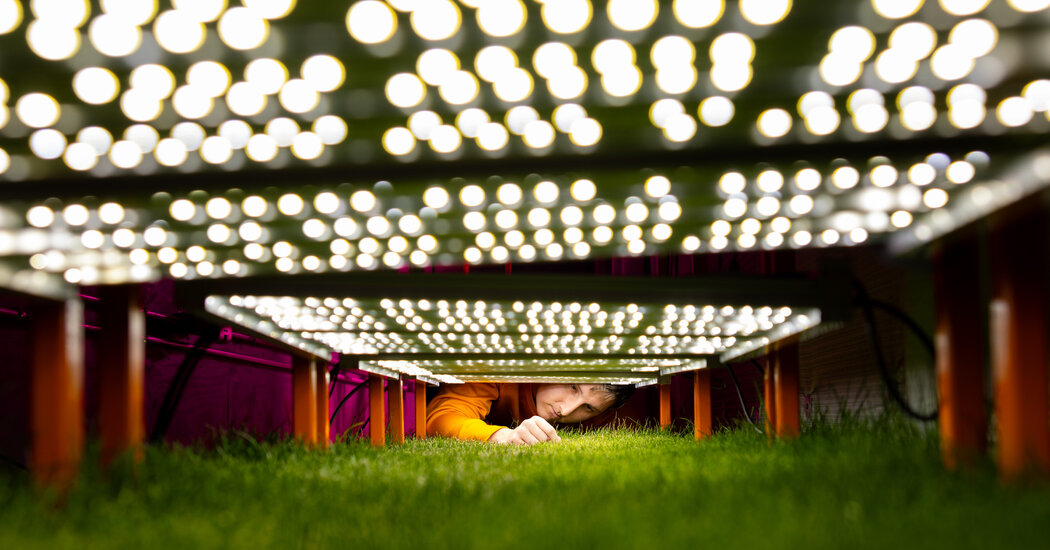
Once installed within the grand, enclosed architectural structures of modern stadiums, these natural grass fields sit atop a sophisticated, underground life-support system designed to replicate the natural world. Modern multiuse stadiums, built with sweeping roofs to protect fans from the elements, present a survival challenge for natural grass by severely limiting fresh airflow and blocking essential sunlight. To keep the turf healthy, engineered fields rely on an advanced subsurface infrastructure. Beneath the living sod lies a deep, highly breathable sand-based root zone that prevents compaction and maintains proper oxygen levels for the roots. Directly below the sand, a structured network of gravel, drainage pipes, and integrated structural systems can rapidly pump water in or out depending on real-time conditions. To replace natural sunlight inside shaded arenas, field crews wheel out massive, two-ton LED grow-light rigs that illuminate the turf for 12 hours a day, providing the specific spectrum of light needed for photosynthesis. Simultaneously, industrial-strength aeration fans blow constant streams of air across the stadium floor, preventing high humidity and stagnant air from fostering fungal pathogens that could destroy the pitch overnight.
[ SOCCER PITCH SURFACE ]┌────────────────────────────────────────────────────────────┐
│ Natural Turfgrass / Synthetic Hybrid Stitched Fiber Matrix │
├────────────────────────────────────────────────────────────┤
│ Engineered Rootzone Sand (Inches of high permeability sand) │
├────────────────────────────────────────────────────────────┤
│ High-Flow Drainage Gravel with Built-in Permavoid Grid │
├────────────────────────────────────────────────────────────┤
│ Underground Vacuum Vent System (Pumps moisture in/out) │
└────────────────────────────────────────────────────────────┘
The Miami Command Center and the Guardian of the Pitch
[ TOURNAMENT OPERATIONS CENTER – MIAMI ]
│
├─► [Real-Time Remote Sensors] ────► Moisture, Soil Temp, Hardness
├─► [Weather Tracking Systems] ───► Humidity, Barometric Pressure
└─► [High-Speed Video Feeds] ─────► Cleat Slippage, Ball Rolling Devs
The nerve center of this entire international scientific effort is located inside the FIFA Tournament Operations Center in Miami, Florida, where Alan Ferguson and his team of specialists monitor the health of all 16 fields around the clock. Through advanced remote sensors embedded in each pitch, the operations center tracks microclimatic variables, from root-zone moisture and soil temperature to surface hardness, allowing them to adjust maintenance schedules at a moment’s notice. During the tournament, Ferguson and his team will watch every match on high-resolution screens, looking for any signs of surface failure, such as sliding players, strange ball bounces, or decaying turf. For these dedicated scientists, success means their years of quiet research go completely unnoticed by viewers, leaving players to focus entirely on the game. Only during the 90 minutes when Ferguson’s native Scotland takes the pitch will his scientific focus waver, allowing a passion for the sport to briefly take precedence over his commitment to the turf beneath. Until then, the success of the 2026 World Cup remains firmly anchored in this quiet, historic feat of agricultural engineering, ensuring a pristine playing green for the global stage.