




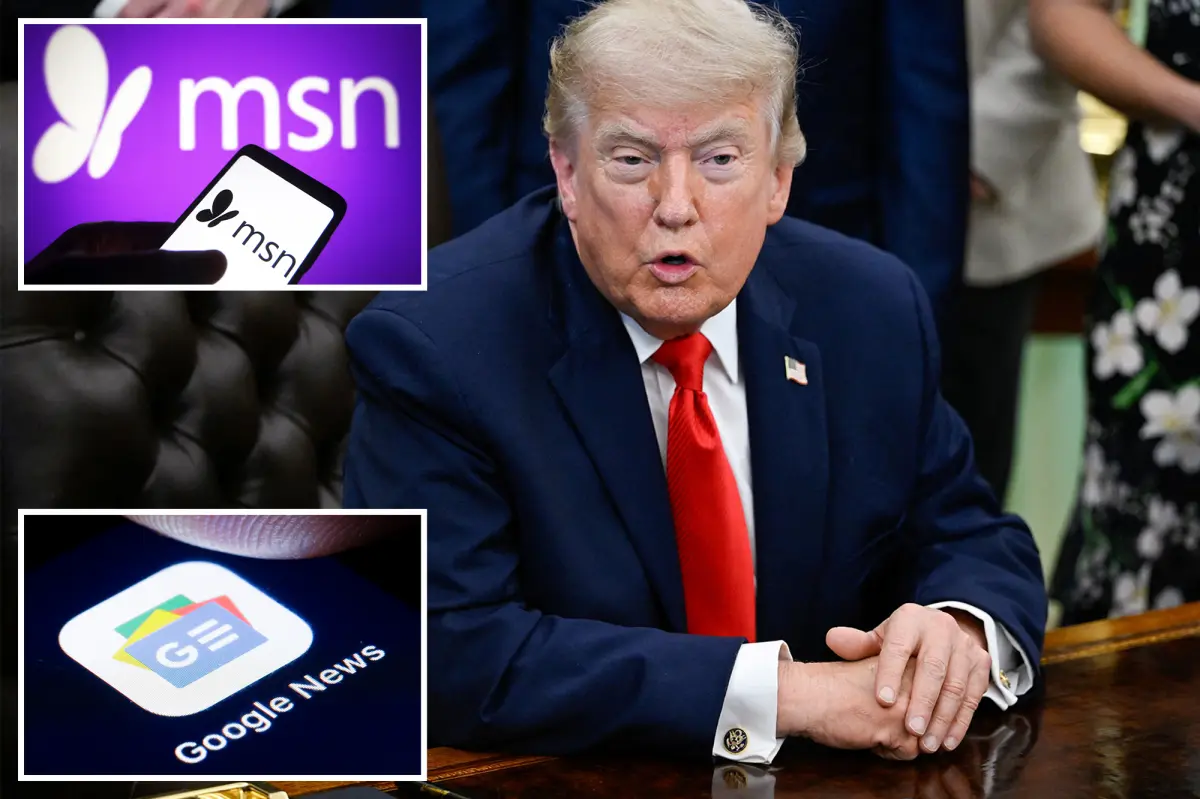
In today’s fast-paced digital era, the way the average person consumes news has undergone a quiet but seismic revolution. Rather than walking down to the local corner store to grab a physical newspaper, flipping through paper pages over a fresh cup of coffee, or even intentionally typing a specific news publication’s URL into a web browser, millions of citizens now receive their daily dose of national affairs passively. As they wake up, silence their alarms, or wait in line during their morning commute, their smartphones buzz with pre-curated notifications, or they casually swipe across their screens to scroll through feeds compiled by Silicon Valley’s “Big Four” news aggregators: Apple News, Google News, Microsoft MSN, and Yahoo News. These massive digital platforms have quietly assumed the mantle of America’s modern public square. They act as the primary window to the world for a vast majority of the population, carrying an immense, almost sacred responsibility to present a balanced, fair, and objective view of our complex cultural and political landscape. However, a major new analysis has revealed a deeply concerning reality that challenges the presumed neutrality of these near-monopolistic technological giants. A comprehensive investigation conducted by the Virginia-based media watchdog group, the Media Research Center, suggests that these main portals of information are not acting as impartial observers of the political ecosystem. Instead, the study alleges that they are actively tilting the playing field during crucial electoral periods, effectively doing the political bidding of the Democratic Party. By systematically marginalizing conservative voices and disproportionately magnifying highly partisan, left-leaning narratives during early coverage of key primary elections, these platforms are accused of stacking the deck against former President Donald Trump and the broader Republican Party at a time when voters are actively trying to form their opinions.
To understand the scale of this alleged digital discrepancy, one must look closely at the empirical evidence harvested during this exhaustive, multi-month study. The Media Research Center embarked on a rigorous tracking mission that spanned a critical 100-day window, running from the beginning of March to the early days of June—a pivotal timeframe when voters were actively deciding the future direction of their political parties. During this intense period of primary activity, analysts meticulously monitored the top twenty morning news stories pushed daily to millions of users by each of the four designated aggregators, establishing a massive dataset of digital content consumption. Out of the vast ocean of articles curated by these platforms, the research team identified 155 specific pieces that focused directly on the high-stakes Republican congressional primaries and the various candidates endorsed by Donald Trump. The results were stark and undeniably lopsided: an astonishing 80 percent of these stories—representing 124 out of the 155 analyzed articles—were sourced from media organizations widely recognized for their left-of-center editorial stances, such as CNN and The New York Times, which have long maintained combative and highly critical editorial policies toward the populist wing of the GOP. In sharp contrast, a meager 5 percent of the promoted stories, totaling just eight index entries, were drawn from conservative-leaning news organizations that might naturally offer a more sympathetic or deeply informed perspective on the primary electorate. The remaining 15 percent, encompassing some 23 stories, came from outlets classified as centrist or politically neutral. To ensure the absolute credibility of these classifications, researchers collaborated with AllSides, a highly respected, nonpartisan organization dedicated to mapping political bias across the media landscape, confirming that this stark imbalance was not a figment of partisan imagination but a quantifiable, structural reality built directly into the engines of modern information retrieval.
When we dissect the individual performance of each tech titan, the degree of uniformity in shutting out conservative viewpoints becomes even more apparent, painting a disturbing picture of an information ecosystem that operates as a near-monolithic filter. Google News, which serves as the default landing page for hundreds of millions of web browsers and mobile devices worldwide, promoted a total of 70 articles concerning the Republican midterms during the study’s timeframe. Of these, 57 were written by left-aligned publishers, while a measly three came from right-leaning sources, leaving the tiny remainder to centrist publications. Apple News, deeply integrated into the native operating systems of iPhones and iPads in almost every American household, featured 47 primary-focused articles; 33 of these were categorized as left-leaning, ten as centrist, and a mere three as right-leaning. Microsoft’s MSN platform followed a similarly lopsided trajectory, steering its massive user base toward 16 stories from left-wing newsrooms, two from centrist publications, and only one solitary article from a conservative source. Perhaps most striking, however, was the performance of Yahoo News, which achieved a total shutout of conservative opinion; of the 19 primary election stories it chose to highlight, 18 were published by left-leaning outlets, one came from a centrist source, and absolutely zero were chosen from the entire domain of right-of-center journalism. This across-the-board consistency suggests that these corporate algorithms, despite being engineered by distinct companies with different histories, are fundamentally aligned in a way that shields the average citizen from experiencing a diverse range of political thought. The psychological impact of this digital quarantine is profound, as passive users are continuously fed a singular narrative, slowly eroding their ability to perceive that other valid, fact-based perspectives even exist in the wider world.
This digital favoritism is not merely a matter of source diversity; it extends deeply into the highly charged, emotional language and heavily biased framing utilized within the curated articles themselves. Rather than presenting objective, evenweight summaries of political campaigns, these aggregators consistently elevated stories that used provocative and aggressive rhetoric to characterize Donald Trump and his endorsed candidates as dangerous outsiders or desperate authoritarians. For example, Google’s feed prominently pushed an article from The Guardian that described the former president as being “like a cult leader whose commune keeps getting smaller” and accusing him of ruling the Republican Party “like a mob boss who can get a horse’s head placed in any bed.” Other stories promoted by these digital gatekeepers repeatedly framed successful primary wins by Trump-backed candidates as somehow being failures in disguise, or depicted his political endorsements as toxic burdens to the GOP’s electoral health. Headlines routinely employed emotionally loaded, negative vocabulary—such as “revenge,” “retribution,” and “villain”—to construct a theatrical, dark narrative of personal vendetta and internal party ruin. A prime example of this occurred when Microsoft’s MSN highlighted a piece from The Independent which warned that Trump’s attempts to secure “revenge” on “disloyal” members of his party would ultimately cost him dearly, referencing his controversial endorsement of conservative Ken Paxton in Texas. In reality, the voters on the ground lived in a different universe than the one created by the tech algorithms, as the MAGA-aligned candidate went on to secure a decisive, landslide victory in the primary runoff, illustrating a massive, widening disconnect between the elite media’s doom-laden predictions and the actual values and votes of the grassroots American electorate.
The revelation of this stark digital bias has sparked fierce, articulate pushback from a diverse coalition of media analysts, local political figures, and campaign representatives, who warn of the long-term dangers such algorithmic engineering poses to our broader democratic norms. Dan Schneider, the Vice President of the Media Research Center, openly questioned the basic journalistic logic of these tech companies, arguing that any sensible publisher would naturally seek out the direct perspectives of right-leaning publications when trying to explain internal Republican primary dynamics to the public. Schneider pointed out that outlets like the New York Post, The Dallas Express, or The Telegraph possess a far deeper, more authentic understanding of conservative voters and regional issues than the progressive, coastal reporters writing for NPR, The New York Times, or The Guardian, who often view conservative politics with open hostility. Furthermore, New York City Councilman Frank Morano, a veteran radio talk-show host and Staten Island Republican, highlighted a vital historical shift in how public opinion is manipulated. He noted that while traditional newspapers and television networks have long been accused of harboring editorial bias, the absolute power concentrated in a few handpicked algorithms today means a small group of Silicon Valley engineers have essentially become the automated, unchecked editors of America’s collective front page. Morano warned that when eighty percent of the news pushed about one of the nation’s two major political parties is filtered through an antagonistic lens, it completely destroys the concept of a free and open exchange of ideas, replacing a healthy public discourse with an artificial echo chamber. Bernadette Breslin, the National Republican Senatorial Committee’s national press secretary, echoed these concerns, emphasizing that despite the media’s attempts to minimize conservative movements, voters remain highly attuned to their own economic realities and will ultimately reject the artificial narratives crafted by these tech giants and their progressive media allies when they step up to cast their ballots.
When directly contacted to address the detailed findings and statistics of their heavily lopsided curation methods, Apple, Google, Microsoft, and Yahoo chose to remain completely silent—a deafening refusal to engage that speaks volumes about the critical lack of corporate accountability inherent in our modern technological monopolies. This defensive wall of silence leaves the voting public with deeply troubling questions about the underlying ethics, political intent, and algorithmic transparency of the software systems that currently shape our shared reality. When the primary curators of global news operate behind proprietary, black-box technologies that shield them from independent oversight, they possess the unchecked power to influence elections and quietly steer national conversations without ever having to justify their editorial parameters to the public. This systemic bias is not merely a threat of raw political favoritism; it strikes at the very heart of the shared factual baseline required for a diverse, self-governing republic to successfully operate. Humanizing our relationship with these digital spaces requires us to demand that these massive automated platforms serve the actual, diverse communities they enrich themselves off of, rather than treating users as passive subjects to be ideologically guided toward a pre-determined worldview. Ultimately, the pathway back to an honest public square lies not in reciprocal censorship or political retaliation, but in a groundswell of demand for transparency, algorithmic accountability, and the conscious restoration of viewpoints from both sides of the aisle. As citizens prepare to navigate future high-stakes elections, fostering active media literacy and pushing for platform reform are essential to ensuring that the digital editors of America’s front page reflect the genuine, multi-faceted voice of the American people.