


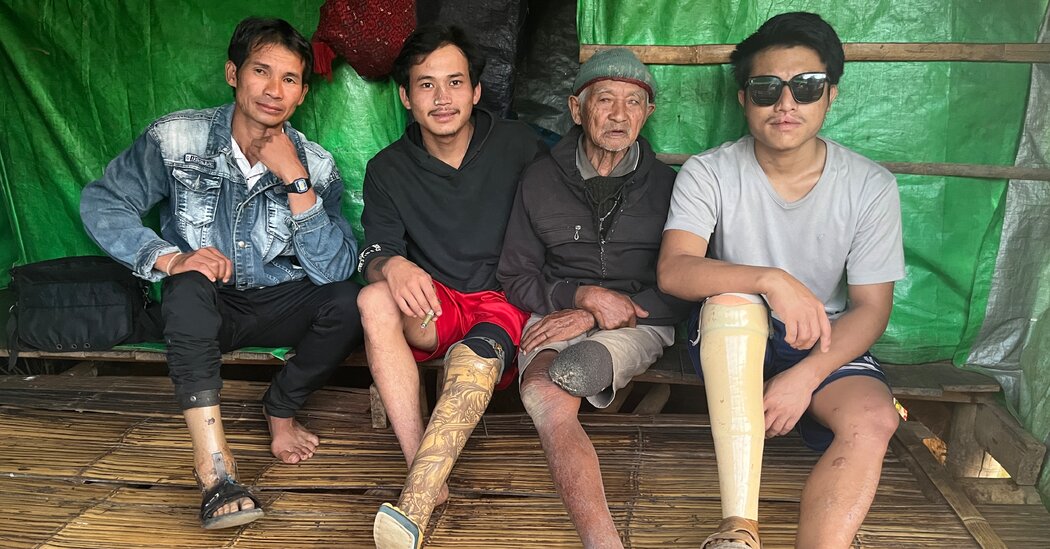
On a sweltering September afternoon in 2023, twenty-five-year-old John New Min and a group of fellow rebel volunteers finished a grueling morning of clearing landmines with nothing more than basic farm forks, rusted shovels, and their bare hands. These lethal traps had been callously planted by Myanmar’s military junta around the peaceful neighborhood gardens, family farms, and church yards of his rural eastern homeland. Seeking a moment of respite from the physical and mental strain, John began walking toward the cool shade of a nearby tree, only to step on a hidden explosive device. The deafening blast launched his body into the air, instantly stealing his right leg, tearing away his eyesight, and forever altering the course of his young life. With that single, tragic step, John became the seventh member of his immediate family to be maimed or killed by these invisible weapons, joining a tragic lineage of physical loss that includes his eighty-eight-year-old grandfather, Bu Ri, who had lost his own left leg to a military landmine in the very same region over thirty-two years prior.
John’s personal tragedy is a agonizingly common thread in the larger, bloody tapestry of modern Myanmar, a nation that has spiraled into relentless civil conflict since the military junta violently seized power from the democratically elected government in February 2021. For decades, the generals have relied on brutal, asymmetric tactics to maintain control over a resistant population, launching indiscriminate airstrikes on civilian gatherings, firebombing religious temples, and seeding the countryside with landmines to terrorize communities. According to a devastating report published by the Landmine Monitor, Myanmar recorded over two thousand landmine casualties in 2024, claiming the grim distinction of having the highest rate of mine-related injuries and deaths in the world for the second year in a row. These hidden executioners do not discriminate between combatants and innocents; instead, they lie patiently in the mud, waiting to shatter the lives of farmers tending their crops, mothers gathering firewood, and young children walking to outdoor schoolrooms.
The epicenter of this crisis lies in places like Karenni State, a remote, mountainous region where local ethnic groups have resisted central military oppression for generations. For the family patriarch, Bu Ri, the return of military tyranny brought a cruel sense of historical repetition, forcing him to flee his ancestral village so quickly that he had to leave his prosthetic leg behind in the chaos. Now, like more than half of Karenni State’s displaced population of nearly half a million people, the elder spends his days navigating a chaotic, muddy jungle refugee camp on wooden crutches, far from the land he spent his life cultivating. Despite his physical limitations and advanced age, Bu Ri’s spirit of resistance remains unbroken, a resolve that inspired his forty-one-year-old son, Thin Naw, and eleven of his grandsons to enlist in the newly formed Karenni Nationalities Defense Force to fight for their liberation.
The price of their patriotism, however, has been written in blood and severed limbs across consecutive generations of the family. Just one week before John New Min was blinded and amputated, his uncle, Thin Naw, was also helping to demine a civilian path when he triggered an explosive, losing his right leg in an instant. This compounding trauma has left Thin Naw wrestling with a dark, existential dread about the ultimate fate of their homeland and his descendants. He laments that if their revolution against the military regime ultimately fails, Karenni State will be transformed into little more than a vast, open-air graveyard and a home for disabled survivors haunted by the ghosts of those who were blown apart. His fears are shared by another cousin, twenty-three-year-old Joseph, who lost his left leg while retreating through a jungle stream during a desperate firefight, navigating the water just moments after seeing a fellow soldier killed by an underwater mine.
Though local resistance forces currently control roughly two-thirds of Karenni State, the threat of landmines continues to intensify daily because active warfare prevents any systematic, safe demining campaigns. Revolutionary leaders explain that as military forces retreat or advance, they seed dense, newly populated civilian corridors with fresh explosives to slow down the rebel momentum, making previously cleared zones active minefields once more. The rebel government does what it can, even organizing armed military escorts to guide displaced villagers through safe paths, but the psychological toll of walking through a landscape of hidden death is suffocating. For survivors like John, who has spent the last year adjusting to a world of absolute physical darkness and limited mobility, every step taken by his surviving family members is a source of intense anxiety, as they must daily gamble their lives on the simple, hazardous act of walking.
Yet, amid the dirt paths of the displacement camp, the bond between these wounded men serves as a powerful testament to human resilience and familial solidarity. When the younger grandsons visit their grandfather, Bu Ri, the old man does not offer hollow pity, but instead uses lighthearted humor and shared experience to heal their psychological wounds, welcoming them into a unique brotherhood of survival with the words, “Now you’ve become like me.” For Joseph and John, their physical sacrifices are endurable only if they lead to a future free from military tyranny, where their children will not have to fear the ground beneath their feet. They remain steadfast in their belief that if their revolution succeeds, their lost limbs and stolen eyes will have bought a legacy of peace, ensuring that future generations can finally walk their ancestral land with heads held high and steps free of terror.