



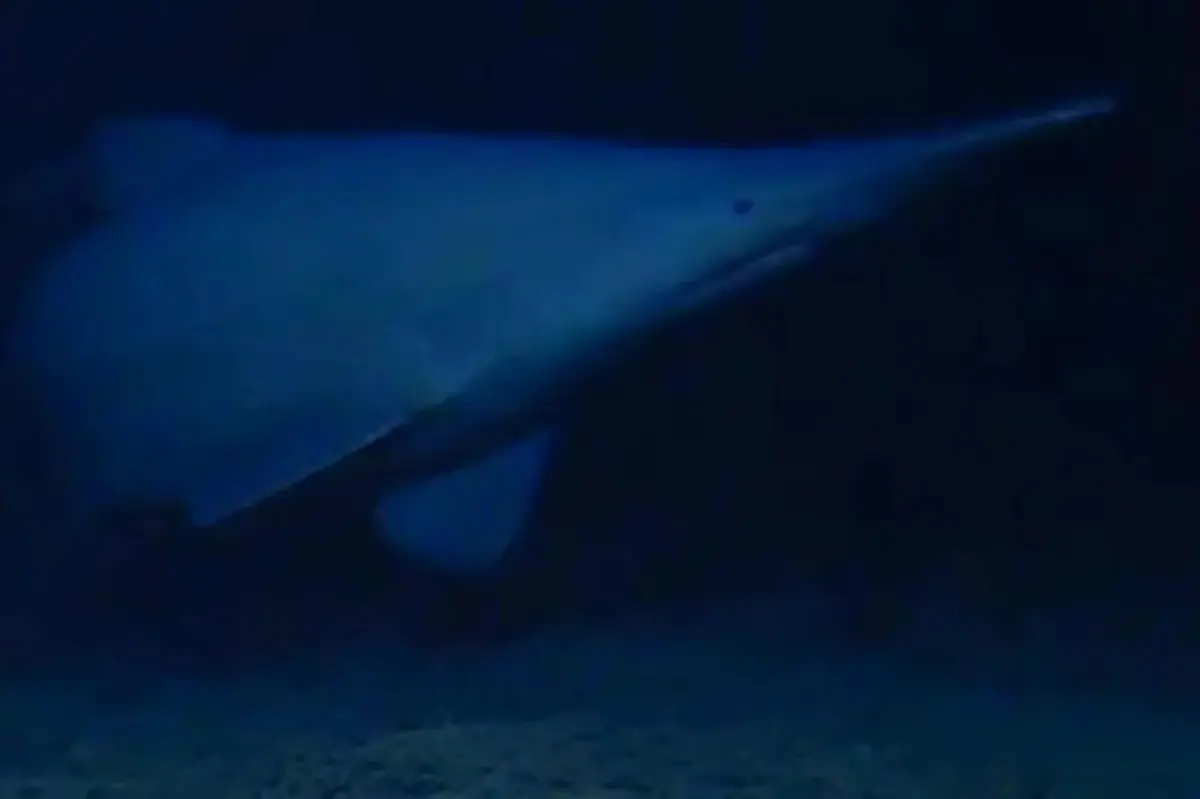
Deep within the lightless, crushing depths of our planet’s oceans lies a realm of perpetual midnight—a vast, silent wilderness where surface worries vanish and life adapts to the most hostile pressures imaginable. It is in this alien landscape that one of the sea’s most mythical and elusive inhabitants has quietly survived, largely untouched by the passage of millions of years. For well over a century, the goblin shark (Mitsukurina owstoni) remained a ghost of the deep, a creature shrouded in myth and known to humanity almost exclusively through tragic, decaying specimens accidentally dragged to the surface by commercial fishing trawlers. First discovered by Japanese fishermen more than a hundred years ago and named Tenguzame after a mythical long-nosed goblin, these brief, lifeless encounters painted a picture of a bizarre, monstrous aberration, leaving marine biologists to wonder if they would ever have the privilege of witnessing this magnificent animal behaving naturally in its true, undisturbed home. That agonizing wait finally came to an end in 2024, when an international team of scientists, deploying a state-of-the-art remote baited camera system into the ink-black depths of the South Pacific’s Tonga Trench, captured the first-ever high-definition footage of a living goblin shark swimming freely. Gliding effortlessly through the freezing water with an eerie, quiet grace, this healthy predator shattered our historical assumptions, offering humanity an unprecedented, breathtaking glimpse into a hidden world that has existed parallel to ours since the dawn of time, proving that even in the darkest corners of the Earth, life finds a way to flourish in magnificent silence.
The emotional resonance of this discovery sent shockwaves through the global scientific community, igniting a wave of profound wonder and humility among researchers who have dedicated their lives to studying the ocean’s darkest corners. Alan Jamieson, a renowned marine biologist and the visionary director of the Minderoo-UWA Deep-Sea Research Center, openly shared his awe, admitting that the goblin shark was one of those legendary, charismatic deep-sea species he never truly expected to see alive in its natural habitat during his career. The thrill of the Tonga Trench sighting was quickly multiplied when researchers, cross-referencing global expedition logs, realized that a parallel miracle had been sitting quietly in the archives of another vessel. In 2019, the celebrated underwater research vessel M/V Nautilus, operating thousands of miles away near Jarvis Island and the Palmyra Atoll in the central Pacific under the stewardship of the Ocean Exploration Trust, had unknowingly recorded a pristine goblin shark cruising near the seafloor. For years, this footage had remained unidentified, a sleeping treasure waiting for the right eyes to connect the dots. When Aaron Judah, an oceanography researcher at the University of Hawaii, and his colleagues synchronized these independent discoveries, the realization was overwhelming: humanity had not just gotten lucky once, but had twice breached the veil protecting this ancient species, showing that the pursuit of scientific truth is often a grand, collective jigsaw puzzle where breakthroughs are shared across years, cultures, and vast oceans.
Beyond the purely emotional and visual triumph of seeing this creature alive, the dual discoveries completely revolutionized our scientific understanding of the goblin shark’s geographical boundaries and physiological limitations. The 2019 footage from the central Pacific effectively blew open the map of where these predators are capable of roaming, proving that their territory is vastly larger, more diverse, and more interconnected than previously believed. Meanwhile, the 2024 encounter in the dramatic descent of the Tonga Trench did something even more staggering: it completely shattered the species’ known depth limits. The shark was observed prowling at a depth nearly 700 meters deeper than any goblin shark had ever been documented before, surpassing the previous record by a jaw-dropping 108 meters. To put this in perspective, at these extreme depths, the hydrostatic pressure is immense enough to crush human bone instantly, yet this resilient shark navigated the lightless slope with the ease of a creature perfectly at peace with its hostile surroundings. This revelation forces marine scientists to completely reconsider the physiological adaptations of deep-sea megafauna, demonstrating that these animals possess an extraordinary resilience to pressure, temperature, and resource scarcity that we are only beginning to comprehend, rewriting biology textbooks in real-time.
To look upon a goblin shark is to gaze directly into the deep, primordial history of our planet, as this bizarre predator is a living fossil in the truest sense of the term. Averaging approximately 12 feet in length, the shark possesses an anatomy that seems more akin to science fiction than Earthly biology: a soft, flabby, almost gelatinous pinkish-translucent body, a flattened, highly sensitive paddle-like snout, and a pale complexion that glows faintly under the artificial lights of scientific submersibles. It stands proudly as the sole surviving member of a specialized evolutionary family lineage, the Mitsukurinidae, that dates back an astonishing 125 million years to the Cretaceous period, having quietly survived the cataclysmic mass extinction event that wiped out the terrestrial dinosaurs. The shark’s most mesmerizing and terrifying feature is its highly specialized jaw mechanism; packed with rows of slender, razor-sharp teeth, its jaws are loosely anchored to its skull and can rapidly catapult forward like a mechanical trap to snatch unsuspecting prey out of the dark water in a split second. The massive snout above these jaws, known as the rostrum, is heavily embedded with specialized sensory pores called the ampullae of Lorenzini, which act as a biological metal detector, allowing the shark to sense the faint electromagnetic fields emitted by nearby organisms in a pitch-black world where eyesight is virtually useless.
The practical implications of these discoveries extend far beyond academic curiosity and spectacular video footage, providing crucial tools for global conservation efforts and critical environmental policy-making. Historically, because goblin sharks were only documented as accidental bycatch in commercial deep-sea fishing nets, they existed in a legislative and ecological vacuum, often omitted from environmental protection strategies because they were deemed too rare or too mysterious to study. Environmental agencies and wildlife management groups found it nearly impossible to advocate for the protection of a species whose living habitat, population density, and exact geographic range were completely unknown to science. Now, armed with undeniable photographic and video evidence of the shark’s active presence in pristine marine ecosystems like the Tonga Trench, researchers can finally add this magnificent predator to regional biodiversity registries and comprehensive wildlife management plans. By establishing that the goblin shark actively utilizes these specific deep-sea zones, scientists can work alongside international policymakers to design targeted marine protected areas (MPAs) that shield these vulnerable, slow-growing creatures from the destructive impacts of deep-sea mining and industrial bottom-trawling, ensuring their uninterrupted survival for generations to come.
Ultimately, the story of the goblin shark’s sudden emergence from the shadows is a humbling reminder of how little we truly know about the vast, watery planet we call home. As Aaron Judah beautifully noted, these discoveries highlight the immense, uncharted frontiers that quiet beneath our oceans, emphasizing the profound truth that there is still so much left to explore, study, and protect in our deep ocean home. Human beings have spent trillions of dollars looking up at the stars, mapping the cold topography of Mars and tracing the orbits of distant galaxies, yet we have barely begun to scratch the surface of our own deep-sea backyard, which contains some of the most complex, beautiful, and resilient ecosystems in the universe. The living goblin shark—gliding through the eternal darkness of the Tonga Trench just as its ancestors did millions of years ago—serves as a poetic symbol of the earth’s enduring mystery. It challenges us to look downward with the same sense of awe, reverence, and curiosity that we reserve for the cosmos, reminding us that we share this fragile blue world with ancient, silent neighbors who deserve our protection, our respect, and our endless wonder.