


Yaroslav Vishnevski’s journey began far from the quiet, rural landscapes of Harrisburg, Illinois, where his American dream would eventually unravel in a high-stakes federal court case. Born in Ukraine, Vishnevski immigrated to the United States when he was just seven years old, carrying with him the aspirations of countless young immigrants seeking a life of purpose and opportunity. For a long time, he seemed to be fulfilling that promise with remarkable success. He not only secured his U.S. citizenship but went on to complete officer training for the United States Air Force and enrolled at the prestigious Saint Louis University School of Medicine. Under military orders, his plan was to serve his adopted country as an Air Force physician after graduation. However, somewhere along the way, his life took a hard detour; he left his medical studies early, transitioned to the Individual Ready Reserve, and quietly began retreating into a private world of high-tech digital fabrication and unregulated firearms development.
The chain of events that would shatter this accomplished facade began on April 22, 2024, when U.S. Customs and Border Protection officers intercepted an seemingly ordinary package originating from China. Addressed to Vishnevski’s southern Illinois home, the parcel was flagged when inspectors discovered two illicit firearm silencers hidden inside. This discovery set a coordinated federal and state sting operation into motion. On May 2, 2024, an undercover agent with the Illinois State Police quietly walked onto Vishnevski’s front porch to deliver the decoy package as SWAT teams and investigators watched from hidden vantage points. Vishnevski brought the package inside, seemingly unaware that his home was surrounded, and left the residence shortly after. The moment he drove away, marked police cruisers executed a sudden traffic stop to detain him safely, while a tactical SWAT team breached his front door to execute a federal search warrant.
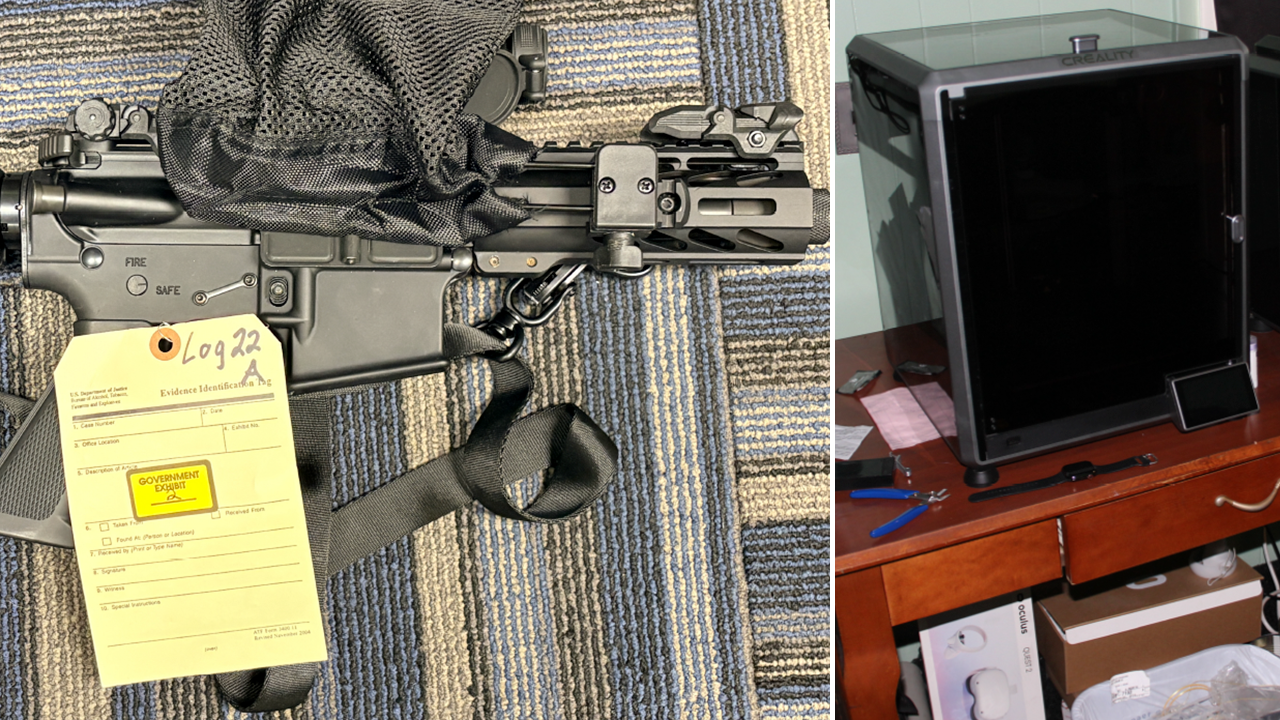
What investigators discovered inside Vishnevski’s house and an adjacent camper was not just a collection of illegal components, but a highly active, cutting-edge digital gun-manufacturing lab. Amid his personal belongings, law enforcement seized three high-powered 3D printers alongside a “Ghost Gunner” desktop CNC machine—a computer-controlled milling tool notorious for its ability to carve out untraceable, “80 percent” firearm receivers from blocks of bare metal. The search uncovered an alarming inventory of 3D-printed silencers, privately printed firearm frames, and unregistered, short-barreled weapons that completely lacked serial numbers. Among the seized weapons was an Atlas Arms 12-gauge short-barreled shotgun with its serial number deliberately obliterated, and a Glock 19X pistol heavily modified with an aftermarket stock and a vertical foregrip, converting it into a highly illegal personal defense weapon style firearm.
This high-tech home workshop quickly led to a federal indictment and a subsequent trial, where a jury found the 33-year-old guilty on five distinct counts. These convictions included the unlawful receipt or possession of unregistered short-barreled rifles, shotguns, and silencers, as well as the manufacturing of National Firearms Act weapons without paying the necessary special occupancy taxes. After the verdict, U.S. Attorney Steven D. Weinhoeft acknowledged the delicate constitutional tightrope that federal prosecutors must walk in an era where firearms can be downloaded and printed at the click of a button. Weinhoeft emphasized that while the Department of Justice staunchly defends the Second Amendment rights of law-abiding American citizens, there is a clear, dangerous line crossed when individuals begin manufacturing untraceable “ghost guns,” illegal military-grade silencers, and modified short-barreled shotguns without government oversight or registration.
Beneath the complex legal charges lies a deeply unsettling human story of paranoia and geopolitical identity. Following his arrest, Vishnevski opened up to local media, revealing that he had long felt he was under government surveillance because of his Ukrainian heritage. With the ongoing, intense geopolitical conflict in his birthplace, Vishnevski believed his background made him an automatic target of suspicion. He recounted a chilling post-arrest interrogation by an agent from the Department of Homeland Security, who bypassed the technical details of his 3D printers to ask probing questions about his personal views on Ukraine and his ongoing associations with Ukrainian citizens. This line of questioning left the former Air Force officer candidate feeling as though his identity, rather than just his manufacturing hobbies, was being put on trial in the country he had once sworn to defend.
Ultimately, Yaroslav Vishnevski’s conviction highlights a modern, tragic intersection of advanced DIY manufacturing, national security anxieties, and personal isolation. What might have begun as a highly intelligent man’s obsessive technical hobby rapidly spiraled into a serious federal crime, bringing a crushing end to a once-promising military and medical career. His case serves as a stark reminder of how easily the boundaries of the digital world can collide with the physical weight of national gun laws. As Vishnevski awaits his sentencing, his story stands as a cautionary tale of the thin line between technological curiosity and criminal enterprise in an increasingly monitored and safety-conscious society.