


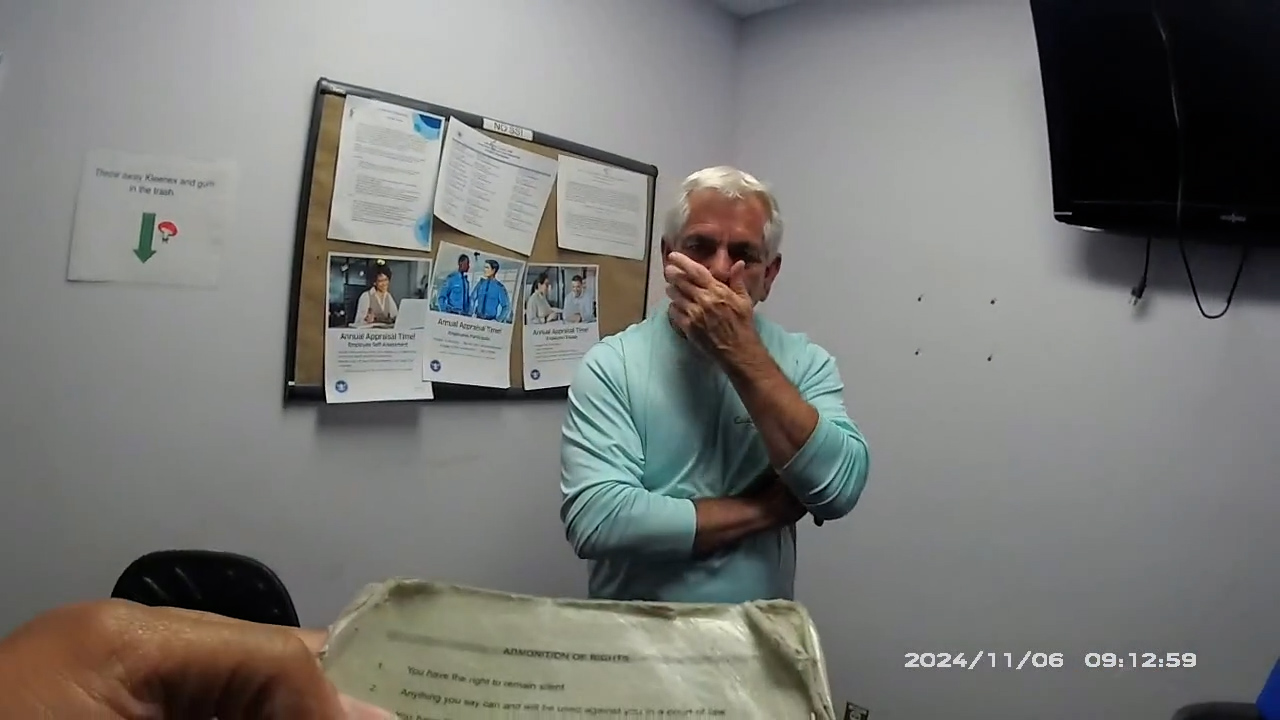
The thin line between an understandable human mistake and a severe security threat is often drawn by the badge a person carries, a stark reality that has plunged Pima County, Arizona, into a passionate debate over justice and accountability. Newly released security and bodycam footage, obtained through public records requests, has thrust Pima County Sheriff Chris Nanos into a harsh spotlight. The video captures the moments leading up to a tense encounter in November 2024, when Nanos was stopped at a Tucson International Airport security checkpoint with an undeclared, fully loaded handgun in his carry-on bag. While active-duty law enforcement officers are typically permitted to travel armed under strict federal guidelines, they must notify their airlines well in advance. Sheriff Nanos had done no such thing, presenting a critical safety hazard as he prepared to board a flight to Laguna Beach, California. A vigilant TSA X-ray technician flagged the bag, leading airport police to discover five live rounds of ammunition in the magazine and another resting in the chamber. For an ordinary citizen, bringing a loaded, chambered firearm into a secure terminal is a life-altering mistake, usually resulting in heavy civil fines, immediate handcuffs, and criminal charges. Yet for the Sheriff, the resolution of this major security breach took a remarkably different, vastly more comfortable path, sparking widespread public outrage and raising painful questions about institutional privilege.
To watch the bodycam footage is to witness an extraordinary display of professional courtesy that feels entirely foreign to the average American traveler. Standing before airport police officers, a visibly stressed Sheriff Nanos explained that his potentially catastrophic oversight was born from a sleepless, high-pressure night spent at a local hotel following a hectic election day. Anxious about leaving his department-issued service weapon in his truck with the hotel’s valet parkers, Nanos decided to slip the loaded pistol into his personal travel bag for safekeeping. When morning arrived in a blur of fatigue and panic, he and his companion rushed to the airport, and Nanos threw the rest of his belongings into the same bag without thinking. “Got up this morning in a rush, we were late, and just threw everything in,” Nanos pleaded on the recording. Although the responding airport officer duty-boundly read the Sheriff his Miranda warnings, the underlying tone of the interaction remained incredibly amicable. Rather than placing Nanos under arrest, the officers allowed him to simply walk back out of the terminal to store the lethal weapon in his private vehicle, with one officer politely bidding him, “You are free to go, good sir—have a wonderful vacation.” This friendly dismissal has fueled deep resentment among local advocates, such as Cory Stephens, president of the Conservative Coalition of America. Stephens pointed out to the county board of supervisors that any private citizen subjected to the same scenario would have faced devastating legal consequences, illustrating a double standard where those in power are escorted to their flights with a smile, while everyday people bear the full, unyielding weight of the law.
This festering frustration over unequal treatment under the law has only been magnified by a heavy-handed police crackdown unfolding just down the road, in a neighborhood haunted by a devastating real-world tragedy. The target of this intense police action is the quietly manicured street where 84-year-old Nancy Guthrie, the beloved mother of NBC’s “Today” co-host Savannah Guthrie, was mysteriously and shockingly abducted. The active-duty search for Nancy Guthrie remains one of the state’s most painful and high-profile unsolved mysteries, carrying a staggering combined reward of more than $1.2 million for any information that might finally crack the case. In the agonizing months since her disappearance, this quiet suburban sanctuary has been fundamentally transformed into a breeding ground for true-crime tourism. Captivated by the high-stakes mystery and the massive financial reward, a wave of digital sleuths, freelance journalists, and livestreamers have descended upon the neighborhood, turning the quiet streets into an interactive, 24-hour broadcast station. What these content creators view as public interest journalism and an effort to keep a cold case alive, however, has felt to the actual residents like an invasive, relentless circus that robs them of their privacy, their safety, and their ability to grieve and heal in peace.
The boiling point in this neighborhood tension arrived when Pima County deputies arrested three prominent internet streamers—Alex Zabel, who broadcasts under the moniker “Criminal Network”; Troy Bradshaw, known to his followers as “DAA JUICE”; and Damian Enderle, who runs the “857 Tucson” YouTube channel. Charged with misdemeanor public nuisance violations, with Zabel facing additional charges of obstructing the roadway, the creators found themselves behind bars, sparking intense First Amendment concerns across the digital landscape. From his perspective, Enderle publicly lashed out on social media, accusing Sheriff Nanos of weaponizing his department to wage a personal vendetta against independent journalists who dare to investigate the unsolved Guthrie kidnapping. Enderle pointed out the painful irony of the situation, arguing that less than a mile south, in areas actively patrolled by the Sheriff’s Department, local communities are left to struggle with open-air drug markets and homeless crises, while deputies instead focus their immense resources on jailing streamers. To these content creators, the arrests represent a dangerous government overreach designed to silence public scrutiny and hide the department’s inability to solve Nancy Guthrie’s abduction. They view their cameras not as weapons of harassment, but as essential tools of public accountability pointing directly at a powerful institution.
However, the Pima County Sheriff’s Department presents a vastly different, more exhausting picture of life on the ground for the residents living in the shadow of this tragedy. According to a department spokesperson, deputies were inundating with distressed calls from neighbors reporting blocked driveways, trespassing on private yards, and constant, aggressive disruptions. The tipping point for Sheriff Nanos came when video evidence surfaced showing one of the arrested streamers publicly urinating behind a makeshift tent erected near the crime scene. Stating that he would no longer tolerate behavior that degrades the quality of life or violates the safety of the community, Nanos ordered a zero-tolerance policy, directing his deputies to transition from gentle warnings to immediate arrests for anyone caught disrupting the peace a second time. This strict approach has received strong support from local leaders, including Pima County Board of Supervisors member Dr. Matt Heinz, who emphasized that while the misdemeanor charges might face challenges in a courtroom, the long-suffering neighbors deserve some semblance of peace. The neighborhood has been under a strict media parking ban since late February, a desperate measure implemented after dozens of large satellite trucks and news crews monopolized the block for weeks, leaving local families feeling trapped in their own homes.
Ultimately, these parallel controversies—a powerful sheriff who walked away from a serious airport firearm violation with a polite wave, and a group of online sleuths thrown in jail for crossing a community’s physical boundaries—expose the complicated heart of modern law, media representation, and equal justice. At the center of this storm remains the quiet, unresolved absence of Nancy Guthrie, an elderly mother whose family and community are left waiting in agonizing suspense for answers that may never come. As the Pima County Attorney’s Office declines to comment due to ongoing litigation, the residents of Tucson are left to navigate a world where a loaded gun at a TSA gate is dismissed as a simple misunderstanding for those who wear the badge, while stepping onto a public street to record a cold case can land a citizen in a jail cell. The ultimate hope remains that the spotlight will return to where it belongs: finding Nancy Guthrie. Her family continues to plead for help, urging anyone with any sliver of information to bypass the digital spectacle and contact the FBI at 1-800-CALL-FBI or submit anonymous tips to Tucson’s 88-Crime hotline at 1-520-882-7463, desperately searching for justice in a community fractured by division.