

The neon glow of Madison Square Garden has long served as the beating heart of New York City’s sports culture, a sanctuary where thousands gather to deposit their hopes, frustrations, and collective dreams onto a hardwood court. On this particular Friday night, that heart beat with a frantic, euphoric rhythm as the New York Knicks clinched a grueling, nail-biting victory over the San Antonio Spurs in Game 2 of the final stretch. As the final buzzer sounded, the legendary arena seemed to exhale a massive, roaring sigh of relief, disgorging a tidal wave of ecstatic, blue-and-orange-clad revelers into the cool night air of Midtown Manhattan. For a few fleeting moments, the streets belonged to the people; it was an atmosphere of pure, unadulterated joy where strangers embraced, historic chants echoed off the towering skyscrapers, and the shared triumph of a sporting victory temporarily erased the grueling anxieties of daily metropolitan life. Yet, in a city of over eight million souls, the boundary separating collective ecstasy from volatile civil disorder is razor-thin. As the celebratory tide surged onto Seventh Avenue, the sheer density of the crowd began to challenge the boundaries of public safety. Some fans, swept up in the intoxicating rush of adrenaline, climbed traffic poles and blocked gridlocked vehicles, turning the asphalt into an impromptu dance floor. In response, a massive contingent of the New York Police Department descended upon the scene, their flashing red and blue lights slicing through the warm night, signaling a swift and jarring shift from communal celebration to authoritarian control. It was in this hyper-charged, volatile environment that a single, devastating moment of physical confrontation would occur, forever tarnishing what should have been a night of pure, unmarred civic pride for one young fan and the shocked onlookers who witnessed his arrest.
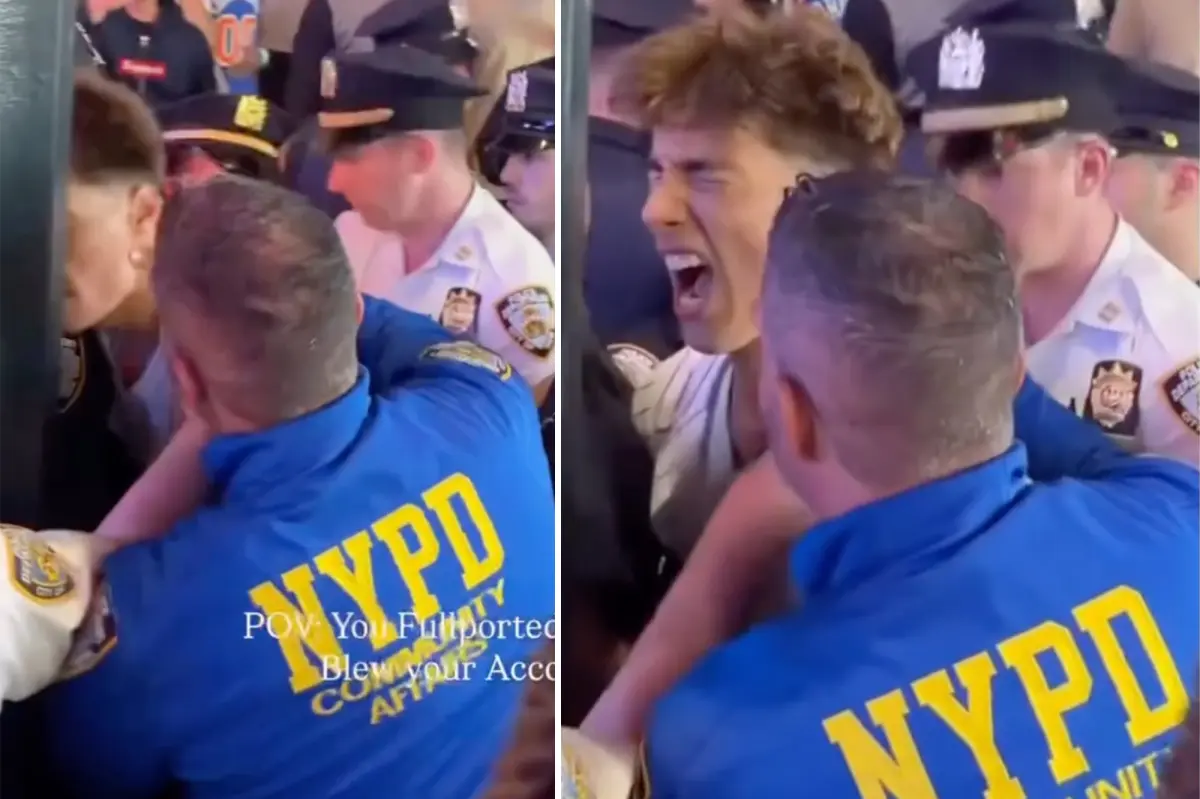
Amidst the swirling sea of flashing lights and shouted commands, the focus of the night violently shifted toward a young, baby-faced Knicks fan who suddenly found himself the target of a heavy-handed police arrest. As several officers, including a captain, swarmed the young man to pin his arms behind his back, he appeared to offer no visible resistance, standing somewhat stunned and subdued as the mechanical click of handcuffs sealed his fate. But before the arrest could be completed quietly, a Community Affairs officer—identifiable by his assignment but behaving with startling aggression—stepped into the fray. With a sudden, shocking burst of force, the officer lunged forward, grabbed the young man by his neck, and brutally slammed his face directly into a solid, forest-green metal utility pole standing on the sidewalk. The impact was sickeningly audible even over the surrounding din, sending a collective shockwave of disbelief through the crowd of bystanders who had gathered to watch the unfolding scene. The young man’s face twisted in an expression of sheer agony as his cheek and jaw collided with the cold iron, his body momentarily buckling under the weight of the assault. The sheer asymmetry of the interaction—a defenseless adolescent with his hands securely bound, subjected to a sudden, highly dangerous localized neck grab and head strike by an officer whose literal mandate is to foster positive community relations—stunned the crowd into an immediate, furious uproar. The raw vulnerability of the fan, juxtaposed against the clinical, indifferent brutality of the officer, instantly transformed the onlookers from jubilant sports fans into horrified witnesses of an apparent abuse of authority.
The horrifying moment might have dissolved into the ether of New York’s chaotic history were it not for the ubiquitous presence of smartphones, which served as digital eyes recording the entire transactional violence of the encounter. Caught on a searing 17-second video clip that was subsequently obtained and uploaded to social media by the accountability platform mrcheckpoint_, the footage quickly went viral, racking up nearly a million views within hours and igniting a firestorm of public outrage. In the video, the immediate aftermath of the face-slam is captured with tragic clarity: the young man winces in deep, palpable pain while the surrounding crowd erupts in a chorus of fierce jeers, boos, and cries of sheer disbelief. “What the f–k! Yo, what the f–k!” shouts an invisible witness, their voice cracking with a mixture of terror and anger that perfectly mirrored the collective trauma of the spectators. This short, digital window into the arrest offered no context of what transpired before or after the camera started rolling, yet the sheer physical mechanics of the officer’s actions speak a universal language of excessive force that transcends the need for background explanation. When contacted by various media outlets seeking clarification, justification, or an explanation of the protocols that would permit a Community Affairs officer to use a permanent iron fixture as a weapon against a restrained suspect, the NYPD maintained a stony, defensive silence, declining to issue any immediate comment. This lack of transparency only served to deepen the public’s frustration, highlighting a familiar and painful disconnect between a community crying out for accountability and a department shielding itself behind a wall of bureaucratic silence.
The arresting officers were operating within a broader, highly volatile theater of operation that night, as the sheer scale of the post-game chaos tested the limits of the city’s crowd-control strategies. Thousands of revelers, drunk on victory and adrenaline, had turned the streets surrounding Madison Square Garden into an unpredictable gauntlet, resulting in several arrests and confrontations throughout the evening. Some individuals crossed the line from rowdy celebration to outright hostility; most notably, a female fan named Karley Reyes was arrested after she allegedly took her aggression to extreme lengths, reportedly punching one police officer and biting another during the height of the street-level madness. These acts of direct violence against law enforcement undoubtedly heightened the anxiety and defensive posture of the officers on duty, creating a high-pressure pressure cooker where every interaction was treated as a potential threat. Yet, the existence of genuine bad actors within the crowd cannot justify a blanket abandonment of professional restraint, nor does it excuse the targeted, physical punishment of a non-resisting individual. The tragic irony of the evening lay in how easily the actions of a few combative citizens and a few overly aggressive officers managed to dismantle the shared joy of thousands of peaceful fans. What was supposed to be a historic celebration of athletic excellence and civic unity instead degenerated into a stark, fractured display of urban friction, leaving the community to grapple with the painful reality that, in the eyes of the system, a night of triumph can instantly devolve into a battlefield of control and subjugation.
To truly humanize this incident requires looking beyond the viral, fifteen-second spectacles of violence and considering the profound psychological toll these encounters levy on both the victims and the communities that witness them. When an officer wearing a “Community Affairs” patch—a designation explicitly created to build trust, de-escalate tensions, and foster a human connection between the police and the neighborhoods they serve—resorts to slamming a restrained teenager’s face into a metal pole, the systemic damage is immeasurable. It shatters the fragile illusion of safety, reinforcing a deep-seated belief among young people of color and working-class sports fans that the police are not a protective shield, but an occupying force capable of arbitrary violence. The young man at the center of this storm was not merely a suspect; he was someone’s son, someone’s friend, a passionate fan who had likely spent the evening cheering alongside thousands of others, only to end his night bleeding on a Manhattan sidewalk, his trust in authority violently stripped away in an instant. The physical wounds—the bruising, the potential concussion, the dental damage from hitting a solid iron pole—will eventually heal, but the psychological scars of being violently subjugated while completely defenseless are far more permanent. This incident illustrates a recurring tragedy in urban policing: the transition from protector to aggressor is often instantaneous, leaving ordinary citizens to navigate a public square where a moment of innocent celebration can, without warning, morph into a life-altering trauma.
The ripples of that Friday night’s violence and the subsequent crackdown quickly altered the landscape of the Knicks’ historic playoff run, casting a long, somber shadow over what should have been an ongoing celebration. The palpable tension surrounding Madison Square Garden only intensified in the days that followed, culminating in the abrupt, disappointing cancellation of a scheduled outdoor watch party for Game 3 on Monday night. Officially, the decision to scrap the highly anticipated fan gathering was attributed to the imposition of incredibly strict, airtight security protocols required for the planned attendance of Donald Trump, whose high-profile presence effectively locked down the surrounding blocks. The collision of sports culture, hyper-militarized executive security, and the raw, lingering anger from the weekend’s policing tactics created an environment too volatile for the city to manage safely, forcing organizers to shut out the very fans who give the team its soul. Ultimately, the image of a young man’s face being violently slammed into a green pole stands as a grim, haunting metaphor for the current state of public life in the city—a place where the rich, organic joy of community celebration is constantly policed, sanitized, and ultimately suppressed under the guise of security. As the Knicks played on in quieter arenas, the city was left to digest the painful truth that municipal order is too often bought at the high price of human dignity, leaving behind a trail of viral trauma, silent police departments, and a community mourning both a lost night of joy and the shattered promise of protection.