


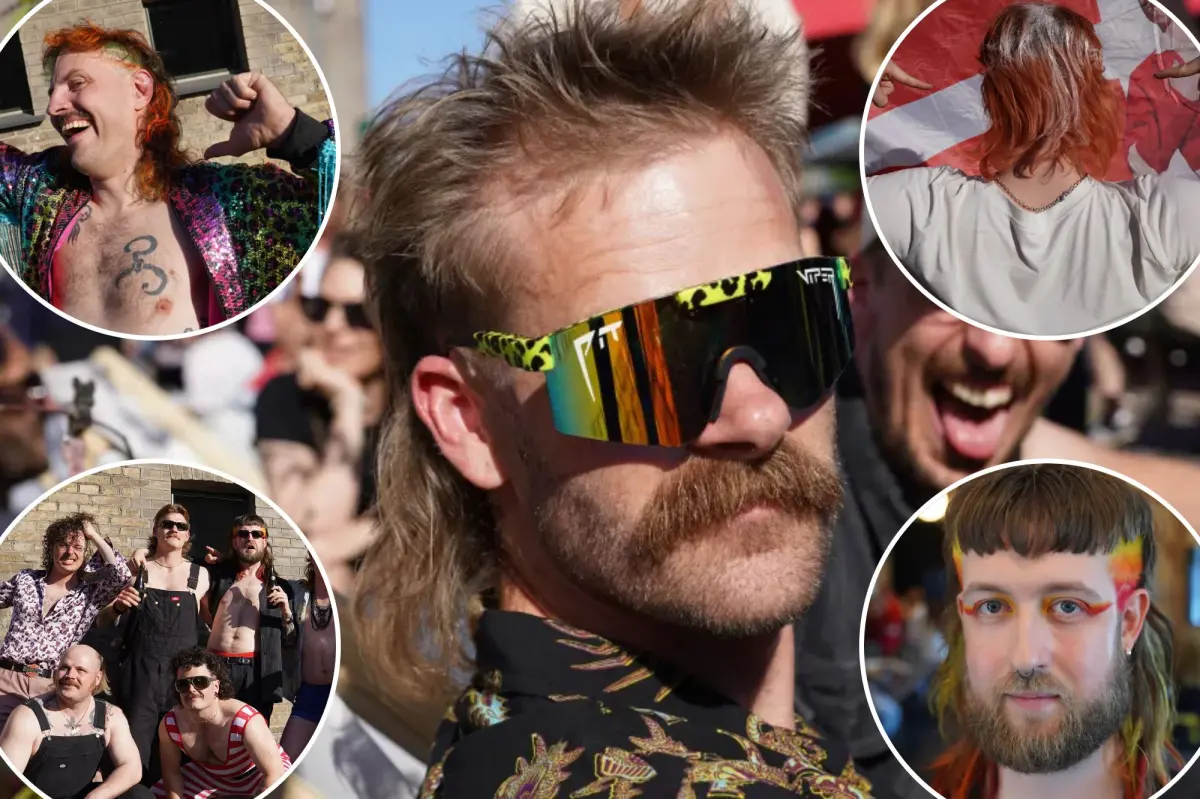
On a brisk, vibrant evening in the heart of Copenhagen, the typical Danish sensibilities of minimalist design and quiet sophistication were joyfully tossed aside in favor of a far more boisterous aesthetic. Beneath the open Nordic sky, a packed crowd of over a thousand roaring spectators gathered around a central outdoor stage to celebrate the ultimate symbol of counterculture grooming: the mullet. Often teased, frequently maligned, yet stubbornly immortal, this unique hairstyle—famously characterized by its “business in the front, party in the back” architecture—took center stage at the 2026 Danish Mullet Championship. The atmosphere was electric, thick with the scent of hairspray, cheap beer, and a shared, infectious enthusiasm for the unconventional. For one unforgettable night, twelve meticulously coiffed competitors walked, danced, and strutted onto the stage, determined to prove that their locks had the perfect balance of retro charm, sheer audacity, and structural integrity. This was not merely a hair show; it was a high-octane celebration of individuality, a communal rejection of uniform beauty standards, and a living, breathing testament to the power of not taking oneself too seriously. The crowd’s cheers echoed through the historic streets of the Danish capital, transforming a simple weekend gathering into a carnivalesque tribute to the glorious, unrefined art of the mane. It was a spectacle that bridged generational gaps, drawing in curious tourists, dedicated style purists, and families alike, all united by a mutual appreciation for a hairstyle that has defied the laws of fashion gravity for decades. As the bass lines thumped from the speakers and the stage lights caught the undulating waves of synthetic and natural hair, it became clear that this event was less about competition and more about a collective embrace of joy, humor, and the liberation that comes with letting one’s hair fly free in the wind.
The mastermind behind this hairy revolution is Steffen Stiw Weber, a warm-hearted, thirty-seven-year-old electrician whose own personal journey with the mullet began under surprisingly vulnerable circumstances. A few years ago, following a hair transplant procedure to combat thinning locks, Weber decided to celebrate his newly restored hair by growing out a classic, unapologetic mullet. Feeling a newfound sense of confidence and belonging within the global community of mullet enthusiasts, he soon sought to test his glorious mane on the international stage. However, his dreams of competing in the prestigious US Mullet Championship were abruptly cut short when he discovered that eligibility was strictly limited to United States citizens. Rather than let this administrative setback dampen his spirits or trim his locks, Weber smiled, shrugged with classic European resilience, and realized that if he could not travel to the party, he would simply have to bring the party home to Denmark. Thus, with a spark of creativity and a healthy dose of determination, he launched the Danish Mullet Championship, an event that has now flourished into its fourth consecutive year, steadily eclipsing its own previous records for attendance and sheer madness. Sitting back and reflecting on the journey, Weber’s eyes light up with a mixture of pride and amusement as he marvels at how a personal quest for self-expression blossomed into a nationwide cultural phenomenon. He views the annual gathering not just as a fun weekend activity, but as a vital space where people from all walks of life can shed their daily anxieties, ignore the rigid expectations of modern professional life, and revel in the absurd beauty of their shared passion. To Weber, every snip of the scissors and every bottle of holding gel represents a triumph of personal agency over societal conformity. He spent countless hours coordinating logistics, securing sponsors, and building a stage that could handle the high-energy performances he knew the contestants would bring to the table. His passion is infectious, and it is his welcoming, down-to-earth demeanor that sets the tone for the entire championship, ensuring that every participant, regardless of whether they have a natural mane or a carefully nurtured transplant, feels like royalty the moment they step into the spotlight.
To properly evaluate the artistic merit of these competing masterpieces, the tournament relied on a distinguished panel of judges, including Bobby Agren, a seasoned Copenhagen hair salon owner who understands the delicate balance between high fashion and lowbrow charm. Agren explained that contestants were judged not merely on the length or density of their hair, but on a complex matrix of style, originality, overall performance, and what the panel affectionately termed “mullet moves”—the physical gestures, flips, and headbongs that bring the hair to life. Each participant was granted a fleeting sixty seconds on stage to captivate the crowd and win over the judges, a minute-long window where normal social boundaries were completely suspended. Agren’s philosophy on the hairstyle is deeply human and artistic, revealing that his favorite cuts are those that possess a certain nostalgic twist, or even those that look almost ridiculous, possessing what he describes as being “ugly in a beautiful way.” This paradox lies at the very heart of the modern mullet’s appeal; it is a conscious rebellion against the sanitized, highly curated, and exhausting aesthetics that dominate our modern digital existence. In a world where social media feeds are flooded with airbrushed influencers, symmetry, and perfect, sterile filtered lifestyles, the mullet stands as a glorious, asymmetrical middle finger to perfection. It is an intentional choice to step outside the boundaries of what is conventionally considered attractive, offering instead a refreshing dose of vulnerability, humor, and raw authenticity. By wearing a hairstyle that invites both laughter and admiration, individuals find a unique way to reclaim their identity and stand out from a sea of identical, algorithm-driven trends, proving that true beauty often lies in our flaws and our willingness to laugh at ourselves. The stage served as a safe haven of self-expression, where the pressure to conform vanished beneath the collective roar of a thousand people cheering for hair that refused to behave. For Agren and his fellow judges, the scoring process was less about cold, objective metrics and more about measuring the emotional voltage each competitor could transmit to the audience, celebrating those brave souls who dared to wear their eccentricity on their sleeves—and on the backs of their necks.
This pursuit of the extraordinary manifested in a series of breathtakingly over-the-top stage routines that pushed the boundaries of performance art and left the spectators gasping for breath. The twelve contestants spared no effort to win the favor of the crowd, unleashing a cascade of theatrics that transformed the outdoor stage into a brilliant, chaotic circus. One competitor paid homage to his national pride by painstakingly styling his mullet to mimic the colors and pattern of the Dannebrog, the Danish flag, a patriotic display of hair engineering that drew massive roars of approval. Others opted for high-energy antics, including synchronized body-popping dance routines, dramatic beer-swilling sequences that sprayed golden liquid into the bright stage lights, and even a soulful, unexpected live saxophone performance that had the entire crowd swaying in romantic unison. The sheer unpredictability of each sixty-second slot kept the audience on their toes, their collective energy feeding back into the performers in a powerful symbiotic loop of cheering, chanting, and wild applause. After every routine, the judges held aloft their hand-painted scorecards, their physical marks reflecting the emotional highs and artistic lows of each presentation. It was a sensory overload of neon colors, retro denim, soaring guitar solos, and gravity-defying hair flips, turning Copenhagen’s historic district into a vibrant tapestry of pure, unadulterated human joy. The boundaries between performer and spectator dissolved entirely, creating a unified community of fun-loving rebels who found a profound sense of connection in the shared enjoyment of the bizarre, cementing the championship as an essential landmark of modern Danish counterculture. By refusing to take themselves seriously, these competitors gifted the audience a rare moment of absolute liberation, where the only rule was to let go and enjoy the ride. The air was thick with the scent of popcorn, beer, and hairspray, creating a nostalgic aroma that transported older spectators back to the relative simplicity of the late twentieth century, while introducing younger generations to the liberating power of a truly unrestrained lifestyle.
When the dust finally settled and the final scores were tallied, it was forty-three-year-old construction worker Thomas Berg who emerged victorious, capturing the coveted title and the hearts of the judges and crowd alike. Berg’s performance was a masterclass in high-octane enthusiasm and retro showmanship, featuring him frantically bounding on a trampoline in a blur of motion, dressed from head to toe in eye-watering, neon green vintage gym gear. He framed his winning mullet with a stark, bright orange athletic headband, a color combination that was as loud as it was nostalgically endearing. Speaking with a beaming, sweat-glistened smile after rightfully collecting his trophy, Berg epitomized the humble, fun-loving spirit of the entire competition, remarking simply that the event was just a massive, beautiful party where he could step completely “outside the box.” For a hard-working construction professional accustomed to the physical rigors, safety coordinates, and strict daily structures of the building industry, the stage offered a rare, golden opportunity to unleash his inner wild child. His victory was not just a win for his hair, but a triumph for every everyday worker who harbors a secret desire to break free from the monotony of the weekly grind and embrace their most colorful, expressive selves. Berg’s genuine happiness was palpable as he embraced his fellow competitors, demonstrating a profound sense of camaraderie that defined the evening; there was no bitter rivalry here, only a shared, joyful conspiracy to make the world a slightly weirder, happier place for a weekend. His family and friends cheered from the front row, throwing their arms around the newly crowned king of the Danish mullet scene, showcasing the deep, personal support networks that underpin this vibrant, quirky subculture. Berg’s triumph served as a powerful reminder that life is far too short to be spent entirely within the confines of societal expectations, and that sometimes, the best way to find yourself is to jump on a trampoline in neon clothes with a glorious crown of long, flowing hair trailing behind you.
While the mullet might seem like a contemporary gag, its historical roots run incredibly deep, tracing a fascinating lineage through global pop culture and the cyclical corridors of fashion history. Though people have undoubtedly worn their hair short in the front and long in the back for centuries, the Oxford English Dictionary officially attributes the popularization of the term “mullet” to the hip-hop legends Beastie Boys, who immortalized the phrase in their 1994 track “Mullet Head” from their iconic Ill Communication album. The style enjoyed a golden era of mainstream dominance in the 1980s, championed by gritty ice hockey players and flamboyant rock stars, before crashing down into decades of mockery and social exile as it was deemed “history’s most divisive hairstyle” by fashion tastemakers like Vogue. Yet, true to the circular nature of human trends, the hairstyle staged a spectacular global comeback around 2020, fueled by the isolation of COVID-19 pandemic lockdowns when closed hair salons forced bored citizens to let their locks grow wild, with British culture magazine i-D famously declaring it the official haircut of the pandemic era. Today, this resurgence has matured into a thriving international movement, with specialized championships cropping up across the globe, from the European Mullet Cup in Belgium to this weekend’s unforgettable showcase in Copenhagen. As judge Bobby Agren wisely observed, fashion moves in predictable, circular waves every few decades, but the enduring appeal of the mullet lies far beyond mere nostalgia; it represents a permanent, democratic outlet for human playfulness, rebellion, and self-love. In a modern era characterized by uncertainty and rapid change, the mullet offers a comforting, humorous constant—a reminder that no matter how serious the world becomes, we will always have the freedom to grow out our hair, act a little foolish, and celebrate the beautiful, chaotic joy of being alive.