


Rewrite the following content into a 2000-word, SEO-optimized article in English. Write it in the style of a professional journalist or news reporter. The article should be fully humanized, natural, and engaging — not robotic or repetitive.
Focus on clarity, flow, and storytelling while preserving the meaning of the original. Structure the article into 6 well-developed paragraphs with smooth transitions, strong headlines, and a professional tone. Use varied vocabulary, sentence lengths, and natural phrasing to make it read like human-written journalism.
Avoid keyword stuffing, but naturally integrate important SEO keywords throughout the article. Ensure the final article feels like it was written by a skilled reporter for a reputable news outlet.
When the military seized power in Mali in 2020, promising to tackle rampant insecurity, many in the West African country cheered.
For years, Mali had been buffeted by armed groups with links to Al Qaeda and ISIS, and many Malians felt the government and its French allies had failed to quell the violence. With the military in charge, the junta said, everything would change for the better.
Things have not turned out that way.
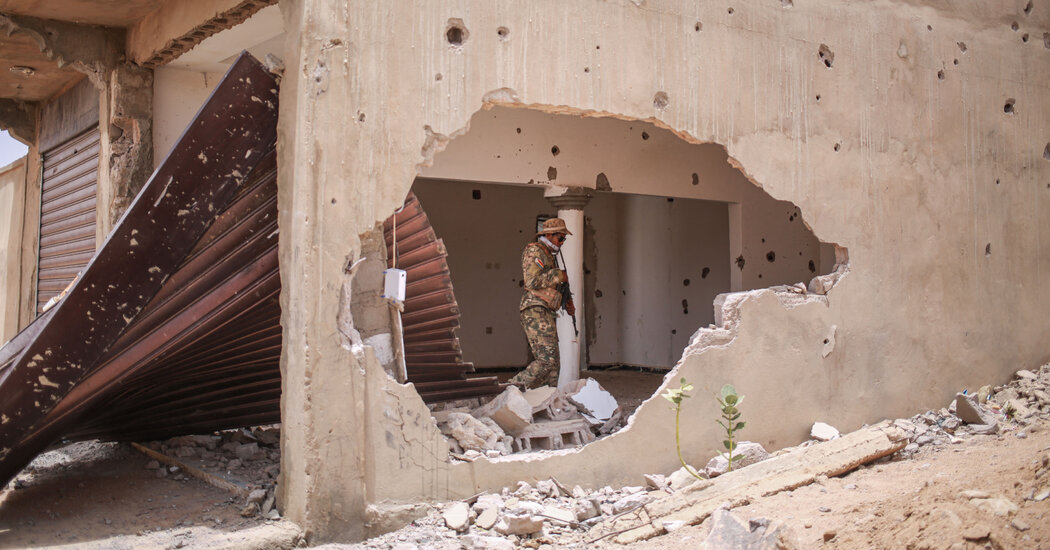
A key city in the north has fallen to a new jihadist-rebel alliance. Mali’s defense minister was recently assassinated in his home. Russian mercenaries allied with the junta were forced to retreat in battle.
These coordinated attacks have been described by experts as the most severe blow ever suffered by any Malian regime. So far, the junta and its president, Assimi Goïta, have survived, but analysts say the jihadists are more powerful and sophisticated than ever, forming alliances as they rampage across the country. Drones are increasingly being used in the conflict.
Some say the junta will soon be forced to negotiate with the insurgents, unless the it is toppled first.
“Neither of them is going to win it easily,” said Ibrahim Yahaya Ibrahim, the deputy director of the Sahel Project at the International Crisis Group. “Maybe opening channels of dialogue is the only way.”
The attacks began on April 25 when a pair of seemingly strange bedfellows came together in a formidable alliance.
On one side are the jihadists known as the Group for the Support of Islam and Muslims, or JNIM. On the other side are Tuareg rebels of the Azawad Liberation Front, or F.L.A., a separatist group fighting for independence in northern Mali.
The alliance began over a year ago when the F.L.A. agreed to accept a moderate form of Shariah law, and JNIM convinced the F.L.A. to seek autonomous rule rather than formal independence, according to Wassim Nasr, a researcher and Sahel expert.
The Tuareg rebels had formed an earlier alliance with jihadists in 2012, but it quickly fell apart when the jihadists expelled the rebels from northern territory and declared strict Shariah law, carrying out executions, amputations and floggings.
French forces intervened as the jihadists advanced on Bamako, the capital. The Tuareg rebels allied with the French. But gradually, the jihadists spread to other areas of Mali and to its neighbors in the Sahel.
When Mr. Goïta seized power, he threw out the unpopular French soldiers and replaced them with Russian mercenaries from the Wagner Group, and then from Russia’s Africa Corps. Many Malians saw the French as an unwelcome occupying force with colonial roots. But the Russians proved no better.
Russian mercenaries have carried out extensive human rights abuses against civilians, making it easier for the jihadists to recruit young men, analysts say. And the military’s embrace of the same hard-line approach as the previous government has not brought peace. Instead, the conflict has spiraled.
“We have realized that the military has no control over the territory,” said Moussa Coulibaly, a mathematics teacher in Bamako. “May God help us.”
Jihadists have nearly tripled their attacks on Mali’s towns and cities in the past five years, according to the International Crisis Group. They have waged a long campaign of economic sabotage against the junta, cutting off highways and torching fuel tankers.
And now, JNIM is once again trying to choke off Bamako, burning vehicles near the city, and residents have reported food prices rising as a result of the siege.
Normally, many Bamakois would have traveled for the Eid al-Adha holiday last week, but most were too fearful to leave, they said.
“Seeing terrorists in Bamako is very shocking,” said a 28-year-old nurse at a hospital in the capital, which she said had received many wounded civilians after the April attacks, something she said she was forbidden from talking about. “We are very afraid.”
Both JNIM and government forces have been accused of killing scores of people in central Mali in recent weeks. The junta and its Russian allies have been accused of using cluster bombs in the north. Even die-hard supporters of the junta have started to express doubts in its strategy.
“I really believed in change and the security of our country,” said Mahamane Maiga, a butcher in Bamako whose business has been hurt by the deteriorating security situation. “They told us everything was fine. But it was all a lie.”
Shortly before the 2020 coup, Mali’s government was considering dialogue with the jihadists, according to the International Crisis Group. But the junta has resisted talks.
Agreeing to sit down with the jihadists could deal another blow to the junta’s grip on power. Central to Mr. Goïta’s popularity has been his strongman image.
“The government does not envisage any dialogue with terrorist armed groups,” Mali’s foreign minister, Abdoulaye Diop, told journalists and diplomats last month.
With no negotiations on the horizon, analysts fear the government could collapse, the jihadists could take over, or an extended standoff could lead to many more civilian deaths. Some have called on the Trump administration to bring the junta and JNIM to the table.
American officials have recently tried to reset relations with Mali and its neighbors in the Sahel, including Niger and Burkina Faso. All three nations are run by military juntas and are growing more violent, despite years of foreign intervention.
But the jihadists themselves may have already moved past the idea of talking. While JNIM’s ultimate aims are not known, two things are clear: It wants the departure of foreign forces and for Mali to adopt some form of Shariah law, perhaps applied as it is in Mauritania or Nigeria, where it coexists with secular law.
Analysts say the group has lately distanced itself from strict Shariah law and from Al Qaeda, to which it pledged allegiance in 2017.
Though JNIM is clearly seeking greater legitimacy and political influence — perhaps looking to Syria as a possible model — it may try to defeat the current regime and negotiate with more amenable leaders, said Corinne Dufka, an independent analyst on the Sahel.
“I do not see a possibility for a military solution to this,” she added.
Meanwhile, the reality of the junta’s military failures is becoming increasingly difficult to conceal. The government’s campaign to stifle dissent, including banning media outlets, has made the true death toll from April 25 attacks impossible to quantify.
But the attacks themselves were a powerful warning, even for the junta’s most loyal supporters. Many are losing faith in the government’s Russian allies, too.
“I always supported Russia’s arrival,” said Amadou Sidibe, a Bamako trader. “I had high hopes that it would bring peace to our country, but as we know today, it’s a complete failure.”