



Shadows Over the Capital: Fresh Clashes in Mogadishu Expose Somalia’s Fractured Security Landscape
The Crucible of Fire: How a Quiet Morning in Mogadishu Shattered into Conflict
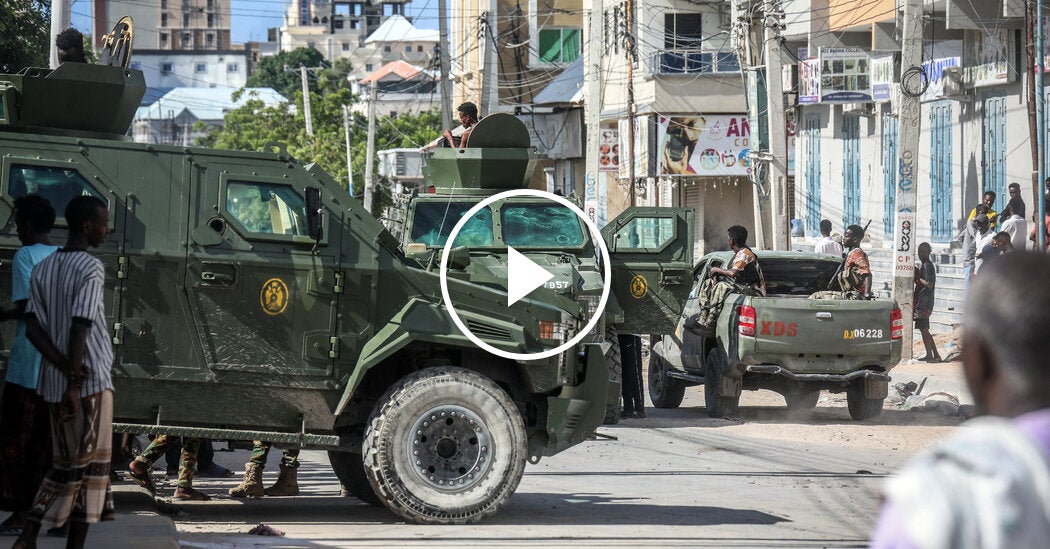
The fragile peace of Somalia’s historic capital was abruptly shattered on Thursday, June 4, 2026, as Mogadishu once again found itself transformed into an active theater of urban warfare. The quiet hum of morning commerce quickly dissolved into panic as heavy gunfire and the concussive, unmistakable thud of rocket-propelled grenades (RPGs) echoed across several key neighborhoods. Residents, accustomed to living on a knife-edge of security, watched as green armored military vehicles rumbled down dust-choked city streets, taking up defensive positions at major intersections. The sudden eruptive violence turned ordinary thoroughfares into active battle lines, forcing shopkeepers to hastily pull down metal shutters and merchants to abandon their open-air stalls. For hours, the city’s skyline was marred by plumes of dark smoke, a grim testament to the high-stakes tactical engagements unfolding between government security forces and various heavily armed militia groups. As the firefights intensified, the auditory backdrop of the capital became a chaotic symphony of light machine-gun fire, distant explosions, and the frantic shouts of civilians seeking immediate refuge. The immediacy of the danger prompted a spontaneous, desperate exodus from the affected districts, with families clutching whatever meager possessions they could carry as they fled the encroaching crossfire. Because the situation remained highly fluid and unstable throughout the afternoon, official channels were unable to provide immediate casualty counts, leaving anxious residents and international observers to fear the worst about the human cost of this sudden destabilization.
                              MOGADISHU SECURITY SECTORS

              [ Hodan District ]                      [ Warta Nabadda ]
          ========================                 ========================
          - High-density residential               - Near Villa Somalia (Palace)
          - Initial flashpoint of firefight        - Government troop reinforcement
          - Civilian exodus path                   - Mortar containment zone
                                                            /
                                                           /
                         v                                 v
                 ===================================================
                 [           CENTRAL TRANSIT CORRIDOR               ]
                 [ - Armored vehicle blockades                      ]
                 [ - Intense RPG & automatic weapons exchanges      ]
                 ===================================================
                                         ^
                                         |
                              [ Medina Hospital Route ]
                              - Emergency triage access
                              - Impeded by ongoing security barriers
A Fractured Frontline: The Complex Topology of Combatants in the Capital
The tactical reality on the ground highlights a deeply entrenched and highly complex security dilemma that has vexed the Somali federal government for decades. The clashes on Thursday were not characterized by a simple, binary struggle between state forces and a singular insurgent adversary; rather, they represented a volatile collision of overlapping interests involving the Somali National Army (SNA), specialized federal police units, and localized clan-based militias. In Mogadishu, the lines of authority are notoriously fluid, with local militias—often organized along deep-seated clan lineages—retaining significant stockpiles of heavy weaponry despite continuous government disarmament campaigns. These militias frequently act as neighborhood security forces or personal guards for powerful political power brokers, meaning that a minor political disagreement, a territorial dispute, or a simple checkpoint misunderstanding can rapidly spiral into a full-scale tactical engagement. The government’s elite units, trained by various international partners, faced a difficult task in navigating these densely populated urban environments, where the tactical advantage often lies with local armed groups who are intimately familiar with the labyrinthine alleyways and defensive bottlenecks of their home districts. This latest outbreak of hostilities underscores the immense difficulty the federal administration faces in establishing a true monopoly on the legitimate use of physical force in a city where weapons are plentiful, clan loyalties are fierce, and the state’s domestic authority is constantly challenged.
The Human Toll: Civilian Exodus and the Silent Tragedies of Displacement
As the physical combat unfolded along the city’s main corridors, the most devastating consequences were, as always, borne by the civilian population of Mogadishu. For the families living in the immediate vicinity of the clashes, the sound of incoming mortar fire and stray bullets penetrating thin corrugated metal roofs triggered an immediate survival instinct, forcing thousands to abandon their homes in a desperate bid for safety. Mothers carrying infants, elderly men supported by younger relatives, and children wide-eyed with fear streamed out of the contested zones, moving toward peripheral neighborhoods that were temporarily deemed safer. This sudden micro-displacement exacerbates an already dire humanitarian crisis within Somalia, where millions are already internally displaced due to a combination of persistent conflict, historic droughts, and economic stagnation. Local non-governmental organizations and community leaders expressed profound concern over the lack of immediate shelter, clean water, and medical assistance for those who fled their homes on Thursday with nothing but the clothes on their backs. The psychological scars of urban warfare run deep in Mogadishu, where multiple generations have grown up under the constant threat of sudden violence, and this latest cycle of conflict serves as a traumatic reminder of the profound instability that continues to threaten their daily lives.
                       MILITIA VS. GOVERNMENT SECURITY SPREAD

 [Somali National Army (SNA) / Danab]             [Decentralized Clan Militias]
 -------------------------------------             -----------------------------
 * Internationally trained personnel               * High familiarity with urban terrain
 * Heavy armored vehicle support                   * Entrenched in local neighborhoods
 * Centralized command structures                  * Fluid tactical maneuvers & ambushes
 * Restricted by rules of engagement               * Embedded within civilian populations
Deep Roots: The Historical Arc of Somalia’s Protracted Transition
To fully understand the significance of this latest outbreak of violence, one must view it through the lens of Somalia’s complex modern history, marked by decades of political fragmentation and the slow, arduous process of rebuilding a collapsed state. Since the fall of the central military government in 1991, the nation has struggled to establish cohesive, centralized institutions that can command the trust and loyalty of its diverse and geographically dispersed population. While the federal government has made significant strides in recent years—liberating several key agricultural towns from the iron grip of the Al-Shabaab insurgency and reforming the country’s financial systems to unlock international debt relief—the municipal security of Mogadishu remains a critical vulnerability. The capital city exists as a micro-cosmos of the country’s wider political tensions, where federal authorities, regional state leaders, and traditional clan elders are locked in a perpetual negotiation over the division of power, resources, and security responsibilities. The presence of persistent militia groups inside the capital is a direct consequence of this unresolved power-sharing equation, as various factions refuse to fully disarm until they receive ironclad guarantees regarding their political representation and physical security. Consequently, even as the federal government launches ambitious military offenses on the national stage, the capital remains susceptible to sudden inner-city convulsions that expose the fragile foundations of the Somali state’s recovery efforts.
The Global Stakes: Geopolitics, Peacekeeping, and the Horn of Africa
The stability of Mogadishu is not merely a domestic concern for the Somali people; it is a critical geopolitical anchor for the entire Horn of Africa, a region strategically positioned along some of the world’s most important maritime trade routes. The international community, led by the African Union, the United Nations, the United States, Turkey, and various European partners, has invested billions of dollars in stabilizing the country and training its domestic security forces. This investment has been driven by a shared imperative to prevent the country from reverting to a lawless haven for regional piracy and international terrorism, specifically the Al-Qaeda-aligned Al-Shabaab network. However, as the African Union Transition Mission in Somalia (ATMIS) systematically draws down its troop presence and hands over primary security responsibilities to the Somali National Army, occurrences of localized urban instability raise serious questions about the readiness of domestic forces to maintain order without international military buffers. A prolonged security vacuum or escalating factional fighting in the capital would not only jeopardize the hard-won gains of the past decade but could also destabilize neighboring East African countries, sparking renewed refugee crises and threatening the maritime security of the Red Sea and the Gulf of Aden.
                  MOGADISHU URBAN GEOPOLITICAL STAKEHOLDERS

                 +---------------------------------------+
                 |         INTERNATIONAL PARTNERS        |
                 |  - UN, EU, USA, Turkey, Gulf States   |
                 |  - Focus: Counter-terrorism & Trade   |
                 +--------------------+------------------+
                                      |
                                      | Strategic Aid & Training
                                      v
                 +---------------------------------------+
                 |       SOMALI FEDERAL GOVERNMENT       |
                 |  - Struggles for central authority    |
                 |  - Managing transition from ATMIS     |
                 +--------------------+------------------+
                                      |
                                      | Friction / Overlap
                                      v
                 +---------------------------------------+
                 |       CLAN LEADERS & LOCAL MILITIAS   |
                 |  - Deep grassroots influence          |
                 |  - Control informal security networks |
                 +---------------------------------------+
Navigating the Path to Peace: Beyond Military Solutions in Mogadishu
Ultimately, the events of Thursday prove that a purely military approach is insufficient to break the cyclic nature of violence that plagues Mogadishu. Achieving long-term stability requires a holistic, politically driven strategy that addresses the underlying drivers of conflict, including systematic clan rivalries, economic desperation, and the lack of social trust in state institutions. Comprehensive security sector reform (SSR) must be prioritized to ensure that the Somali National Army and national police forces represent all segments of the population rather than operating as extensions of specific political or clan interests. Concurrently, the federal government must initiate genuine, localized political dialogues aimed at disarming and demobilizing urban militias, offering their members viable economic alternatives and pathways to integration into formal, state-controlled security frameworks. The resilient and vibrant population of Mogadishu, which has rebuilt schools, launched innovative businesses, and revived the city’s coastal economy in the face of immense adversity, deserves a security environment that nurtures rather than destroys their efforts. Only through a sustained commitment to political inclusivity, legal accountability, and community-level reconciliation can the Somali capital hope to banish the specter of sudden violence and secure a peaceful, prosperous future for its people.