


The Caucasus Crossroads: How Armenia’s General Election Became a Geopolitical Battleground Between East and West
1. A Nation at the Precipice: Nikol Pashinyan’s Battle for Political Survival in Armenia
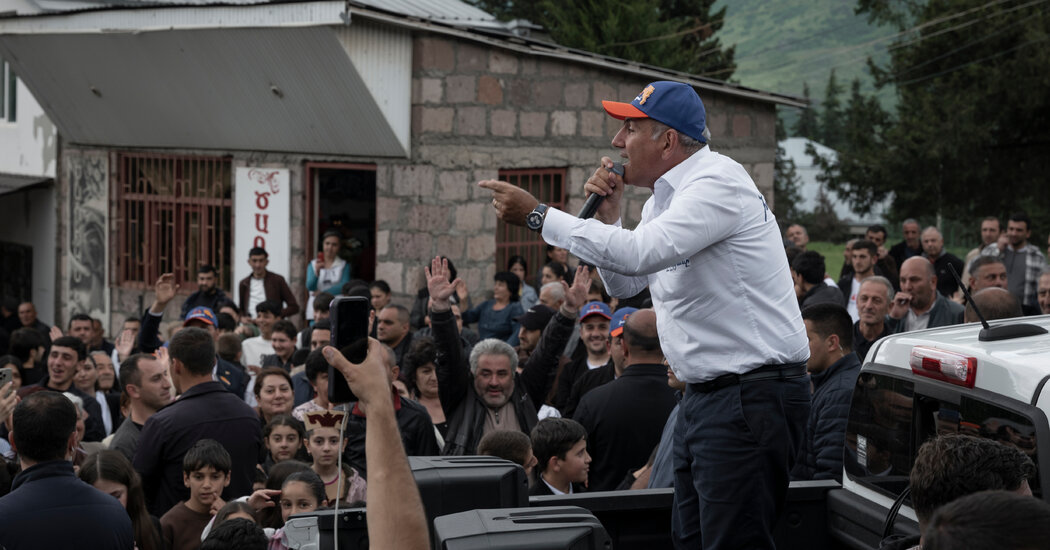
In the rugged, sun-drenched mountain villages of northern Armenia, the high-stakes drama of global geopolitics feels both impossibly distant and urgently close. Last week, in a quiet hamlet near where he spent his youth, Prime Minister Nikol Pashinyan bounded onto the flatbed of a pickup truck. Dressed in his trademark casual campaign attire, he gestured warmly to a crowd of local villagers gathered in the afternoon light. To his supporters, he remains the charismatic, populist leader who swept into power during the anti-corruption “Velvet Revolution” of 2018, promising a transparent, democratic future free from the grip of post-Soviet oligarchs. Yet, as the country prepares for a critical parliamentary election, the atmosphere on the campaign trail is far from celebratory. Pashinyan is locked in a fierce, multi-front struggle for his political survival, facing a deeply divided electorate and an opposition determined to see him ousted, prosecuted, or exiled.
                   GEOPOLITICAL PULL OF ARMENIA

      ┌─────────────────────────────────────────────────────┐
      │                                                     │
      ▼                                                     ▼
 WESTERN FLANK                                        EASTERN FLANK
[United States & EU] [Russian Federation]
• TRIPP Infrastructure • Traditional Energy Supply
• EU Summit & EU Membership • CSTO Security Alliance (Frozen)
• Trump’s Diplomatic Support • Economic & Import Restrictions
This election has transcended domestic policy to become a major proxy battle between global superpowers. On one side stands Washington, with former U.S. President Donald Trump publicly endorsing Pashinyan on his media platform, praising him as a “great friend and leader” capable of steering his nation toward safety and prosperity. On the other side stands the Kremlin. Infuriated by Pashinyan’s steady pivot toward the West, Russian President Vladimir Putin has deployed a sophisticated arsenal of economic, diplomatic, and covert pressure to undermine the Armenian leader. Domestically, the campaign has devolved into a bitter contest of mutual recrimination, with the government and its pro-Russia opponents trading accusations of treason, corruption, and financial impropriety. For Armenia—a small landlocked nation of three million people scarred by the trauma of war, displacement, and territorial loss—the upcoming vote represents a critical juncture that will define its sovereignty and foreign policy for decades to come.
Amid the geopolitical noise, Pashinyan has sought to ground his campaign in the everyday realities of the Armenian working class. From his makeshift mobile stages, he has highlighted his administration’s social reforms, pointing to the rollout of the nation’s first comprehensive state health insurance program, the construction of new provincial schools, modern day care centers, and affordable rural housing initiatives. Yet, every speech eventually returns to the central theme of his premiership: the fragile, hotly contested path to regional peace. Pashinyan has argued that his re-election is essential to preserving and implementing a preliminary peace accord with neighboring Azerbaijan. Helping broker the initial stages of this diplomatic framework during his presidency, Donald Trump’s diplomatic efforts have provided Pashinyan with significant political cover. The Prime Minister frequently describes the delicate, nine-month-old peace process as an infant that must be carefully nurtured by the Armenian public if it is to survive the hostile forces seeking its demise.
2. The Shadow of Nagorno-Karabakh and the Bold Gamble for a New South Caucasus
To understand the raw emotion defining this election, one must look to the devastating aftermath of the Nagorno-Karabakh conflict. Sunday’s vote marks the first time Armenians will go to the polls since the catastrophic events of autumn 2023, when a lightning military offensive by Azerbaijan seized control of the long-disputed enclave. The defeat resulted in the total collapse of the self-proclaimed ethnic Armenian administration in Karabakh and triggered a mass exodus of more than 100,000 residents, who fled their ancestral homes through the Lachin Corridor into Armenia proper. The loss of Nagorno-Karabakh—a territory that had been at the heart of Armenian national identity and a source of intermittent warfare since the final, turbulent years of the Soviet Union—shattered the country’s national psyche. The pro-Russia domestic opposition has laid the blame for this historical catastrophe squarely at the feet of Pashinyan, labeling him a traitor who abandoned his compatriots in their hour of greatest need.
DEVASTATING GEOPOLITICAL TIMELINE OF ARMENIA (2018–Present)2018 ──► Pashinyan takes power in the peaceful anti-corruption “Velvet Revolution.”
2020 ──► First major military escalation with Azerbaijan over Nagorno-Karabakh.
2022 ──► Border clashes inside Armenia proper; Moscow declines military intervention.
2023 ──► Azerbaijan takes full control of Nagorno-Karabakh; 100,000+ refugees flee.
2024 ──► Pashinyan freezes CSTO membership; pursues historic Western integration.
In response to these charges, Pashinyan has offered an alternative vision: a realist foreign policy designed to secure Armenia’s future through regional integration rather than perpetual conflict. He has campaigned on the promise of an Armenia finally at peace with its neighbors, arguing that the country can no longer afford to live in a state of permanent mobilization. This proposed reconciliation extends beyond Baku to include Ankara; normalizing relations with both Azerbaijan and Turkey would lead to the reopening of borders that have been sealed for over thirty years. By breaking this economic siege, Pashinyan hopes to transform his landlocked country into a central transit hub for international trade, thereby reducing its historical dependence on Moscow.
Central to this transformative vision is the Trump Route for International Peace and Prosperity, commonly referred to as “TRIPP.” Promoted eagerly by Pashinyan on the campaign trail, the TRIPP initiative envisions a modern, secure roadway and rail corridor running through southern Armenia. Under the proposed terms, this critical infrastructure would be operated in cooperation with Western partners, providing Azerbaijan with a transport link to its Nakhchivan exclave while ensuring Armenia retains full sovereignty over its territory.
           THE "TRIPP" TRANSPORT ROUTE CONCEPTUAL MAP

  [ Turkey ] <=======> [ Southern Armenia ] <=======> [ Azerbaijan ]
                         (Western-Operated
                         Transit Corridor)
To bolster this Western-oriented strategy, Pashinyan has significantly deepened Yerevan’s engagement with Washington and Brussels. Over the past year, his government hosted high-profile visits from U.S. Vice President JD Vance and Secretary of State Marco Rubio, signaling a bipartisan American interest in the stability of the South Caucasus. Furthermore, Pashinyan has publicly entertained the prospect of Armenia seeking European Union membership, hosting a historic EU-Armenia summit in Yerevan alongside key regional leaders, including Ukrainian President Volodymyr Zelensky.
3. The Great Alignment Shift: Tearing at the Seams of Russia’s Outer Empire
The rapid reorientation of Armenia’s foreign policy reflects a profound psychological shift among its populace. For generations, the Russian Federation was viewed by most Armenians as the ultimate guarantor of their national security against historic adversaries Turkey and Azerbaijan. However, this foundational assumption shattered between 2022 and 2023. When Azerbaijani forces initiated cross-border shellings into Armenia proper, Moscow declined to intervene, brushing aside its formal defense obligations under the Collective Security Treaty Organization (CSTO). The subsequent fall of Nagorno-Karabakh, occurring under the eyes of inactive Russian peacekeepers, was perceived by many in Yerevan as a betrayal. This sentiment is vividly captured by public opinion data compiled by the Caucasus Barometer; the percentage of Armenian citizens who identify Russia as their nation’s “main friend” plummets from a dominant 57 percent in 2019 to just 14 percent in 2024.
SHIFT IN ARMENIAN PUBLIC OPINION: "RUSSIA IS OUR MAIN FRIEND"2019 [████████████████████████████████ ] 57%
2024 [██████ ] 14%
Despite the public’s growing disillusionment, completely severing ties with Moscow is a highly complex task. Russia remains an indispensable economic partner for Armenia, retaining ownership of the country’s railway network, controlling its natural gas distribution system, and maintaining a major military base in the northern city of Gyumri. Aware of these vulnerabilities, the Pashinyan administration has walked a delicate diplomatic tightrope. Rather than pursuing an outright break with the Kremlin, Armenian officials have framed their policies as an effort to balance their international relations.
“We have stated points of disagreement numerous times, but we are not seeking a confrontation with Russia,” explains Ruben Rubinyan, a senior leader of Pashinyan’s Civil Contract party and the Vice President of the Armenian Parliament. “It is not our intention to enter a geopolitical standoff. Russia has long been a close partner for us, and we want to maintain functional relations. However, we will not compromise on Armenia’s core interests. Our objective is to strengthen our sovereignty by diversifying our foreign policy, moving away from a system where we rely on a single geopolitical center.”
Nevertheless, this balancing act has not stopped the Kremlin from utilizing its economic leverage. In recent months, Moscow has initiated what regional experts describe as a coordinated campaign of economic coercion, imposing sudden quality-control restrictions on imports of Armenian agricultural goods, brandy, mineral water, and cut flowers. These sanctions, combined with threats to increase the price of natural gas and a barrage of anti-Pashinyan propaganda on Russian state television, are designed to signal to Armenian voters the immediate economic costs of pivoting toward the West.
4. The Oligarch’s Gambit and the Threat of the Georgian Path
As Sunday’s vote approaches, political analysts warn that the election is a referendum on the very nature of Armenia’s independence and governance. “The central question on the ballot is whether Armenia will remain a sovereign, democratic state,” notes Gerard Libaridian, a prominent Armenian-American historian and former diplomatic adviser. “A return to Russian hegemony does not simply mean a shift in our foreign alliances; it directly impacts our domestic model of government, threatening to dismantle the democratic reforms achieved since 2018.” Indeed, the election has laid bare deep domestic divisions, characterized by a bitter polarization that has led to arrest warrants, allegations of state-sponsored repression, and charges of electoral manipulation.
COMPETING VISIONS FOR ARMENIA'S DOMESTIC FUTURE┌────────────────────────────────────────┬────────────────────────────────────────┐
│ CIVIL CONTRACT PARTY (Pashinyan) │ STRONG ARMENIA PARTY (Karapetyan) │
├────────────────────────────────────────┼────────────────────────────────────────┤
│ • Pro-Western integration & EU outlook │ • Pro-Russian alignment & energy ties │
│ • Realist border demarcations │ • Rejection of Western transit deals │
│ • Democratic reforms & anti-corruption │ • Oligarchic governance model │
└────────────────────────────────────────┴────────────────────────────────────────┘
The primary challenger to Pashinyan’s rule is the Strong Armenia party, a coalition backed by Samvel Karapetyan, an Armenian-born billionaire who amassed his fortune in Russia’s real estate, construction, and energy sectors. Under current Armenian law, Karapetyan’s joint Russian and Cypriot citizenship disqualifies him from holding the office of Prime Minister or running for Parliament. Seeking to circumvent this obstacle, his party has mounted an aggressive campaign with the explicit promise of revising constitutional residency and citizenship requirements once in power.
For many observers, the rise of the Strong Armenia party carries strong echoes of recent political developments in neighboring Georgia. There, the Georgian Dream party, founded by billionaire Bidzina Ivanishvili—who also generated his wealth in post-Soviet Russia—has systematically reversed years of integration with the West, steering Tbilisi back into Moscow’s political orbit. A victory for Karapetyan’s faction could place Yerevan on a similar path, potentially ending Armenia’s democratic transition and cementing its status as a Russian client state.
The campaign has been further complicated by Karapetyan’s personal legal situation. The billionaire has spent the last year under house arrest in his Yerevan mansion, facing charges of money laundering and conspiring to organize a coup d’état—allegations his legal team and supporters dismiss as politically motivated. From his residence, Karapetyan has released statements portraying himself as a defender of traditional Armenian values and national security.
His running mate and the second-ranked candidate on the Strong Armenia ticket, prominent defense attorney Aram Vardevanyan, has criticized the government’s actions. “The criminal prosecutions targeting our leadership are a clear abuse of administrative power,” Vardevanyan stated in an interview. “When Mr. Karapetyan asserted that patriots would act ‘in their own way’ to protect the country, he was referring to standard civic engagement—forming a political party, presenting an alternative platform, and participating in elections. To twist these statements into charges of sedition is a disservice to the rule of law.”
5. Altars and Accusations: The Unprecedented Clash with the Apostolic Church
As the political struggle intensifies, the campaign has moved beyond the halls of parliament to engage one of the nation’s most revered cultural institutions: the Armenian Apostolic Church. For over 1,700 years, the Church has served as a cornerstone of Armenian identity, preserving national heritage through centuries of foreign rule. However, during the past year, the historically conservative clergy has emerged as a key center of political opposition. Led by senior archbishops and heavily funded by philanthropic contributions from Samvel Karapetyan, the Church has mobilized mass anti-government demonstrations across Yerevan, with high-ranking clergy publically demanding Pashinyan’s resignation over his border demarcation agreements with Azerbaijan.
                THE STATE VS. THE CHURCH STANDOFF

GOVERNMENT (Pashinyan)                     APOSTOLIC CHURCH (Clergy)
┌───────────────────────────┐ ┌───────────────────────────┐
│ • Charges of “oligarchic” │ │ • Accuses Government of │
│ conspiracies │ VS. │ territorial betrayal │
│ • Arrests of key bishops │ │ • Demands PM’s resignation│
│ • Tax audits on Church │ │ • Mobilizes protests with │
│ properties │ │ Karapetyan’s funding │
└───────────────────────────┘ └───────────────────────────┘
The resulting confrontation between the Prime Minister and the clerical hierarchy has led to an intense and highly public dispute. Pashinyan has accused the Church leadership of corruptly aligning with the country’s former ruling elite, characterizing their protests as a “criminal-oligarchic plot” to destabilize the state. In a series of speeches, he questioned the moral authority of his critics, accusing prominent bishops of violating their vows of celibacy and using religious institutions to shield illicit wealth. In response, several high-ranking church officials were arrested on charges of inciting civil unrest, while state tax authorities initiated unscheduled audits of Church-owned properties.
This confrontation soon produced a series of personal accusations and counter-accusations. In one incident, pro-government social media channels circulated a video purposing to show a senior bishop engaged in an extramarital affair, which the cleric denounced as a fabricated smear campaign orchestrated by State Security Services. In response, a spokesperson for the Mother See of Holy Etchmiadzin attacked Pashinyan’s character, accusing him of lacking a traditional national identity and suggesting he was secretly aligned with his regional adversaries. The rhetoric escalated to the point where Pashinyan offered to submit to physical medical examinations to disprove the personal slurs directed at him by opposition figures.
This public dispute has deeply unsettled many voters, who feel caught between their traditional religious loyalties and their desire for democratic reform. For the opposition, the government’s willingness to target the Church is presented as evidence of an authoritarian shift. For Pashinyan’s supporters, however, dismantling the political influence of the clergy is viewed as a necessary step in separating church and state and modernizing the nation’s political system.
6. Moscow’s Economic Noose and the Uncharted Road to Yerevan’s Future
With the campaign entering its final days, the pressure on Armenia continues to mount. The geopolitical dimensions of the vote were highlighted during a tense meeting at the Kremlin between Vladimir Putin and Nikol Pashinyan. According to diplomatic sources, the Russian President warned that Yerevan could not expect to maintain its duty-free trade privileges within the Eurasian Economic Union while simultaneously pursuing closer political integration with Brussels. Putin reportedly urged Pashinyan to drop the prosecution against Samvel Karapetyan and allow pro-Russian political forces to campaign without state interference. In a televised follow-up, Putin drew a direct comparison to recent history, warning that Armenia’s European aspirations could lead the country down the same destabilizing path as Ukraine.
KREMLIN VS. YEREVAN: KEY FLASHPOINTS┌─────────────────────────────────┬─────────────────────────────────┐
│ RUSSIA’S LEVERAGE │ ARMENIA’S RESPONSE │
├─────────────────────────────────┼─────────────────────────────────┤
│ • Ban on flower & produce sales │ • Frozen participation in CSTO │
│ • Threats to increase gas prices│ • Diversified security partners │
│ • Control over energy & rail │ • Engagement with EU & Ukraine │
└─────────────────────────────────┴─────────────────────────────────┘
On the ground, the impact of Moscow’s economic measures is already being felt. In specialized agricultural communities across the Ararat Valley, small-scale farmers and commercial greenhouse operators are facing significant losses as their shipments of tomatoes, luxury flowers, and agricultural produce remain blocked at the Upper Lars border crossing to Russia. At a recent opposition rally in central Yerevan, organizers broadcast video testimonials from affected rural workers, who blamed the Prime Minister’s foreign policy choices for their sudden financial distress.
“Pursuing a confrontational path with our primary economic partner is a dangerous policy,” argued Anna Grigoryan, an opposition Member of Parliament representing the Armenia Alliance. “Armenia is not in a position to absorb these kinds of economic shocks. The European market remains closed to our agricultural products due to strict regulatory standards, making sustainable short-term alternatives unrealistic. By unnecessarily provoking Moscow, Pashinyan is putting our economic stability at risk.”
Despite these challenges, public polling indicates that Pashinyan’s Civil Contract party remains the frontrunner in the election, sustained by a base of voters who fear a return to the oligarchic governance of the past. However, because his party lacks clear coalition partners, failing to secure an outright parliamentary majority could leave him vulnerable to a post-election challenge. As Armenians head to the ballot box, they face a fundamental decision: to reaffirm their support for Pashinyan’s Western-oriented, democratic path despite the economic and security risks, or to seek stability by returning to Moscow’s traditional sphere of influence. The outcome of this vote will shape not only the future of Armenia but also the geopolitical balance of power across the South Caucasus.