


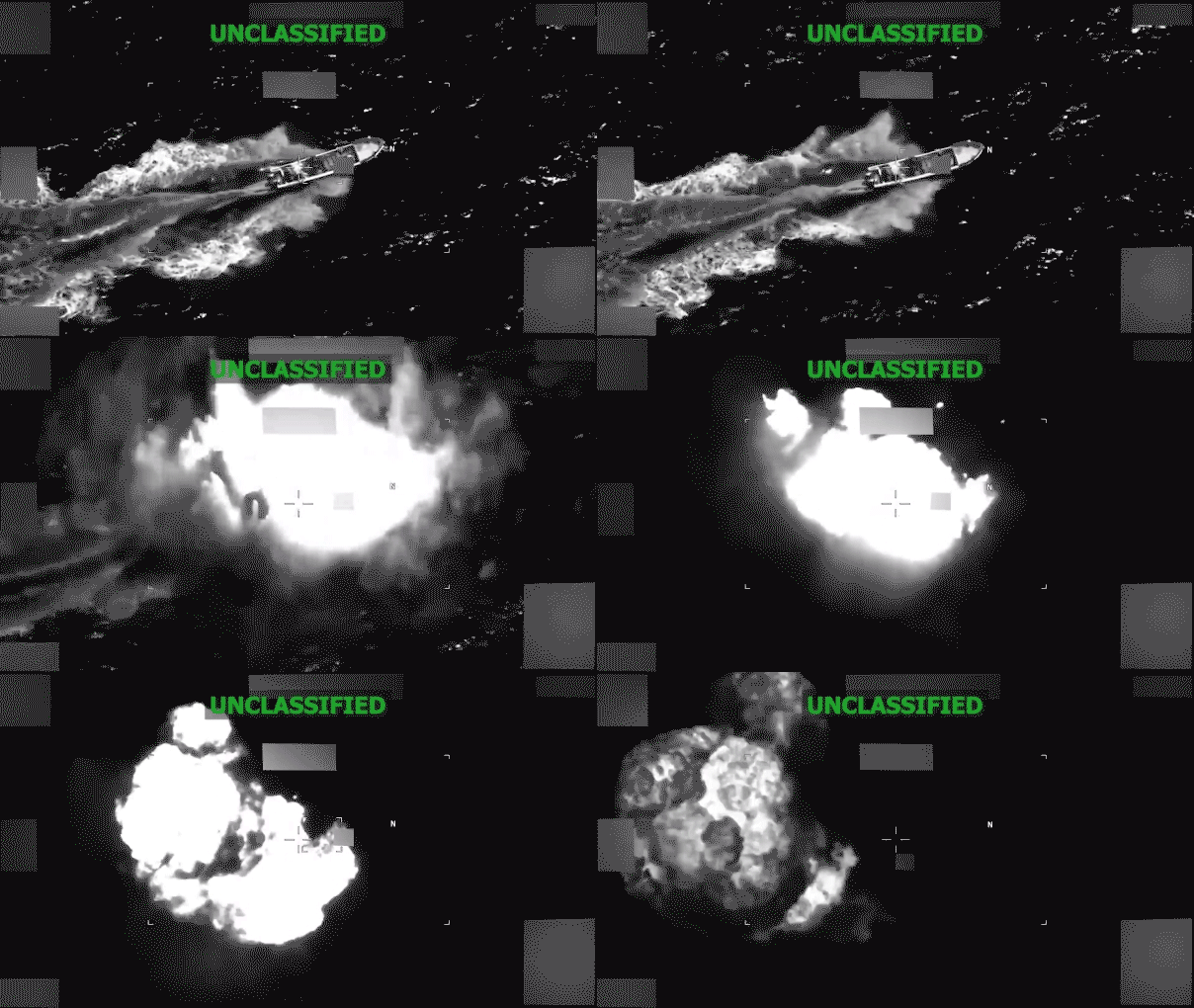
The vast, shimmering expanse of the Eastern Pacific Ocean, often romanticized as a serene frontier of endless blue, has quietly transformed into a high-tech, lethal battleground where the United States military conducts a silent, clinical war against unseen adversaries. On June 3, this deceptive maritime peace was violently shattered yet again of the coast of Central and South America. At the direct order of U.S. Southern Command’s leader, General Francis L. Donovan, a specialized military unit known as Joint Task Force Southern Spear executed what officials euphemistically termed a “lethal kinetic strike” on a fast-moving vessel navigating suspected smuggling corridors. In an instant, the peaceful ocean air was replaced by fire, metal, and water, as the targeted boat was utterly decimated. According to military press releases, two men—labeled by the Pentagon as “narco-terrorists”—perished in the blast, their lives extinguished in a flash of military precision. While the command reported that no American forces were harmed in the operation, the clinical language of their official reports did little to soften the heavy, tragic reality of human lives cut short on the high seas, leaving behind a wake of unanswered questions and a growing pile of burning wreckage in the deep ocean.
This recent strike was not an isolated incident of defense, but rather the latest installment in a relentless, escalating sequence of military actions designed to dismantle transnational smuggling operations. Just days prior, the waters of the Eastern Pacific had witnessed a succession of similar, deadly encounters that highlight the frantic tempo of this ongoing maritime offensive. The previous Saturday, a strike claimed the lives of three suspected traffickers, which followed a Friday operation that similarly ended the lives of three men. Merely days before that, another mid-week strike killed two individuals, while a Tuesday engagement left one person dead and two survivors stranded in the vast ocean. Even earlier in May, another strike resulted in two deaths and one lone survivor. This rapid-fire succession of lethal operations belongs to a broader, highly aggressive campaign mobilized during the Trump administration and quietly sustained since, which has resulted in the deaths of at least 207 people. What was once primarily a law enforcement mission conducted by the U.S. Coast Guard, focused on interdicting vessels and bringing suspects to trial, has increasingly evolved into a militarized zone of engagement, where suspected traffickers are met not with handcuffs and a courtroom trial, but with air strikes and immediate, irreversible destruction.
To the public, these strikes are often presented as short, digitized spectacles of administrative efficiency, shared across social media platforms like X through grainy, night-vision or monochromatic videos. In these sterile, black-and-white recordings, a tiny, fragile watercraft is seen slicing through the dark ocean waves before suddenly erupting into a violent fireball, its occupants obliterated in a fraction of a second. Recently, however, SOUTHCOM shared what appeared to be its first color video of a strike, rendering the violence of these encounters in vivid, distressing detail. Despite the high-definition transparency of the footage, a profound shroud of secrecy remains over who these people actually were and what cargo they carried. The military routinely labels the targets as members of “Designated Terrorist Organizations,” yet it rarely, if ever, releases the identities of the deceased, documentation of the cargo onboard, or concrete evidence verifying that the vessels were carrying illicit narcotics at the moment of their destruction. This informational void forces the public to trust the military’s word blindly, turning these human lives into nameless statistics and reducing complex societal challenges to silent, explosive spectacles of technological dominance.
Behind the ominous and heavily politicized label of “narco-terrorist” lies a far more fragile, human reality that is frequently overlooked in the grand calculations of national security. The individuals operating these low-profile vessels and fast-moving panga boats are rarely the wealthy, untouchable cartel kingpins who orchestrate the multibillion-dollar global drug trade from the safety of fortified jungle compounds or urban luxury estates. Instead, those risking their lives on the volatile currents of the Pacific are often impoverished coastal fishermen, desperate young men from marginalized communities in South and Central America, and fathers struggling to feed their families in regions devastated by systemic economic collapse. Coerced by the brutal, predatory recruitment tactics of transnational syndicates or driven by sheer, crushing poverty, these individuals agree to pilot dangerous, fuel-drenched vessels across thousands of miles of open water for a minuscule fraction of the cartel’s eventual profits. When a high-tech military strike vaporizes one of these vessels, it does not dent the operational capacities of the massive cartels, which view these runners as entirely dispensable assets; instead, it simply leaves impoverished families in remote coastal villages wondering why their sons, husbands, or brothers vanished without a trace, never to return from the sea.
This shift toward utilizing lethal military force against civilian suspects outside traditional combat zones has ignited fierce debate and deep apprehension among civil liberties advocates, international legal scholars, and human rights watchdogs. Critics argue that these unilateral, kinetic strikes on the high seas directly bypass the foundational tenets of domestic and international law, which guarantee the right to due process, the presumption of innocence, and a fair trial under a recognized judicial system. Under standard maritime interdiction protocols, law enforcement officials are expected to disable a vessel’s propulsion—often through targeted sniper fire to the engines—and apprehend the crew for prosecution. By utilizing lethal, explosive air strikes instead, the U.S. military is essentially carrying out extrajudicial executions of suspects who have never been formally charged, let alone convicted, of a crime. This aggressive expansion of military authority into global law enforcement corridors sets a highly controversial precedent, raising troubling questions about where the boundaries of sovereign military action lie and whether the global war on drugs has quietly authorized a permanent, borderless zone of impunity where human rights are secondary to tactical outcome.
Ultimately, these fiery, dramatic explosions on the Eastern Pacific serve as a somber reminder of the enduring, tragic futility that has defined the global war on drugs for over half a century. While the United States military and Southern Command assert that these high-seas strikes are vital to protecting American borders and disrupting transnational criminal organizations, decades of evidence demonstrate that the supply of narcotics is highly resilient, immediately shifting routes and finding new recruits to replace those lost at sea. As long as the insatiable demand for illicit substances persists in the consumer markets of wealthier nations, cartels will continue to find desperate people willing to risk everything to transport cargo across the ocean. The burning debris of these vessels eventually sinks to the cold, silent depths of the Pacific floor, leaving behind no legacy but grief, unanswered legal questions, and a cycle of violence that shows no signs of slowing down. In the end, these lethal strikes do not resolve the structural economic failures, systemic corruption, or addiction crises that fuel the drug trade; they merely ensure that the quiet waters of the Pacific remain a graveyard for the desperate and the forgotten, caught in the crosshairs of an endless, undeclared war.