


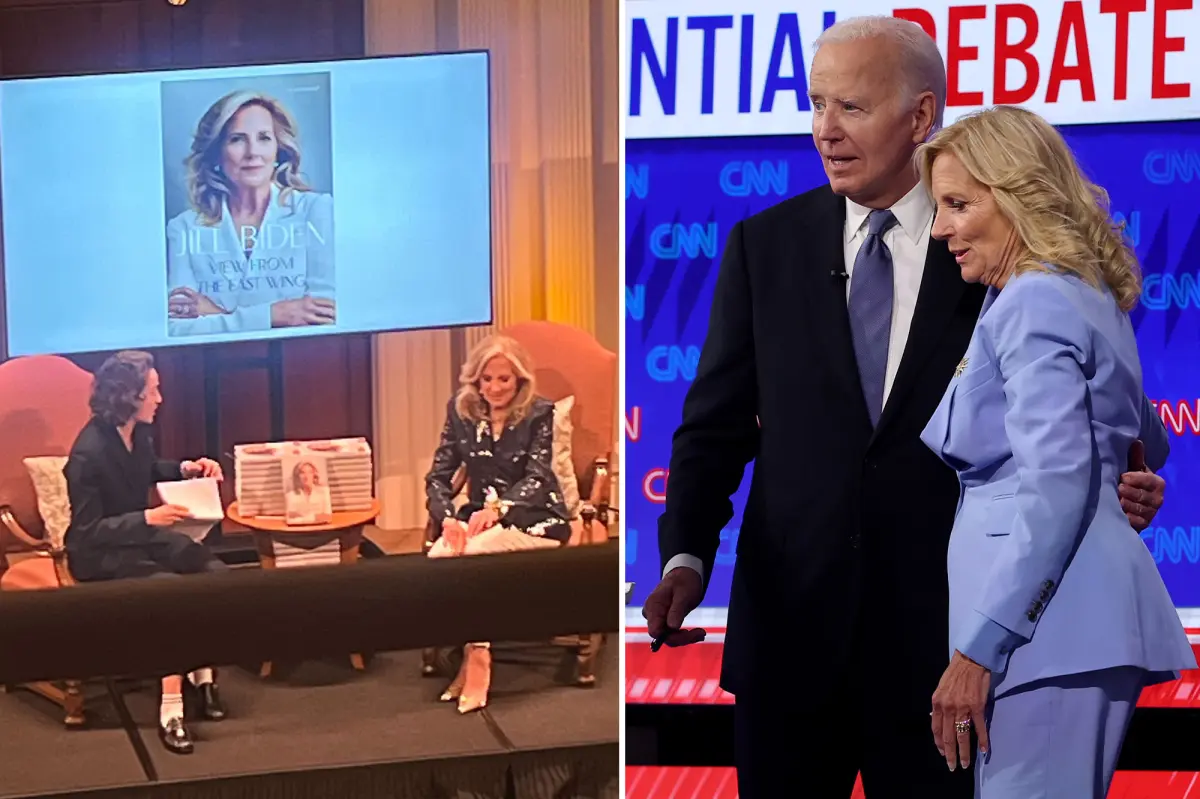
The warm, dimly lit sanctuary of the historic Sixth & I Synagogue in Washington, D.C., recently served as the evocative setting for an unusually candid, deeply reflective, and profoundly intimate look into the inner life and private worldview of Jill Biden. A woman who has spent nearly five decades gracefully balancing the loud, theatrical, and often predatory stage of national politics with the quiet, earnest discipline of the community college classroom, she stepped onto the stage not just as a political figure, but as an author, an educator, and a wife reflecting on the heavy mantle of leadership. Ostensibly gathered to celebrate and discuss her newly released memoir, the audience was treated to something far more valuable than standard diplomatic talking points: a profound, humanizing exploration of what it means to hold onto one’s authenticity when surrounded by the distorting mirrors of immense power. Throughout her historic tenure in the public eye, she has fiercely guarded her dual identity, insisted on continuing her work as a dedicated English professor, and maintained a grounded perspective that is exceedingly rare in the corridors of the nation’s capital. On this particular evening, the atmosphere in the synagogue was thick with a mixture of collective curiosity, shared history, and quiet vulnerability as she began to unpack the delicate, often exhausting path she has walked. By framing her personal and public life through the pragmatic lens of classroom instruction, she invited those in attendance to see her not as a distant, heavily scripted icon, but as a real woman navigating the complex, often messy realities of family, duty, and aging. It was an invitation to understand that the very same principles of structure, accountability, high standards, and unwavering honesty that govern a successful academic classroom are the exact coordinates she has used to navigate her family through the stormiest seas of modern American political life, proving that some lessons are universal.
The heart of the evening’s discussion took an unexpectedly lighthearted yet deeply revealing turn when the moderator began reading aloud some of the anonymous student reviews of her teaching from the popular, often brutally honest website Rate My Professor. These evaluations, written by everyday community college students who often had no idea they were being graded by a sitting or former Second and First Lady, painted a remarkably consistent portrait of an educator who was decidedly “tough but fair.” Hearing her students’ words read aloud in a public forum brought a warm, knowing smile to her face, highlighting the deep pride she takes in her identity as Dr. Biden, a teacher who refuses to hand out easy praise or simple passing grades just to be liked. Rather than shying away from the descriptor of being a difficult or demanding instructor, she leaned into it with a sense of quiet triumph, explaining that real education, much like real love, requires a willingness to confront shortcomings and demand better. This dynamic of “tough love” is not merely a pedagogical technique she leaves behind at the classroom door when her lectures end; rather, it is the foundational blueprint of her entire life, serving as the guiding force in how she raises her children and mentors her grandchildren. In an era where indulgence and superficial affirmation often replace genuine guidance, she spoke passionately about her refusal to coddle the younger generations of her family, noting that her ultimate goal is to challenge them, to stretch their capabilities, and to ensure they are prepared for the harsh realities of the world. By demanding rigor from her students and her family alike, she seeks to make them stronger, more resilient, and fundamentally better equipped to face their own challenges, proving that true care is often wrapped in the mantle of uncompromising expectation and honesty.
This commitment to relentless, unvarnished honesty takes on an even more profound and high-stakes significance when applied to her decades-long marriage to Joe Biden, a partnership that has survived the highest peaks of political triumph and the most devastating valleys of personal grief. Addressing the audience with a striking mix of tenderness and fierce resolve, she declared, “He is the love of my life, but I have to tell you I’m honest with him. Because no one else will be.” This single, poignant statement cuts directly to the dark, isolating reality of the American presidency and high-level political power, a world where leaders are perpetually surrounded by anxious aides, ambitious advisors, and sycophantic flatterers who are often too terrified of losing access to speak the hard truths. In such an environment, the political “bubble” can easily become a dangerous echo chamber that distorts reality, making a spouse’s role as an independent truth-teller not just a private marital duty, but a vital democratic safeguard. Jill Biden conceptualizes her role in her husband’s life not as a passive cheerleader who blindly validates every decision, but as a grounding force, a human anchor who protects him from the seductive illusions of his office by keeping him tethered to the raw, unvarnished truth of the real world. It is a testament to the depth of their relationship that after fifty years of marriage, she still views her most sacred duty as being the one person in the world who loves him enough to tell him the things he does not want to hear. This radical honesty is the lifeblood of their partnership, ensuring that amid the deafening noise of global crises and domestic political battles, there is always at least one voice speaking with absolute sincerity, clarity, and unconditional devotion.
The conversational narrative inevitably turned to one of the most painful, highly scrutinized, and historically consequential moments of their public journey: the infamous presidential debate in late June of 2024. This disastrous performance, which sent shockwaves through the political landscape and ultimately set in motion the sequence of events that led to Joe Biden’s historic decision to step aside from the presidential campaign, remains a raw wound in the national consciousness. Many observers and critics at the time wondered how those closest to the President, particularly his fiercely protective wife, could have allowed him to step onto that stage in such a vulnerable state without offering a candid intervention beforehand. Addressing this lingering question with a quiet, explanatory solemnity, Jill revealed a logistical reality that shocked many who assume political couples live in an inseparable, highly coordinated bubble: she simply had not seen her husband to offer her trademark honesty in the crucial days leading up to the event. As she explained to the quieted room, she was fully immersed in her own demanding, cross-country campaign schedule, traveling tirelessly from state to state to rally voters, which kept her entirely separated from the intensive “debate camp” sessions sequestered at the rustic, secure retreat of Camp David. This revelation humanizes the immense, administrative exhaustion of a modern political campaign, stripping away the myth of omniscient control and revealing two partners running on parallel, incredibly demanding tracks. It shows that even within the most powerful family in the world, the sheer kinetic momentum of public life can create tragic gaps in communication, leaving even the most vigilant partners temporarily unable to protect each other from the harsh glare of the public spotlight.
This poignant disconnect underscores the profound, often agonizing human element of aging, vulnerability, and transition that lies beneath the polished veneer of geopolitical power and historical legacy. The decisions faced by the Biden family during this tumultuous period were not merely matters of strategic polling, campaign fundraising, or political survival; they were deeply personal, agonizing choices about dignity, physical limits, and the inevitable, universal march of time. Navigating the twilight of a monumental, half-century-long career in public service under the relentless, often cruel microscope of the 24-hour news cycle and social media is a burden that few families in history have ever had to bear. For Jill Biden, the role of protective spouse during this transition required an incredibly painful balancing act: she had to defend her husband’s legendary legacy and indomitable spirit while simultaneously helping him confront the stark, undeniable realities of his physical limits. The public often demands that its leaders be invincible, treating them as political chess pieces rather than aging human beings with families, feelings, lived histories, and vulnerabilities. By opening up about her absence from the debate preparations and the subsequent national fallout, she allowed the public to see the deep vulnerability that exists when a family’s private struggle with aging becomes the focal point of global geopolitics. It stands as a powerful reminder that behind every historic headline, every monumental speech, and every shocking political withdrawal, there are real human beings feeling the sharp sting of criticism, the heavy weight of duty, and the profound, quiet sadness of letting go of a lifetime of shared dreams. This vulnerability illustrates that even first families must eventually bow to the passage of time, relying on the quiet strength of love to carry them through the transitions that await us all.
In the final analysis, Jill Biden’s reflections at the Sixth & I Synagogue offer a beautiful, enduring thesis on the power of radical, loving honesty as an anchor in an increasingly chaotic, partisan, and superficial world. Whether she is standing at a classroom chalkboard grading an undergraduate English essay, offering firm guidance to a growing grandchild, or looking into the eyes of the President of the United States, her ultimate mission has remained remarkably consistent: “trying to make them better—not worse.” Her life story suggests that true loyalty is never found in silent complicity or easy praise, but in the courage to speak difficult truths when the stakes are at their absolute highest. As the Biden presidency transitions into the history books, her legacy will likely be defined not just by her political achievements or her historic role as a working First Lady, but by her unwavering dedication to keeping her family grounded in humanity. In a town notorious for its fleeting alliances, calculated falsehoods, and political posturing, her quiet, classroom-honed philosophy of tough love serves as a refreshing, deeply human testament to the enduring power of truth. By refusing to let the gilded cage of the presidency diminish her raw, authentic self, she has shown that the most powerful thing we can offer those we love is not our uncritical adoration, but our honest, uncompromising presence. Ultimately, her message is one that transcends the shifting tides of politics, reminding us all that the truest form of love is the one that possesses the courage to hold up a mirror, demand our very best, and guide us gently but firmly toward our highest selves.