

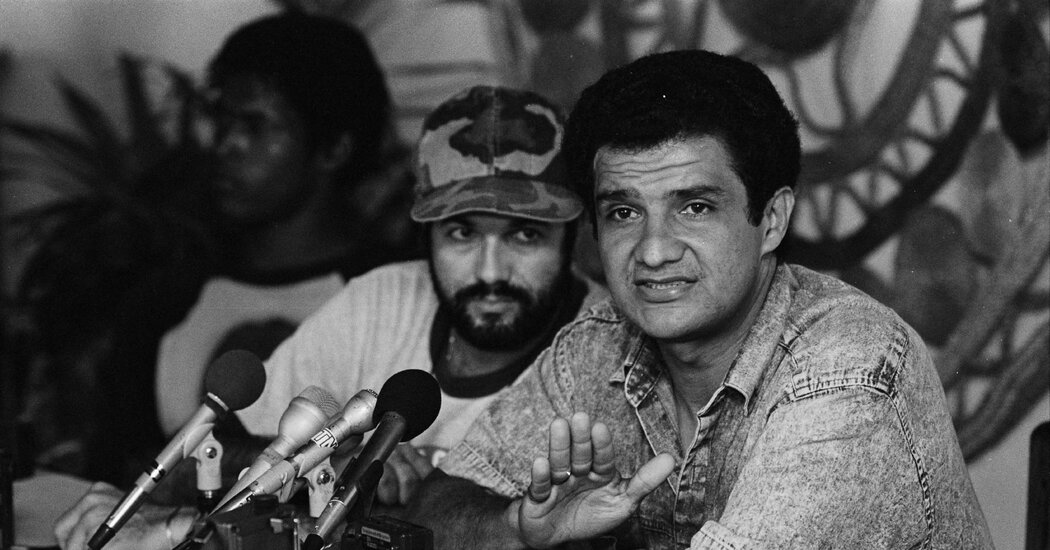
Through a fragile, static-heavy telephone line, the voice of Dina Carolina Fagoth Rivera carried the profound grief of a family in mourning and the heavy burden of an entire indigenous nation in shock. Speaking from a place of deep sorrow, she laid bare her family’s urgent determination to bring the body of her uncle, Brooklin Rivera, back to his ancestral home on the northern Caribbean coast of Nicaragua. The family’s grief is compounded by a fierce and justified distrust of the autocratic government of President Daniel Ortega, which announced Rivera’s death while he was in state custody. “We do not, for one moment, think that any of what they’re telling us is true,” Ms. Fagoth Rivera insisted, her skepticism rooted in a lifetime of witnessing state violence and repression. Her family’s suffering is double-edged; her father, Steadman Fagoth Müller, another legendary Miskito leader, was also arbitrarily detained by the regime in 2024. For Dina, her uncle was not merely a political figure or a relative; he was the literal embodiment of hope for a deeply marginalized population. “He was a light for our people,” she said softly. “He meant freedom for our people.”
To understand the weight of Brooklin Rivera’s death is to understand the long, bloody history of the Miskito people, an Indigenous nation of approximately 500,000 individuals living along Nicaragua’s isolated, resource-rich, and spiritually significant Caribbean coast. For more than forty years, Rivera stood as the preeminent political and cultural pillar of this community, navigating the treacherous waters of Nicaraguan politics to defend his people’s sovereignty. The northern Caribbean coast is a world away from the Pacific capital of Managua, not just geographically, but culturally and linguistically, as the Miskito people have fiercely defended their separate identity and self-governing traditions against successive colonial and national authorities. Rivera’s journey from a young grassroots defender to a highly influential member of the national legislature, to which he was first elected in 2007, was a testament to his tenacity. His entire life was inextricably bound to the preservation of communal lands and local autonomy, making him a living shield for his people against the relentless encroachment of outside forces seeking to exploit their natural resources.
The political trajectory of Rivera and his party, Yatama (meaning “Sons of Mother Earth”), reflects the deeply complex and tragic nature of modern Nicaraguan history. In the 1980s, during the height of the Cold War and the Sandinista revolution, Rivera took up arms alongside the Contra rebels to fight against the first Sandinista government, in which Daniel Ortega played a central role. The Sandinistas’ initial attempts to forcibly assimilate the Caribbean coast led to a brutal armed conflict, which eventually paved the way for the Autonomy Law of 1987. Decades later, when Ortega returned to power through democratic elections in 2007, Yatama entered into a pragmatic, uneasy alliance with the Sandinistas in hopes of finally achieving the legal demarcation of their ancestral territories. However, this alliance gradually disintegrated as the Ortega government systematically betrayed its promises, permitting violent incursions by illegal armed settlers, illegal gold mining, and massive logging operations on sacred Miskito lands, all while the state looked the other way or actively encouraged the plunder.
As Ortega’s government descended into a brutal, unchecked dictatorship, the regime targeted anyone who dared to stand in the way of its absolute control, eventually turning its wrath directly upon Rivera and Yatama. In 2023, the government officially banned Yatama from participating in elections, stripping the Miskito people of their last remaining legal avenue for political representation. Early that year, while Rivera was abroad speaking out at the United Nations about the systematic destruction of Indigenous rights and environmental degradation in Nicaragua, the regime barred him from returning to his own country. Refusing to be condemned to a comfortable exile while his people suffered under the boot of authoritarianism, Rivera made the dangerous, courageous decision to slip back into Nicaragua secretly, traveling by water through the labyrinth of coastal mangroves. He knew the risks, but the love for his homeland outweighed his fear; shortly after his return, he was arrested by state security forces, vanishing into the labyrinth of the regime’s notorious prison system.
The tragedy of Rivera’s suspicious death in captivity has resonated far beyond the borders of Nicaragua, drawing sharp condemnation from international human rights bodies. Reed Brody, a distinguished member of the United Nations Group of Human Rights Experts on Nicaragua, noted that Rivera was likely the most influential Miskito political figure of the last four decades, making his death in detention a catastrophic milestone in the ongoing human rights crisis. According to data compiled by the U.N. group, Rivera’s fate is part of a much broader, systemic attempt by the Ortega-Murillo regime to crush Indigenous resistance and seize control of their territories. Since the nationwide anti-government protests in 2018, the United Nations has documented at least 124 arbitrary detentions of Indigenous leaders and activists, with at least 46 individuals murdered in episodes of land-related violence along the Caribbean coast. As Brody points out, Rivera’s tragic end encapsulates the total dismantling of Indigenous autonomy in Nicaragua and shines a harsh light on the regime’s routine use of enforced disappearances to silence dissent.
Today, the family of Brooklin Rivera, alongside human rights advocacy groups worldwide, is demanding an independent, international investigation to uncover the truth behind his death, refusing to accept the state’s hollow explanations. Their struggle to bring his body back to the northern Caribbean coast is a final, poetic act of defiance against a regime that sought to erase his name, his voice, and his legacy from history. Though the physical light that Rivera represented has been extinguished, his struggle remains etched into the collective memory of the Miskito people, who continue to endure state terror with quiet resilience. His life story stands as a heartbreaking yet inspiring testament to the high price of defending ancestral lands, human dignity, and the right to self-determination. In the hearts of his family and the half-million Miskito people he spent his life protecting, Brooklin Rivera remains undefeated, a enduring spirit of freedom that the walls of a prison cell could never truly contain.