



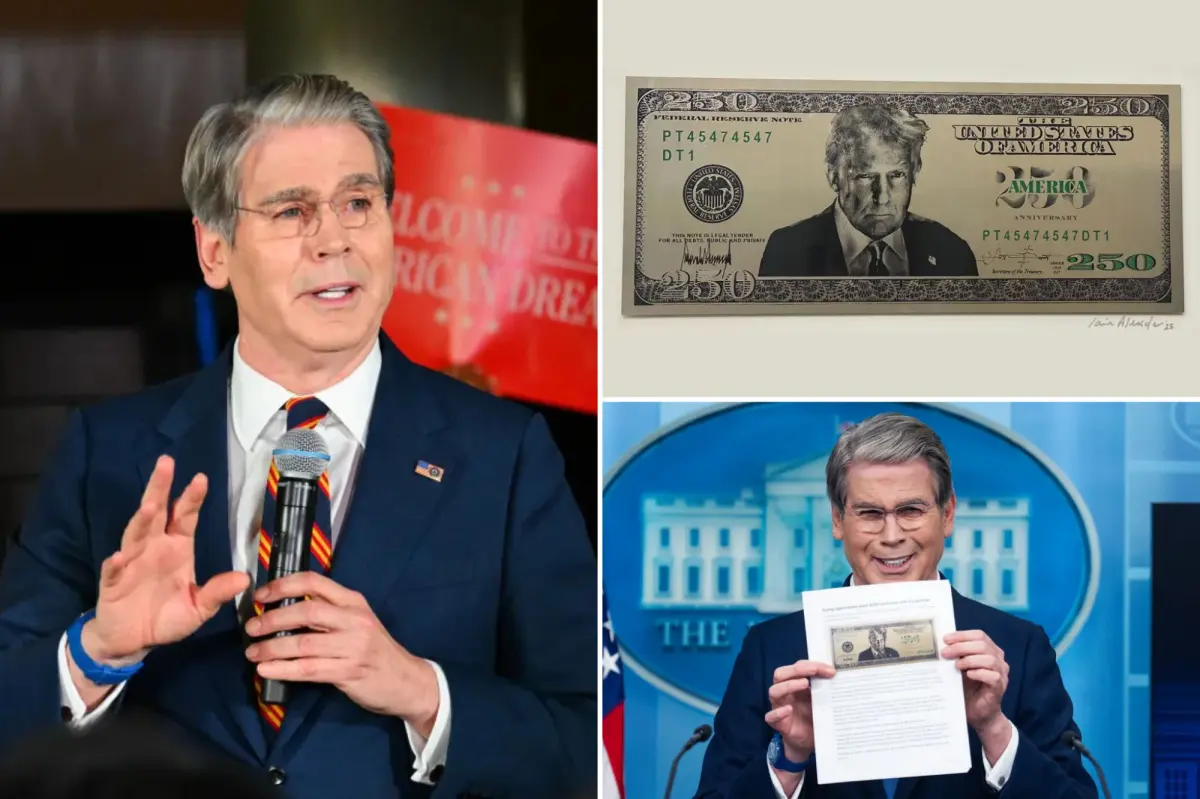
As the United States rapidly approaches its semi-quincentennial—the landmark 250th anniversary of its founding—Treasury Secretary Scott Bessent has stepped directly into the cultural and political spotlight to defend a highly unusual, historically charged initiative: mockups of a $250 banknote adorned with the face and signature of President Donald Trump. Appearing on Fox News’s “Sunday Morning Futures,” Bessent framed the project not as an act of partisan vanity, but as a fitting, forward-looking celebration of a transformative leader presiding over a monumental milestone in the American story. For Bessent, the intersection of Trump’s presidency with the nation’s banner anniversary presents a unique narrative opportunity, one that elevates the physical currency we carry from mere legal tender to a tangible, historic keepsake. He argued with quiet confidence that if Congress ultimately chooses to codify this tribute into law, his department has a duty to be prepared, transforming what critics view as an administrative overreach into a proactive exercise in archival design and national readiness.
To ground this bold endeavor in some semblance of institutional tradition, Bessent pointed to deep-seated historical precedents where the Treasury Department used currency to immortalize both national landmarks and the leaders who oversaw them. Specifically, he drew a parallel to President Calvin Coolidge, who was honored with a commemorative coin during the nation’s 150th anniversary celebrations in 1926. In Bessent’s view, marking epochal American birthdays with the likenesses of sitting presidents is a time-honored way to capture the spirit of an era, anchoring the grand sweep of American history to the tangible, everyday artifacts used by its citizens. By linking Trump to Coolidge, the Treasury Secretary sought to strip away the immediate, highly emotional polarization surrounding the current administration, contextualizing the proposed $250 bill as a natural extension of a long-standing legacy of national pride, commemoration, and executive celebration.
However, translating this grand celebratory vision into actual, physical greenbacks requires navigating a formidable labyrinth of centuries-old federal laws designed specifically to keep monetary design free from contemporary cults of personality. Standing directly in the Treasury’s path is the landmark Thayer Amendment of 1866—a post-Civil War law enacted to prevent living politicians and bureaucrats from engraving their own faces onto the nation’s wealth, decreeing that no living person may appear on United States currency, bonds, or financial notes. Furthermore, existing statues strictly regulate the valid denominations of U.S. paper money, limiting the Treasury to traditional bills like the $100, $500, $1,000, and $5,000 notes, with absolutely no provision for a $250 bill. Despite these daunting legal barriers, reports originally uncovered by the Washington Post revealed that administration officials actively encouraged the Bureau of Engraving and Printing to begin drafting physical mockups of the Trump banknote anyway, initiating a quiet, bureaucratic hustle behind closed doors to visualize what this unprecedented currency would look like.
The legislative spark behind this controversial design push belongs to Representative Andy Barr, a Republican from Kentucky, who has championed the specialized bill in Congress to bypass existing statutory limits and authorize the creation of the $250 denomination. Bessent defended the Treasury’s decision to sketch out the design prior to the bill’s passage as a matter of simple, pragmatic administrative foresight, arguing that the intricate process of security engraving, plate-making, and anti-counterfeiting design requires years of lead time. “We have sketched out what it would look like because we have to prepare way in advance,” Bessent explained, painting the Treasury’s actions as responsible logistics rather than political presumption, promising that the physical bills will only see the light of day if Congress officially greenlights the proposal. Stepping temporarily into the national spotlight as the acting White House Press Secretary while Karoline Leavitt was on maternity leave, Bessent pushed back hard against media scrutiny, dismissing the building controversy as a fabricated non-story and asserting that there was absolutely nothing untoward or inappropriate about a federal agency doing the preparatory legwork for pending congressional directives.
Predictably, this push to imprint Donald Trump’s likeness onto the nation’s financial bloodstream has ignited a fierce, deeply emotional backlash from congressional Democrats, who view the project as an egregious politicization of the country’s shared economic symbols. Leading the legislative counteroffensive, Representative Jimmy Gomez of California introduced targeted legislation earlier this spring specifically designed to block Trump’s signature and face from ever gracing any form of U.S. currency, arguing that putting a living, highly divisive figure on federal tender undermines the universal, non-partisan trust required of the greenback. For Gomez and his colleagues, the fight is over the sacred, collective identity of American money—an institution they believe should represent enduring democratic values rather than serving as a billboard for any individual president’s political brand. This clash highlights a profound philosophical divide over who owns the visual narrative of the United States, transforming a simple piece of paper into a volatile ideological battleground.
Ultimately, the fierce debate over the $250 Trump bill reveals how deeply Americans care about the symbols that represent them, proving that paper currency is far more than an instrument of economic transaction; it is a repository of national identity, values, and collective memory. To his supporters, placing Trump on a special anniversary bill is a rightful acknowledgment of a leader who promised to disrupt the status quo and revitalize the nation; to his detractors, it represents a breach of historical norms and a step toward state-sponsored personal tribute. As the Bureau of Engraving and Printing’s sketches sit quietly in federal archives, caught between the ambition of a commemorative milestone and the reality of a divided Congress, the greenback remains a mirror reflecting the country’s deep political polarization. Whether this controversial banknote eventually finds its way into the wallets of everyday citizens or remains a historical footnote, it has already secured its place as a powerful symbol of America’s ongoing, passionate struggle to define its own legacy on the eve of its 250th birthday.