



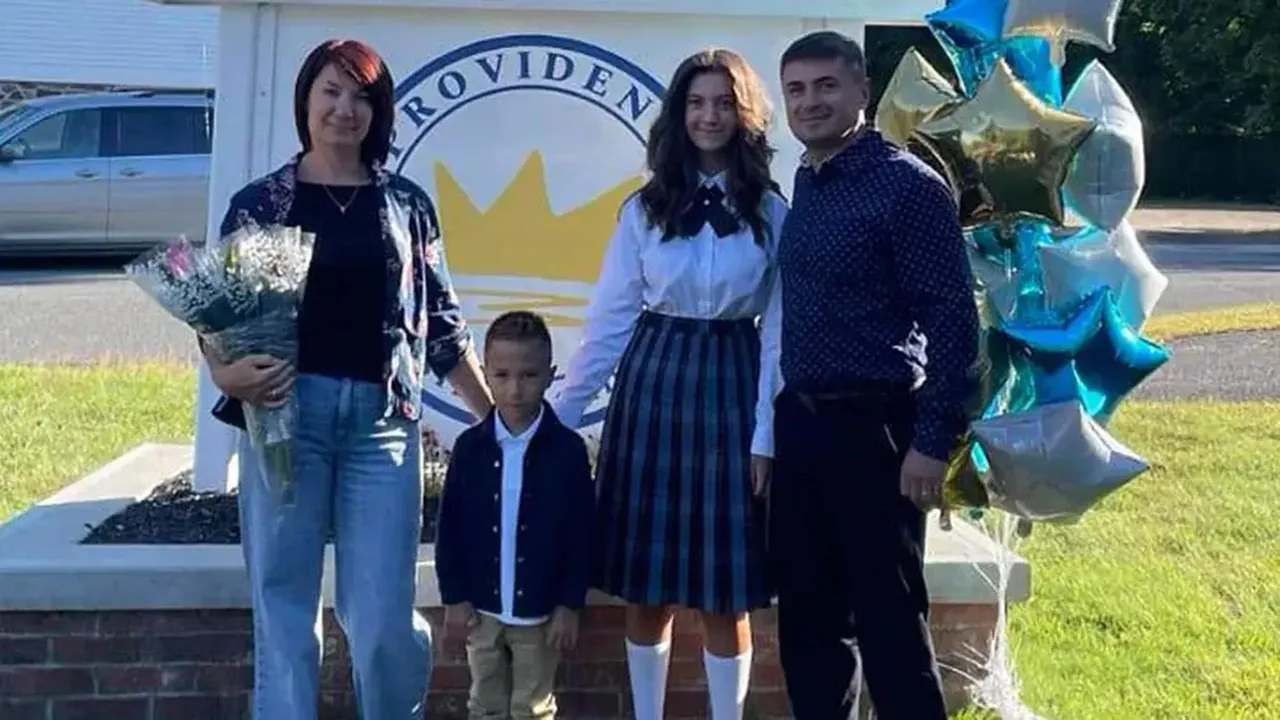
In the quiet, close-knit communities of Greenfield and Worcester, Massachusetts, a profound and heavy silence has fallen, replacing the warm familiarity of daily life with an unbearable sense of loss that words can scarcely capture. This is the devastating human cost of a catastrophic highway collision that claimed five innocent lives, including an entire family of four whose future was extinguished in a single, terrifying instant. Dmitri Doncev, a hardworking and dedicated 45-year-old father, and his beloved 44-year-old wife, Ecterina, were the bedrock of their household, nurturing a family dynamic filled with hopes, dreams, and quiet ambitions. They were traveling with their two young children: 13-year-old Emily, a girl standing on the promising threshold of her teenage years, and 7-year-old Mark, whose bright laughter and playground adventures were cut tragically and needlessly short. Alongside them, the Worcester community is deeply mourning the loss of 25-year-old Priscilla R. Mafalda, a vibrant young woman whose life was full of burgeoning potential, career goals, and personal dreams that would never be realized. These individuals were not mere statistics on a state police traffic report, nor were they anonymous travelers on a minor, forgotten corridor; they were neighbors, classmates, colleagues, and cherished friends who went to sleep in their vehicles anticipating a safe, routine arrival at their destination. The sheer, overwhelming weight of this tragedy has sent shockwaves through their Massachusetts hometowns, where local schools are now coping with the deeply painful task of addressing the empty desks of two bright young children, and friends are left wondering how a routine journey on one of America’s most heavily traveled interstate highways could culminate in such a devastating, fiery end. Neighbors remember the Doncev family as kind and generous, always willing to lend a helping hand, while friends of Priscilla describe her as a beacon of joy whose smile could light up any room. In the face of this sudden and unimaginable catastrophe, the grief of their surviving extended family members is matched only by a collective community resolve to remember them not for the horrific manner of their deaths, but for the profound light they brought into the world during their tragically short lives.
The horrific event unfolded in the deep, dark hours of the early morning at approximately 2:35 a.m., along a southbound stretch of Interstate 95 in Stafford County, Virginia, a vital transit artery that usually thrums with the steady rhythm of overnight travel. At this hour, when the vast majority of the world is asleep, the highway becomes a transient space for long-distance family road trips, late-night truckers, and commercial buses operating overnight schedules. On this particular night, the quiet rhythm of the interstate was interrupted by an upcoming highway work zone, a routine occurrence on major eastern seaboard routes designed to facilitate infrastructure repairs during hours of lower traffic volume. The vehicles ahead, including a Chevrolet Suburban containing occupants who relied on the safety of the roadway, and an Acura SUV, complied with the posted safety signs, their red brake lights illuminating the dark pavement as they slowly decelerated to protect the highway construction crew working diligently ahead. However, barreling down from behind them was a massive, heavy charter bus operated by E&P Travel, carrying numerous passengers on a grueling overnight route spanning from the bustling streets of New York City to Charlotte, North Carolina. In a terrifying split-second failure of observation and control, the massive motorcoach failed to slow down, slamming violently into the rear of the Chevrolet Suburban with unimaginable force. The brutal physics of the high-speed impact were completely merciless; the initial collision propelled the heavy Suburban directly into the Acura SUV ahead, creating an unstoppable, violent chain reaction that ensnared multiple other vehicles in a chaotic tangle of twisting metal and shattering safety glass. Amidst the physical carnage of the crash, a devastating fire erupted almost instantly, quickly engulfing the vehicle carrying the Doncev family in a swift, hot, and inescapable inferno. What should have been a standard and peaceful overnight journey through the Virginia night transformed in an instant into a scene of absolute, chaotic devastation, leaving emergency first responders to battle raging flames, secure the hazardous scene, and initiate the heartbreaking task of recovering those whose lives were shattered in the blink of an eye.
At the absolute center of the subsequent criminal investigation is the driver of the charter bus, Jing S. Dong, a resident of Staten Island, New York, whose life has been fundamentally altered by the gravity of the incident. Dong, a naturalized United States citizen originally from China, had only recently obtained his commercial driver’s license earlier in 2024, placing him in the high-stakes, immensely demanding position of operating a massive passenger bus with very little real-world experience navigating America’s complex interstate system overnight. Following the devastating multi-car pileup, Virginia State Police acted swiftly, arresting and officially charging Dong with two counts of involuntary manslaughter, with the distinct promise of additional, serious charges looming on the horizon as the comprehensive investigation continues to compile evidence. The legal jeopardy and public scrutiny Dong now faces highlight a harrowing intersection of corporate delegation, regulatory oversight, and individual capability, raising difficult questions about the pathway through which a newly licensed driver was tasked with navigating a highly demanding interstate route. For Dong, the transition from a hopeful new commercial operator trying to carve out a living in his adopted country to a criminal defendant accused of causing a catastrophic loss of life represents a tragedy of immense proportions, illustrating the devastating consequences when human capacity is mismatched with the extraordinary responsibility of transporting dozens of human souls. The public and safety advocates alike are left trying to understand the disconnect that allowed a driver, who on paper possessed the legal credentials to pilot a commercial vehicle, to fail so catastrophically on the road, leaving five families destroyed and his own future permanently derailed by the shadow of involuntary manslaughter. This heartbreaking reality underscores the massive weight carried by commercial transportation operators, where a single moment of confusion, fatigue, or operational failure can cause ripples of deep, irreversible sorrow across multiple communities and erase entire linear generations in a matter of fractions of a second.
Beyond the immediate criminal charges and the tragic loss of life, the incident has exposed a glaring, controversial, and deeply concerning regulatory vulnerability: Dong’s complete lack of English language proficiency. Under long-standing federal safety regulations established by the Federal Motor Carrier Safety Administration (FMCSA), commercial vehicle drivers operating in the United States must possess the ability to read, speak, and understand the English language well enough to converse with the general public, comprehend highway traffic signs and signals, respond to official inquiries, and make legible entries on administrative reports and records. This requirement is far from a mere bureaucratic formality or a cultural preference; rather, it is a foundational pillar of modern transportation safety designed to protect millions of drivers on the road. A commercial bus driver must be capable of processing complex road signs dynamically, reading flashing warning boards about construction hazards, and communicating effectively with emergency personnel, passengers, and law enforcement during a crisis. The revelation that Dong was unable to speak or understand English sufficiently to meet these basic standards raises alarming questions about the oversight clean-ups and licensing integrity of the New York State licensing system. It points to a deeply troubling, systemic failure where the critical mechanisms designed to verify safety and regulatory compliance are bypassed, ignored, or poorly enforced, allowing individuals who cannot navigate basic linguistic safety requirements to take the wheel of massive commercial vehicles on long-distance, high-speed regional routes. In a diverse nation, welcoming naturalized citizens into the workforce is a vital value, but when regulatory shortcuts bypass mandatory safety requirements, the consequences can prove fatal, transforming what should be a proud transition to a new career into a highly dangerous public hazard.
This administrative failure and the resulting loss of life have drawn fierce, unyielding criticism from the highest levels of the United States government, most notably from the newly appointed U.S. Transportation Secretary, Sean Duffy. Expressing his deep frustration and anger on social media platforms, Duffy labeled the circumstances surrounding Dong’s licensing and operation of the bus as “unacceptable,” pointing to this tragedy as a prime example of why the federal government must enforce the rules of the road with absolute, unwavering rigor and hold state-level agencies accountable for lax licensing practices. Duffy made it abundantly clear that if an individual cannot communicate with law enforcement, read crucial road warnings, or be properly trained in accordance with federal law, they have absolutely no business behind the wheel of a commercial passenger vehicle. In response to the fatal accident, the federal Department of Transportation has launched a far-reaching, comprehensive investigation that will thoroughly examine New York’s licensing records, Dong’s training documentation, and his personal driving history. Duffy has issued a stern, unequivocal warning that any entity—whether it be the parent bus company E&P Travel, the commercial driving school, or the specific state licensing examiners who signed off on Dong’s credentials—that contributed to putting an unqualified and non-compliant driver on the road will face intense, unrelenting scrutiny and severe legal and financial penalties for their complicity in this systemic failure. This federal crackdown signifies a broader movement to eliminate administrative loopholes and ensure that commercial transportation companies prioritize absolute safety and regulatory adherence over quick profits, ensuring that those who act as gatekeepers for road safety are held fully responsible when their processes lapse into fatal negligence.
Ultimately, as the legal proceedings move forward through the justice system and federal investigators dismantle the administrative errors that allowed this tragedy to occur, the true focus of our collective attention must remain on the human lives that were so abruptly and needlessly taken. The heated regulatory debates, political statements on social media, and structural reforms of the transportation sector serve as a cold, distant comfort to the grieving communities of Greenfield and Worcester, where empty chairs at kitchen tables and silent bedrooms stand as permanent, painful monuments to this devastating night. The memory of the Doncev family—Dmitri, Ecterina, young Emily, and little Mark—alongside the tragically brief life of Priscilla Mafalda, must serve as an urgent, unyielding reminder of the human stakes involved in interstate transit safety. Ensuring that our public highways are safe is not merely a bureaucratic checkbox or a matter of compliance logistics; it is a sacred covenant we make to every family that buckles up for a long drive home, trusting that the drivers of massive commercial vehicles beside them are fully qualified, alert, and capable of operating safely. To honor those whose lives were cut short on that dark stretch of Virginia’s I-95, the commercial transportation industry, state licensing departments, and federal regulators must work tirelessly to ensure that no unqualified driver is ever allowed to take the wheel again, transforming this profound tragedy into a catalyst for systemic change that protects the lives of future travelers. By doing so, we might ensure that out of the ashes of this unthinkable heartbreak, a safer, more accountable system emerges to protect every traveler who sets foot on our shared roads.