

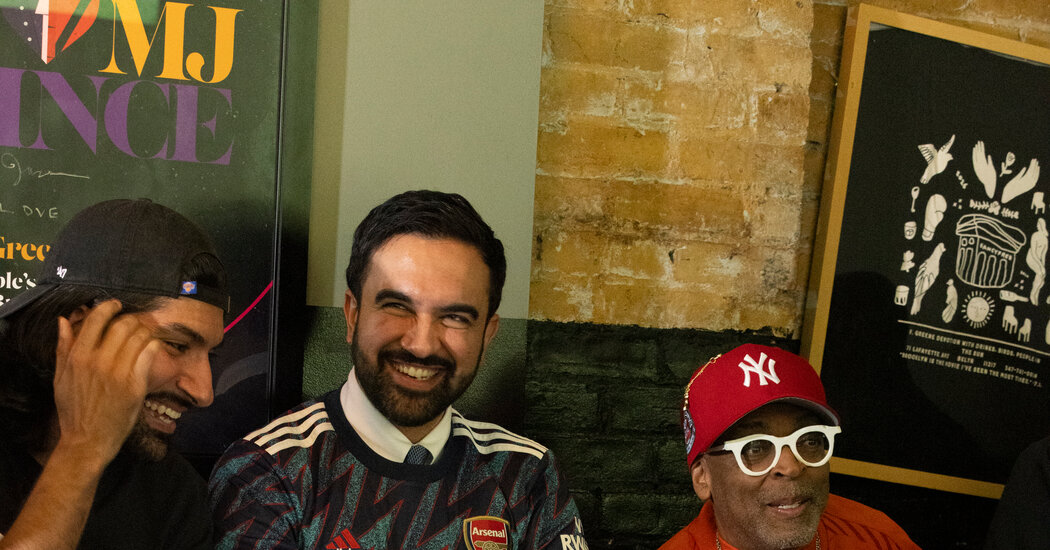
On a crisp, bustling Saturday morning in the heart of Brooklyn’s historic Fort Greene neighborhood, the typical weekend rhythm was delightfully shattered by the electric hum of anticipation centered around a beloved local establishment. At FancyFree, a neighborhood sports bar that has long served as a sanctuary for athletic devotion, the scene resembled a vibrant festival of red and white. Flags bearing the crest of the North London soccer club Arsenal snapped vigorously in the cool morning breeze, while rhythmic chants of “Arsenal! Arsenal!” reverberated down the block, turning the sleepy streets into a stadium-like atmosphere. The tension inside the tavern was palpable, with patrons packed shoulder-to-shoulder, their eyes darting nervously between their drinks and the glowing television screens. Moments before the high-stakes noon kickoff, a sudden surge of ecstatic shouts erupted near the entrance, though not for any play on the field. Instead, the crowd was hailing New York City Mayor Zohran Mamdani, who made a dramatic entrance dressed in a hybrid of his public and private selves: a bright red-and-blue Arsenal jersey pulled over a crisp white dress shirt and a neatly knotted blue tie. Waving to his constituents and weaving through the dense sea of red, the mayor was met with booming cheers and a warm, enthusiastic hug from film director Spike Lee, who welcomed him to their seats. This was no ordinary weekend fixture; it was the highly coveted Champions League final, and having secured the Premier League title just one week prior, the global fan base of the Gunners stood on the precipice of an unprecedented, historic double that would cement their legacy forever.
For a political leader whose daily life is an endless, grueling marathon of budget crises, legislative battles, and policy negotiations, this match was a non-negotiable escape into a realm of pure, unadulterated passion. As the opening whistle blew, Mayor Mamdani became indistinguishable from the passionate faithful surrounding him, clapping fervently to the beat of “Human” by The Killers alongside his security detail, his childhood friends, and high-profile companions like Lee. In the seventh minute, the atmosphere reached a fever pitch when Kai Havertz made a breathtaking run down the left flank toward the opponent’s goal. Instinctively, Mamdani leapt onto a wooden bench, his gaze locked onto the screen, and as the ball rippled into the back of the net, he threw his head back in a triumphant roar, pumping his fists wildly before burying his face in his hands in absolute disbelief of the dream scenario unfolding before them. Yet, the beautiful game is notoriously cruel, and the euphoria was soon tested during the second half when the bar’s screens suddenly dissolved into a frustrating, empty blue screen due to a lost broadcast signal. Chaos ensued as patrons, including the mayor himself, desperately pulled out their smartphones to track the match in real-time, only to watch in horror as Paris Saint-Germain capitalized on a penalty kick to tie the game in the dark. By the time the broadcast flickered back to life in the sixty-seventh minute to anxious cheers, the agonizing weight of the one-all deadlock began to take its toll, visible in the mayor’s tightly crossed arms, tense posture, and the nervous fluttering of his lips as the clock ruthlessly marched toward the ninetieth minute.
Among the packed crowd sharing this volatile emotional roller coaster was thirty-five-year-old Katie Morais, a native of Northwest London who had grown up in the very shadow of Arsenal’s home turf and later immigrated to New York, only to find herself living directly across the street from FancyFree. She marveled at the unique, radically inclusive community that had organically formed in this Brooklyn corner, noting that in America, such a deep, authentic sporting fellowship is incredibly rare, especially one where a city’s mayor and an iconic filmmaker can mingle as equals with everyday working people. This unfiltered projection of identity is central to Mamdani’s appeal; by wearing his sporting passions on his sleeve and integrating his favorite team’s crest into his traditional political attire, he has managed to preserve his humanity and anchor his soul during a period of meteoric, dizzying career changes. Reflecting on this in an intimate essay written for The Athletic, Mamdani candidly admitted that over the last two chaotic years of managing the nation’s most complex city, the fortunes of Arsenal had served as his singular, grounding constant. This profound connection is echoey of his own youth, when he was simply known on the pitch as “Z,” a relentless and fearless defender who once tasted the glory of a league championship himself. His deeply personal investment in the sport is a testament to how soccer has transitioned from an immigrant subculture into a defining element of the modern, working-class New York identity.
The tradition of New York mayors seeking refuge, identity, and political capital in the city’s sporting arenas is a long and storied one, though few have walked the tightrope with the authenticity that Mamdani displays. Rudy Giuliani famously used his passionate, almost childlike devotion to the New York Yankees as a nostalgic bridge to his 1950s Brooklyn childhood, visibly ecstatic whenever the Bronx Bombers achieved championship glory, projecting an image of old-school New York grit. Similarly, the late David Dinkins was widely regarded as the unofficial mayor of the tennis world, utilizing his deep, lifelong love for the sport—and his tireless advocacy for its diversification—as a guiding moral compass throughout his political trajectory from the state assembly to Gracie Mansion. Dinkins’s administrative crowning achievement was brokering the landmark municipal deal that built a state-of-the-art stadium in Queens, ensuring the U.S. Open remained a crown jewel of New York City’s cultural landscape. Conversely, the city has historically shown a ruthless intolerance for mayors who attempt to counterfeit or diplomatically split their sporting allegiances for political convenience. Eric Adams discovered this painful truth in the autumn of 2024 when he tried to appease both fan bases by wearing a visually bizarre, Frankenstein-like customized hat featuring half-Mets and half-Yankees logos, a move that was universally panned by local fans as insincere. Similarly, Bill de Blasio’s stubborn, unapologetic allegiance to the Boston Red Sox—New York’s most hated rivals—remained a constant source of friction that nearly derailed his initial mayoral ambitions.
Mamdani’s deep-seated devotion to soccer avoids these performative pitfalls because it mirrors a massive, authentic cultural evolution sweeping through the very fabric of the city he leads. Today’s New York is more of a vibrant, global soccer capital than it has ever been, fueled by a booming, passionate coalition of millennials, Gen Z residents, and working-class immigrants—the exact multi-ethnic demographic that served as the engine for Mamdani’s political rise. This cultural shift is set to reach a historic zenith with the metropolitan area preparing to co-host the highly anticipated World Cup final, a moment that will cement the city’s status on the international sporting stage. Outside FancyFree, this dynamic was vividly alive as the bar overflowed to capacity, forcing dozens of eager fans to crowd onto the exterior sidewalks, peering through the glass windows to catch a glimpse of the action and sharing a collective smile with their mayor, who beamed back at them. Among them was Francisco Cabrera, a thirty-nine-year-old Astoria resident and lifelong Arsenal supporter who had proudly campaigned for Mamdani’s mayoral run. Cabrera noted that even if he did not agree with all of the mayor’s policies, seeing him remain the exact same passionate, unpretentious person he was before ascending to the city’s highest office was a powerful reaffirmation of why he had cast his ballot for him, showing that the mayor’s love for the game was a genuine reflection of his character rather than a calculated political maneuver.
As the grueling match dragged past the ninety-minute mark and stretched into the exhaustion of a second overtime period, the unbearable pressure in the bar reached its peak, prompting the mayor to glance at his wrist and quietly instruct a bespectacled aide to clear his schedule of upcoming official duties. The ensuing penalty shootout was an agonizing, slow-motion drama that had the entire room, including the mayor, swaying back and forth in an anxious, collective prayer, seeking strength by leaning on the shoulders of nearby friends. When the final Arsenal shooter stepped up to the spot and sent the decisive penalty kick sailing wide of the woodwork, a sudden, heavy silence fell over the mayor’s corner of the bar, extinguishing the dreams of a historic Champions League victory. Mamdani stood temporarily frozen, his arms tightly crossed over his chest, before slowly sinking back into his seat to rest his hands on his worn knees, staring blankly at the glowing screen as if trying to rewrite the unhappy ending with his eyes. Yet, in true New York fashion, the heavy pall of defeat was quickly broken by a loud, defiant voice from the back of the crowded pub shouting, “We still got the Knicks!” providing a comforting, laughter-inducing reminder that in a city of endless struggles, there is always another team to rally behind, another season on the horizon, and another chance to hope.