



Behind the imposing, weathered brick walls of Delaney Hall in Newark, New Jersey, the human cost of America’s deeply fractured immigration system has quietly simmered for years, but recently, it boiled over into a cry of sheer desperate sadness that reverberated far beyond the facility’s physical perimeter. This current crisis did not begin with a highly choreographed political rally, but with the quiet, urgent scratching of ink on paper, as a group of undocumented detainees managed to draft and successfully smuggle out an open letter addressed to the world outside their locked windows. Within these raw, emotional pages, the authors painted a harrowing portrait of their daily existence, alleging systemic physical and psychological abuse, the systematic denial of necessary medical treatment, and a profound lack of basic sustenance. This intimate appeal for simple human dignity struck a profound chord with local advocates and families, laying bare the deep psychological trauma experienced by those caught in the cold, unyielding gears of administrative detention. However, the federal government swiftly mounted a robust defense to protect its institutional reputation. The Department of Homeland Security vehemently denied every allegation of maltreatment, shifting the public narrative from one of raw human suffering to one of logistical and clinical compliance. In an effort to counter the grim, firsthand testimonies of the detainees, the department took the unusual step of publicly releasing the facility’s weekly menus, showcasing scheduled meals such as chicken fajitas and Salisbury steak to prove that those within were receiving adequate nutrition. This bureaucratic defense created a stark, deeply unsettling contrast between the lived reality claimed by the immigrants—who described a purgatory of hunger, pain, and isolation—and the sterilized, orderly picture presented by official government paperwork. To the families waiting anxiously on the outside, this disparity exemplified the cold, institutional wall they routinely confront, wherein human suffering is reduced to menu items and administrative denials, leaving the welfare of their loved ones shrouded in deep systemic distrust and emotional despair.
As news of the detainees’ desperate plea rippled through the broader region, the quiet frustration of the local community was rapidly overtaken by a tempest of external energy, transforming the immediate surroundings of Delaney Hall from a place of solemn vigil into an aggressive, heavily fortified combat zone. The physical landscape of the facility underwent a sudden, stark mutation, as local authorities erected massive orange plastic water-filled barricades and reinforced metal fencing to completely wall off the detention center from the public eye. What had started as a peaceful demonstration of solidarity with suffering immigrants quickly deteriorated into raw physical violence on the streets, as federal agents faced intense, physically aggressive confrontations from crowds of angry, vocal demonstrators. Incidents of biting, kicking, and punching directed toward Immigration and Customs Enforcement agents resulted in the injury of federal workers and the subsequent arrests of nine individuals earlier in the week, highlighting the rapidly eroding safety of the shared urban space. In response to this rising tide of physical confrontation, Democratic Governor Mikie Sherrill intervened dynamically, ordering the New Jersey State Police to take absolute control over the security perimeter of the facility. Sherrill justified this dramatic redeployment of state law enforcement by asserting it was a necessary shield to protect peaceful civilian protesters from what she characterized as an aggressive, highly destabilizing “ICE surge” that threatened to inflame the community further. This protective move effectively pitted state police resources against federal enforcement agents, illustrating the deep, systemic fractures within the American government where local, state, and federal entities clash over the management of human migration. To the average bystander, the neighborhood around Delaney Hall had ceased to be a residential or commercial hub; it had become an armed camp, defined by the constant hum of police cruisers, the glare of emergency lights, and the palpable anxiety of a community caught in the crossfire of a physical and philosophical war over legal status and human sovereignty.
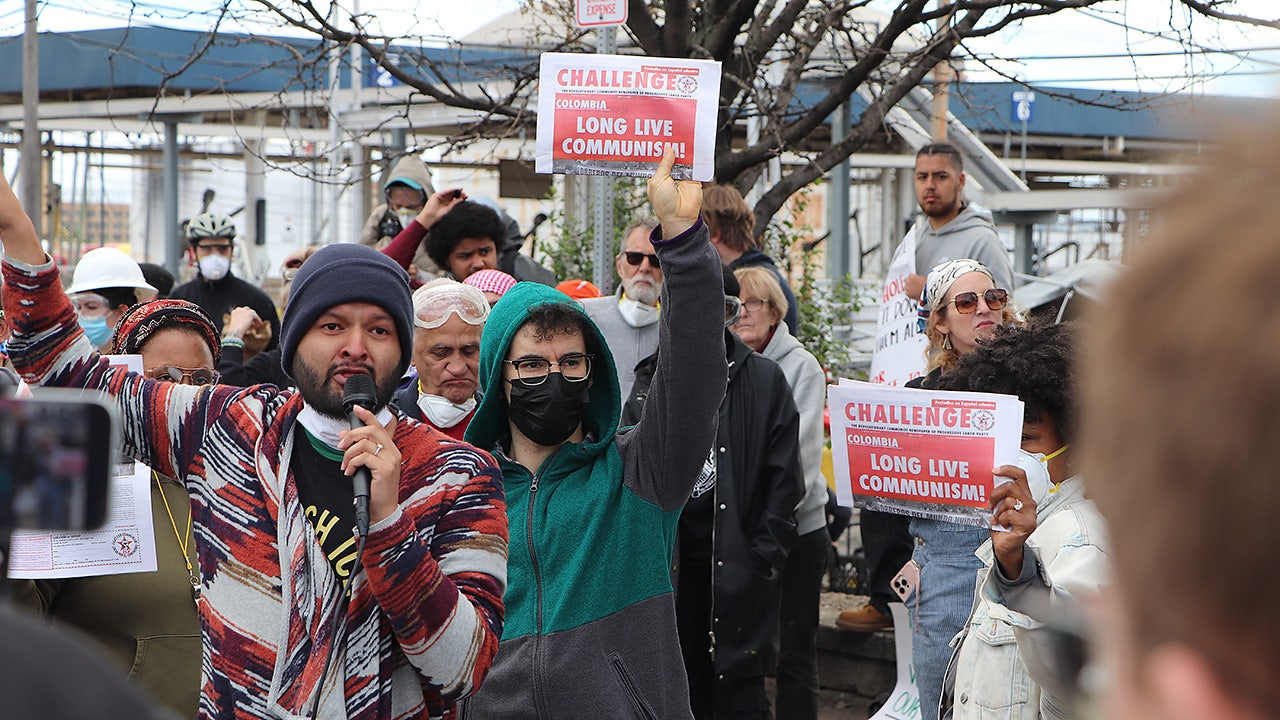
Yet, as the days wear on, the tragic irony of the Delaney Hall protests has become increasingly apparent: the actual voices of the immigrant detainees and their local families are being systematically drowned out by a wave of external, highly ideological actors who have descended upon Newark to fight a much larger, abstract proxy war. New Jersey Attorney General Jennifer Davenport shed light on this unsettling dynamic by confirming that of those arrested by state authorities during the escalating clashes, the vast majority—five out of six—were not residents of New Jersey at all, but rather out-of-state agitators traveling to the site to exploit the local human crisis for their own broader political agendas. By Saturday, the dominant presence outside the heavy brick walls was a crowd of roughly two hundred anti-ICE demonstrators, whose composition was deeply intertwined with radical far-left and socialist organizations. For these passionate activists, the facility was not simply a place where vulnerable human beings were suffering; it was a physical monument to capitalism, state violence, and imperialism that needed to be dismantled through immediate, systemic upheaval. The air filled with highly organized, rhythmic chants of “Stop ICE Gestapo! Communist revolution!” as organizers moved through the crowd distributing pamphlets emblazoned with inflammatory headlines like “LONG LIVE COMMUNISM!” and “NO PAPERS, NO BORDERS, NO BOSSES.” This heavy injection of global revolutionary theory completely shifted the paradigm of the protest. The quiet, heartbreaking stories of mothers, fathers, and children torn apart by deportation were replaced by abstract debates over Karl Marx, global border abolition, and the aggressive overthrow of the state, turning a human rights emergency into a highly dogmatic theater where the actual immigrants in the cells became secondary to the broader ideological crusade.
The volatile mixture outside the facility grew exponentially more dangerous when a rival ideological faction arrived on the scene, turning the protest into a micro-level reflection of the deep polarization that currently fractures American civic life. Members of the far-right Proud Boys, carrying pro-ICE banners, heavy American flags, and carrying cases of water and food to hand to law enforcement officers, marched directly into the demonstration area. Their physical presence acted as an immediate catalyst, sending a powerful wave of mutual hostility through the heavily outnumbering anti-ICE crowd of left-wing activists. Almost instantly, the focus of the demonstration shifted from the plight of the detainees to an intense, face-to-face ideological showdown. Left-wing agitators rushed toward the newly erected security barriers, screaming profanities and shouting at the top of their lungs to drown out the newcomers, changing their collective chants from anti-deportation slogans to a hostile, repeated demand: “Proud Boys go home.” In this moment, the human element of the migration crisis was entirely obscured by visceral, tribal hatred. The scene became a terrifying display of raw human emotion, where the two extremes of America’s political spectrum stood inches apart, separated only by thin metal barriers and the strained, sweating bodies of state troopers. The air was thick with the scent of adrenaline, dust, and raw, unrestrained anger. To anyone watching, it was clear that the people inside Delaney Hall—those waiting for news of their court dates, those wondering if they would ever see their children again—had been entirely forgotten in favor of a turf war between two rival political subcultures who used the detention center merely as a dramatic backdrop for their mutual animosity.
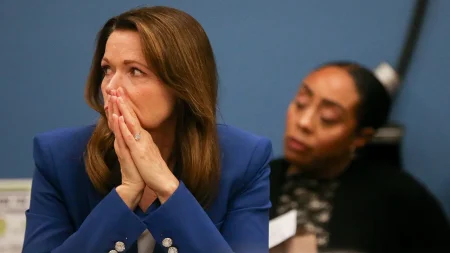
As the chaos outside escalated, politicians scrambled to control the narrative, reflecting the intense pressure to appease partisan bases while maintaining public order, further illustrating how human suffering is mediated through political machinery. During a hastily arranged press conference on Saturday afternoon, Governor Mikie Sherrill walked a difficult political tightrope, attempting to validate the anger of progressive voters while simultaneously condemning the violent methods of the radical groups that had hijacked the movement. Sherrill directed some of her sharpest criticism toward the federal government, claiming that the active engagement of ICE agents on the ground created an “incredibly dangerous situation” and reaffirming her commitment to stand firm against what she characterized as the aggressive, threatening immigration policies of the Trump administration. Yet, in the same breath, the governor had to acknowledge the destructive influence of the “national extremist groups” that had infiltrated her state, warning these out-of-state agitators that their performative radicalism was actively endangering the local public and doing absolutely nothing to help the actual human beings locked inside the facility. Her raw, direct plea for sanity—urging protesters to “bring the temperature down” so that the community could refocus its collective energy back onto the detainees and their terrified families—revealed the deep exhaustion of a leader realizing that the situation had spun completely out of control. Her words served as a sobering reminder that while out-of-state activists can easily pack up their banners, jump into their cars, and return to their comfortable lives elsewhere, the local community, the state law enforcement officers, and the vulnerable families of the detained are left to pick up the shattered pieces of a community fractured by imported violence.
Ultimately, the tragedy of the Delaney Hall standoff lies in the lingering shadows of systemic opacity and administrative deadlock that remain long after the street battles fade and the television cameras are turned off. Governor Sherrill brought to light a deeply concerning aspect of the ongoing crisis, revealing that when state health inspectors recently attempted to conduct a thorough, independent evaluation of the facility’s living conditions, they were aggressively restricted by facility management, permitted to view nothing more than the kitchen area. This lack of transparency only fuels the fires of public suspicion, leaving the public to wonder what lies beyond the pristine, government-approved menus and the scrubbed stainless-steel countertops. Even more troubling are the allegations championed by local advocates and echoed by the governor, who called upon the Department of Homeland Security to immediately cease its reported practice of pressuring highly vulnerable, legally unrepresented detainees into signing their own deportation documents under duress. This accusation cuts to the very heart of the human rights crisis at Delaney Hall, painting a picture of an unequal struggle where isolated, frightened individuals are coerced into giving up their legal battles far away from the eyes of the public or legal representation. As the sun sets over Newark and the physical barricades remain firmly in place, the fate of the human beings inside Delaney Hall remains as uncertain as ever. They are trapped in a physical limbo of detention and a psychological limbo of exploitation, caught between a cold, unyielding federal bureaucracy that views them as administrative numbers, and a radicalized political landscape that views them merely as rhetorical ammunition for a never-ending cultural conflict.