The gray, misty waters of Puget Sound recently played host to an extraordinary maritime spectacle that sent ripples of curiosity through the city of Seattle, transforming a standard autumn week into an impromptu showcase of ultra-luxury. While locals are deeply accustomed to seeing massive container ships, rugged commercial fishing trawlers, and towering cruise ships gliding past the coastline, the sudden appearance of Meta founder and CEO Mark Zuckerberg’s floating empire brought a whole new level of intrigue to the Pacific Northwest. Slipping through the historic Ballard Locks and carving a clean path into the freshwater basin of Lake Union, the tech giant’s mammoth 387-foot superyacht, Launchpad, instantly became an attraction for tech workers, maritime enthusiasts, and casual joggers who lined the canal walls to gawk at its pristine hull. Yet, what many casual observers watching from the shores of Lake Union did not realize was that this colossal display of wealth did not travel alone. Tucked away several minutes south, quietly moored at the Smith Cove Cruise Terminal at Pier 91, sat its faithful, utilitarian companion: a massive, 262-foot support vessel appropriately named Wingman. Together, this duo of state-of-the-art maritime engineering represents the absolute pinnacle of private yachting, transforming Seattle’s scenic waterfront into a temporary staging ground for one of the world’s most powerful billionaires, while igniting a broader conversation about wealth, leisure, and the culture of the modern tech elite.
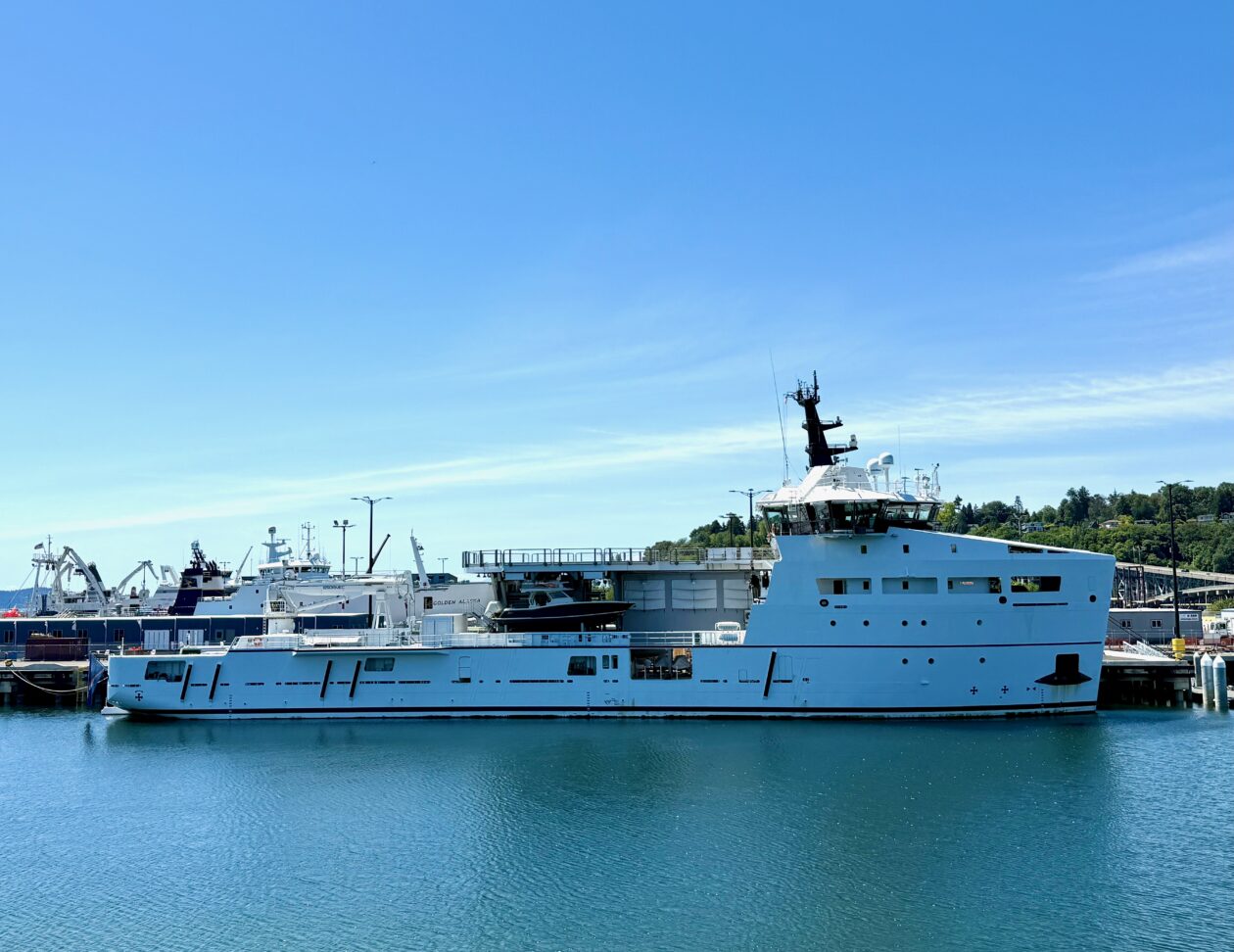
To understand the presence of Wingman is to understand the changing nature of high-stakes luxury travel, where a single superyacht is no longer sufficient to carry the vast array of personal items demanded by today’s adventure-seeking billionaires. Widely described by industry insiders and maritime enthusiasts as a “floating garage,” Wingman is a specialized shadow vessel built to shoulder the heavy, disruptive, and industrial burdens of global exploration so that Launchpad can remain an oasis of pure relaxation. When you are traveling the globe with an appetite for high-speed adventure, you need a safe harbor to house the helicopters, water tenders, dive chambers, and personal watercraft that make such excursions memorable. Rather than cluttering the clean aesthetic and leisure decks of the primary yacht, these toys are relegated to Wingman, which features a massive onboard crane designed to effortlessly hoist heavy recreational crafts from the deck into the open ocean. Currently docked at the northern end of Seattle’s waterfront, the imposing vessel looms large near the Interbay neighborhood, highly visible to commuters crossing the Magnolia Bridge and outdoor enthusiasts traversing the Elliott Bay Trail. It sits quietly at a pier typically reserved for commercial cruise ships, framed by the modern, glass-paneled headquarters of online travel giant Expedia just across the water, serving as a silent, physical testament to the staggering scale of private wealth.
For the average Seattle resident going about their daily routine, the arrival of these vessels provoked a fascinating mix of complete apathy and intense curiosity. While crowds filled the parks surrounding Lake Union to snap photos of Launchpad, the atmosphere around Wingman at Pier 91 remained decidedly low-key, with commuting cyclists and dog walkers barely sparing a second glance at the black-and-white ship. Yet, behind the security gates, the reality of the vessel’s arrival was firmly established; a guard stationed at the gated entrance of Smith Cove confirmed that the support vessel made its landfall on a Wednesday morning, just a day after the primary yacht arrived. Flapping gently from the stern of both intimidating ships was the distinctive flag of the Marshall Islands, a choice of registry that is a familiar sight in the world of luxury shipping. As marine legal experts often point out, registering a vessel in the Marshall Islands offers a highly attractive tax framework and levels of operational privacy that are simply unavailable under domestic jurisdictions. This detail highlights a sharp, systemic contrast between the daily lives of the local citizens—who pay high local sales and property taxes to fund the very infrastructure these visitors enjoy—and the global, boundary-defying financial systems navigated by the owners of these floating palaces, who can seamlessly migrate their wealth across international waters with ease.
Beyond the technological marvel and the operational logistics of managing such a fleet, the timing of the armada’s arrival in Seattle carries a poignant and uncomfortable irony that has not been lost on the local community. Seattle is a major corporate hub for Meta, but it is also a city that has recently felt the painful, lingering sting of corporate contraction and historic labor displacement. Within the past couple of years, massive rounds of tech layoffs swept through the region, impacting nearly 1,400 regional Meta employees who suddenly found themselves navigating a highly competitive and deeply uncertain job market. For those affected workers, and indeed for many residents watching the widening economic divide in the Emerald City, the sight of a $100 million support ship companion to a $300 million superyacht traveling through local waters serves as a stark visual metaphor. It highlights the vast, almost incomprehensible division between the daily struggles of high-skilled professionals losing their livelihoods and the casual, multi-million-dollar leisure activities of the executive class. When a crew member aboard Launchpad casually mentioned during their transit through the locks that they were not in town for any major events like the upcoming FIFA World Cup and were simply planning to “come and go,” it reinforced a sense of transient, untouchable privilege, where a major metropolitan city is merely a scenic place to drop anchor before disappearing over the horizon.
To appreciate Wingman as a marvel of engineering, one must look at the impressive specifications and historical background of this highly specialized vessel, which was originally built under the project name U-81. The ship was delivered in 2022 by the renowned Dutch shipyard Damen Yachtbuilding, a company globally celebrated for pioneering the support yacht category and rewriting the rules of luxury ocean voyages. Valued at an estimated $100 million, Wingman is designed to prioritize performance, durability, and versatility over purely ornamental luxury, though its interior accommodations are nothing short of world-class. According to the maritime database Superyacht Fan, the ship is built to house a highly trained, dedicated crew of approximately 18 professionals who work tirelessly behind the scenes to keep the daily operations running flawlessly, alongside up to eight guests who can be accommodated in four beautifully appointed cabins. This configuration means that the ship is not merely a cargo hold for toys; it can function as an independent exploration platform in its own right, allowing guests to embark on deep-sea diving, heli-skiing, or marine research expeditions far away from the mother ship. This systematic division of labor and play ensures that no industrial noise or heavy lifting disrupts the absolute peace of those resting aboard the primary yacht, reflecting a growing trend among the world’s wealthiest elite, including fellow tech magnate Jeff Bezos, who utilizes a similar shadow vessel to carry his own fleet of helicopters and ocean gear.
As the morning mist rolls over Elliott Bay and the daily commuter traffic begins to build, both Wingman and Launchpad remain peacefully moored in their respective berths, temporarily woven into the city’s complex maritime tapestry. Whether they are preparing to head north toward the rugged, pristine wilderness of Alaska or planning a journey south along the Pacific coast, their brief stay has left a lasting impression on the city. Seattle has always been a place defined by its relationship with the water, from its early days as a bustling timber and gold rush port to its modern identity as a global powerhouse of technology, aviation, and global commerce. The presence of Zuckerberg’s dual-ship armada serves as a vivid, real-time reflection of this evolution—a physical intersection of high technology, high finance, and classic marine exploration. Eventually, the ropes will be cast off, the powerful engines will hum to life, and both the main yacht and its faithful Wingman will slip away as quietly as they arrived, leaving the local residents to return to their everyday routines along the Magnolia Bridge and Elliott Bay Trail. In the end, the visit of these magnificent but highly controversial ships reminds us of the fleeting nature of wealth’s grand displays, leaving behind an evocative story of how a modern tech pioneer brought his own personalized, floating universe to the shores of Puget Sound, if only for a brief moment in time.