



The Shattered Silence: Israel Resumes Intense Air Campaign Over Beirut’s Suburbs After a Three-Week Lull
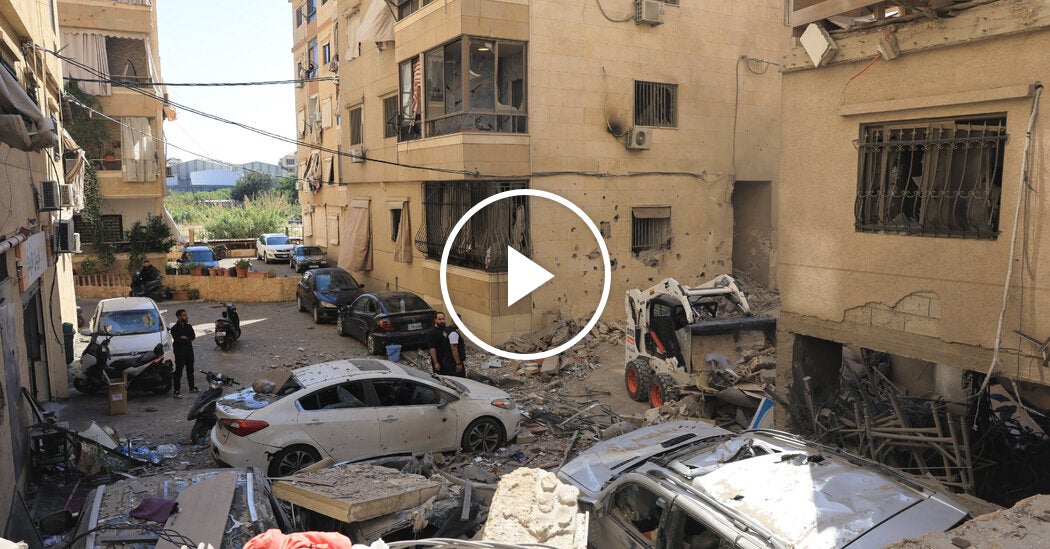
On Thursday, the fragile silence that had hung over the Lebanese capital for twenty-one days was abruptly shattered as Israeli military aircraft launched a series of powerful precision airstrikes targeting the southern outskirts of Beirut. The bombardment, which targeted the densely populated suburb of Dahieh—long identified as a stronghold for the political and military leadership of Hezbollah—marks a sharp escalation in a conflict that has kept the region on a knife-edge. According to statements from the Israel Defense Forces (IDF), the operations were meticulously calibrated to dismantle key infrastructure, strategic command centers, and weapons storage facilities used by the Iran-backed militant group. Concurrently, Israeli air forces bombarded several high-profile strategic targets across southern Lebanon, aiming to disrupt tactical positions near the demarcation line of the blue border. This sudden resumption of offensive operations underscores the volatility of the geopolitical landscape in the Middle East and effectively dispels any immediate hopes that international diplomatic pressure had succeeded in engineering a durable, long-term de-escalation between the warring nations.
Tactical Resalience: Demystifying the Military Strategy Behind the Resumption of Strike Operations
The decision by Israeli military commanders to pause aerial bombardments over Beirut for a three-week window had generated intense speculation among intelligence analysts, with many suggesting it was a tactical concession to accommodate backchannel cease-fire negotiations orchestrated by Western emissaries. However, the renewed aerial campaign reveals that Israel’s security cabinet remains committed to its stated primary objective: the systematic degradation of Hezbollah’s offensive capabilities. Military intelligence suggests that the three-week Operational Halt allowed the IDF to gather updated reconnaissance, locate freshly shifted command centers, and map out the logistics of Hezbollah’s subterranean supply networks. By striking southern Beirut and launching simultaneous operations in southern Lebanon, Israel is attempting to sever the communication and logistical links between the group’s high command in the capital and its frontline combat units stationed along the northern border. This dual-pronged offensive is designed not only to preempt retail retaliatory rocket barrages into northern Israeli towns but also to project a clear message of military dominance, showing that no geographic sanctuary remains beyond the reach of the Jewish state’s air superiority.
The Human Cost of Conflict: Dispatches from the Heart of a Relentless Humanitarian Crisis
Behind the technical vocabulary of precision-guided munitions and strategic targets lies a humanitarian catastrophe that continues to unfold with devastating speed across Lebanon. In Dahieh and the agricultural towns of the south, the sudden return of screaming fighter jets and concussive shockwaves triggered fresh waves of panic among civilians who had only recently attempted to return to their homes during the brief relative lull. Local emergency rescue services, already operating under severe resource constraints, struggled to navigate through debris-choked streets to reach victims trapped beneath collapsed residential blocks, as black smoke billowed over the Beirut skyline. Human rights organizations have repeatedly voiced concerns regarding the immense psychological trauma and physical displacement inflicted upon the civilian populace, with estimate counts of displaced persons rising into the hundreds of thousands over the duration of the current conflict. For the ordinary citizens of Beirut, the resumption of airstrikes serves as a grim template of daily survival, illustrating a persistent vulnerability where the boundary between civilian life and military conflict has been fundamentally erased by the relentless demands of modern asymmetric warfare.
The Diplomatic Impasse: Why the Machinery of International Conflict Resolution Continues to Fail
The latest outbreak of violence exposes the profound limitations of international diplomacy, which has repeatedly struggled to construct a viable framework for peace in the Levant. For months, special envoys from Washington, Paris, and the United Nations have scurried between regional capitals, drafting proposals centered around the enforcement of UN Resolution 1701—which stipulates that Hezbollah must withdraw its armed forces north of the Litani River. Yet, these diplomatic initiatives remain deadlocked by diametrically opposed demands: Israel insists on a permanent guarantee that its northern citizens can return to their homes free from the threat of cross-border incursions, while Hezbollah refuses to disarm or retreat as long as Israeli forces occupy disputed territories and conduct surveillance over Lebanese airspace. The failure of these talks is exacerbated by the broader regional proxy dynamic, with Tehran continuing to supply financial and technical lifelines to its non-state allies, thereby embedding the local conflict into a global geopolitical struggle for dominance. As long as these macro-level dynamics remain unresolved, the peace proposals put forward by external mediators will likely remain aspirational documents, routinely bypassed by the hard realities of military strategists on the ground.
A Regional Crucible: Analyzing the Intricate Interconnection of the Two-Front War
The military developments in Lebanon cannot be analyzed in isolation from the ongoing operations in the Gaza Strip, as both theaters are intrinsically linked by a shared web of geopolitical alliances and security imperatives. Since the initial outbreak of hostilities, Hezbollah has framed its rocket campaigns against northern Israel as an act of solidarity with Palestinian factions, establishing a strategic linkage that complicates any attempt to negotiate a localized peace agreement on the northern border. For Israel, this two-front security challenge has necessitated a complex allocation of resources, forcing the IDF to continuously balance its ground maneuvers in the south with preemptive and retaliatory operations along its northern frontier. This strategic balancing act has altered the traditional rules of engagement, leading Israeli defense planners to adopt a more proactive, high-stakes military posture designed to deter regional adversaries from launching a coordinated multi-front assault. The spillover potential of this ongoing confrontation remains a constant domestic concern for neighboring countries like Jordan, Syria, and Cyprus, highlighting how quickly a localized border dispute can evolve into a wider regional war capable of disrupting global shipping routes and energy markets.
The Road Ahead: Navigating the Delicate Boundary Between Escalation and Mutual Deterrence
As the dust settles over the newly pulverized blocks of southern Beirut, the immediate future of the Israel-Lebanon conflict remains poised on a knife-edge, with both sides facing a critical choice between further escalation and a return to calculated deterrence. Should Israel choose to expand its current air campaign into a sustained, large-scale ground incursion, it risks entangling its military in a highly unpredictable war of attrition against a well-entrenched, battle-tested insurgent force familiar with the rugged mountainous terrain of southern Lebanon. Conversely, if Hezbollah reacts to these latest strikes by deploying its stockpiles of long-range, precision-guided missiles against high-value infrastructure deep within Israel’s urban centers, it would almost certainly trigger a catastrophic regional response that could draw direct participation from global superpowers. At this high-stakes juncture, the prospects for a lasting peace seem remote, leaving the international community to focus its energies on managing the immediate humanitarian fallout and keeping open minimal channels of communication. The coming weeks will reveal whether this latest round of airstrikes is a prelude to a defining military confrontation or simply the latest tragic chapter in a cyclic, decades-long war that continues to define the Levant.