



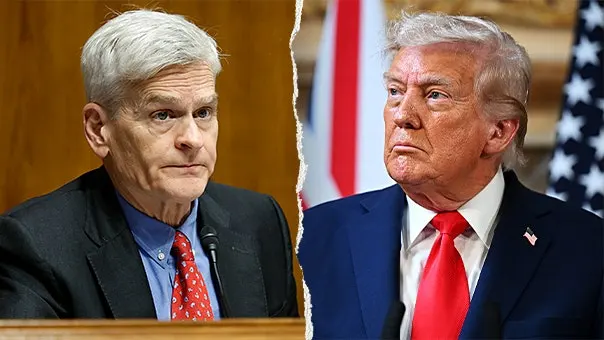
The political landscape of Louisiana has recently become the stage for a dramatic clash of loyalty, legacy, and defiance, as veteran Republican Senator Bill Cassidy faces the twilight of his congressional career. Having been effectively ousted from his seat after President Donald Trump threw his formidable endorsement behind Representative Julia Letlow—who is now locked in a highly anticipated runoff against state Treasurer John Fleming—Cassidy could have easily chosen a quiet, dignified retreat into the private sector. In modern American politics, when a sitting lawmaker is vanquished by their party’s nominal leader, the conventional playbook counsels a silent exit to avoid further alienating the partisan base. Yet, Cassidy has chosen an entirely different, far more combative path, refusing to go gently into the political night. Instead, he has utilized his remaining days in the upper chamber to actively push back against some of Trump’s most cherished policy objectives and spending proposals. This stubborn resistance is more than just a parting shot from a defeated politician; it is a deeply human manifestation of a man who refuses to let his entire legislative career be defined by submission to another individual. In doing so, Cassidy has transformed his final months in office into a high-stakes test of political survival and personal principle, drawing a sharp line between those who view public service as a vehicle for personal fealty and those who see it as a sacred trust bound by institutional duty. As he navigates this final chapter, the Louisiana senator stands as a poignant symbol of the broader, ongoing civil war within the Republican Party, demonstrating that even when stripped of electoral power, an individual’s conviction can still disrupt the plans of the most powerful figures in Washington.
This intense ideological and personal battle became strikingly visible to the public through a remarkably candid and reflective message that Cassidy shared on the social media platform X. In a lengthy, philosophical post that addressed the future of the United States, the outgoing senator made a passionate plea for unity, maturity, and decorum in the nation’s high offices. While Cassidy carefully avoided mentioning the former president by name, the post was universally interpreted as a direct, albeit veiled, critique of Donald Trump’s famously erratic and performance-driven leadership style. Cassidy mused that at its absolute best, America has always managed to renew and revitalize itself through leaders who understood that holding public office is an immense, life-altering responsibility, rather than merely a theatrical performance designed for television ratings and social media engagement. He wrote passionately that the American electorate does not demand absolute perfection from those who govern them, but they do have a fundamental right to expect a basic level of seriousness, intellectual honesty, and emotional stability. Leaders, in Cassidy’s view, must be steady instead of erratic, thoughtful rather than impulsive, and dedicated to lowering the rhetorical temperature of the nation rather than deliberately inflaming tribal divisions for short-term electoral gain. When later pressed by reporters about the underlying motivation behind this pointed message, Cassidy offered a remarkably grounded, human observation about the nature of relationships, stating that if trust is destroyed—whether in a marriage, a business partnership, or the halls of government—it becomes nearly impossible to accomplish anything of lasting value. For Cassidy, the building of trust is not a naive secondary goal, but the practical, everyday engine of successful governance, a reality he believes has been tragically lost in the modern era of hyper-partisan theater.
To fully understand Cassidy’s current defiance and his deep-seated skepticism of Trump’s brand of politics, one must look back to the defining crossroads of his career: his vote to convict the former president during his second impeachment trial following the tragic events of January 6, 2021. This vote was not merely a political calculation; it was a profound, career-altering moment of conscience that placed Cassidy in a small, isolated circle of Senate Republicans who chose to break ranks on the national stage. For Cassidy, the decision was agonizingly personal, knowing full well that it would invite the wrath of the party’s standard-bearer and alienate a vast portion of his home-state constituency in Louisiana. Yet, when asked about the political cost of that momentous decision in the immediate aftermath of his recent primary loss, Cassidy displayed a rare and refreshing lack of regret, telling reporters with absolute certainty that he had voted to uphold the United States Constitution. In a political culture where survival is often prioritized over principles, Cassidy’s rhetorical question, “It may have cost me my seat, but who cares?” echoed as a stunning rejection of self-preservation in favor of historical legacy. He expressed a profound sense of gratitude for having had the rare privilege of defending the nation’s founding document, framing his electoral defeat not as a tragic failure, but as a fair price to pay for maintaining his personal integrity. This perspective humanizes the intense internal struggle that many modern politicians face behind closed doors, highlighting the quiet peace that can come from making a decision based on enduring moral convictions rather than the transient winds of political expediency.
The reaction from the opposite side of this political divide was swift and characteristically unforgiving, illustrating the transaction-based nature of Donald Trump’s political relationships. When asked for comment regarding Cassidy’s thinly veiled criticisms, the White House pointedly directed observers to review a series of highly critical posts on Trump’s social media platform, Truth Social. In these public statements, Trump openly celebrated Cassidy’s primary defeat, presenting it as a vindication of his own influence and a well-deserved punishment for what he characterized as ultimate betrayal. Trump claimed that Cassidy had falsely rode his coattails to victory in previous elections, using their purported relationship to secure votes, only to turn around and vote for impeachment on what Trump described as preposterous, criminally insane charges. To Trump, Cassidy’s behavior was the epitome of legendary disloyalty, and he expressed a dark satisfaction in declaring that the senator’s political career was officially over. This sharp, public exchange exposes the starkly divergent worldviews held by the two men: where Cassidy saw an oath-bound duty to protect the Constitution and foster institutional stability, Trump saw a simple, transactional demand for absolute personal loyalty, where past political favors required unconditional future obedience. By framing Cassidy’s defeat as a cautionary tale of disloyalty, Trump sought to send a chilling message to other potential dissenters within the party, reinforcing a system where personal devotion to the leader is prioritized above all else. This public falling out highlights the immense human drama of Washington, where decades of public service can be instantly erased in the eyes of the party faithful by a single vote of conscience, leaving lawmakers to choose between the safety of the collective herd and the isolation of their own principles.
Rather than allowing himself to be sidelined by this presidential wrath, Cassidy has actively translated his moral independence into concrete legislative defiance during his final months in Washington. In a move that sent shockwaves through the Republican conference, Cassidy crossed the aisle to join nearly every Senate Democrat in a pivotal vote designed to severely limit the president’s unilateral war powers regarding potential military conflicts with Iran. This crucial vote provided the necessary momentum to advance a resolution that directly challenged the administration’s military authority, displaying a willingness to check executive power that is increasingly rare in today’s polarized Congress. Furthermore, Cassidy has emerged as a leading voice of opposition against a highly controversial, surprise $2 billion “anti-weaponization” fund proposed by the Department of Justice—a fund that has severely disrupted the Republican party’s broader efforts to secure immigration and border patrol funding for the remainder of Trump’s term. Following an intense, closed-door meeting of Senate Republicans, Cassidy publicly and flatly rejected the proposal, arguing that everyday Americans are far more concerned with making ends meet and surviving in a difficult economy than they are with funding what he characterized as an unprecedented, legally dubious political slush fund. By insisting that Congress must retain its constitutional power of the purse and have a direct say in how these billions are allocated, Cassidy has positioned himself as a champion of traditional legislative oversight. His stance on this funding fight humanizes the policy debate, shifting the focus away from abstract partisan warfare and back to the practical, pocketbook concerns of ordinary citizens who expect their government to operate under a clear, transparent framework of law rather than political convenience.
As Senator Bill Cassidy’s time in the United States Senate draws to a close, his final chapter serves as a compelling and complex study of political courage, personal cost, and the shifting nature of American conservatism. By refusing to submit to the demands of a powerful president, even in the wake of a career-ending electoral defeat, Cassidy has carved out a unique and defiant legacy that challenges the prevailing winds of his party. His actions during these waning months remind us that behind the sanitized headlines of legislative procedures and partisan skirmishes lie deeply human struggles of men and women grappling with their legacy, their conscience, and their responsibility to the nation. While his political career in Congress may indeed be reaching its conclusion, the principles he has championed—steady leadership, constitutional fidelity, the preservation of checks and balances, and the vital importance of building public trust—will continue to resonate long after he leaves Washington. Whether Cassidy’s lonely stand will inspire other lawmakers to find their footing in the face of immense partisan pressure remains an open question, but his willingness to pay the ultimate political price for his beliefs stands as a powerful testament to the enduring strength of personal conviction. In the end, Cassidy’s journey suggests that true leadership is not measured by the quantity of elections won through blind obedience, but by the quiet, unshakable resolve to do what is right for the country, even when it means walking away into the sunset alone, with one’s head held high and one’s integrity fully intact.