



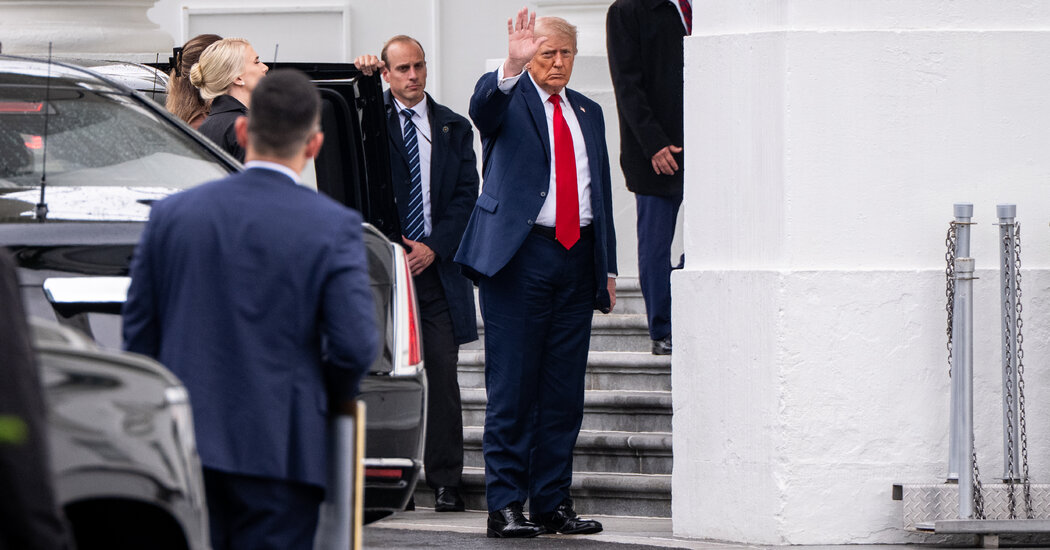
Walter Reed National Military Medical Center, with its towering concrete facade and sterile, high-security corridors, has long served as the solemn backdrop for the physical assessments of American leaders, but on a recent Tuesday, its clinical environment played host to an examination carrying unprecedented historical weight. President Donald J. Trump, currently standing as the oldest individual ever inaugurated to the presidency, crossed the threshold of the medical center for a semiannual physical exam just one month shy of his eightieth birthday. For an octogenarian navigating the most high-pressure office on Earth, the visit was far more than a standard medical checklist; it was a high-stakes performance in the perpetual theater of public confidence. Shortly after departing the facility, the President took to social media with his characteristic bravado, declaring to his millions of followers that “Everything checked out PERFECTLY.” This triumphant digital announcement, meant to project an image of absolute, unassailable physical vigor, immediately clashed with the quiet, clinical reality of an aging body subject to the unrelenting forces of time and stress. The contrast between Trump’s assertion of flawless health and the natural, inevitable vulnerabilities of a man entering his eighth decade of life highlights a profound human struggle: the exhausting effort to project absolute strength when faced with the undeniable reality of physical decline. By entering Walter Reed for the fourth publicly disclosed medical exam of his second term, the President once again spotlighted the delicate, often uncomfortable balance between the biological realities of senior citizenship and the psychological demands of global leadership. This recurring cycle of clinical evaluation and boastful reassurance reveals a deeply human reluctance to acknowledge the creeping limitations of age, a sentiment amplified tenfold when one’s daily decisions shape the destiny of a nation. Ultimately, this hospital visit stands as a testament to the immense friction between the biological clock that governs us all and the political necessity of appearing immortal to an expectant public.
Beneath the carefully curated veneer of political invincibility lies a collection of very human physical ailments that have increasingly drawn the empathetic yet critical observations of the American public. Over the course of his second term, the President’s physical appearance has frequently hinted at a more complex, relatable story of physical wear and tear than his social media posts care to admit. Discerning observers have frequently noted distinctive dark bruises on the President’s hands—blemishes that his staff reportedly conceals with cosmetic makeup to preserve an aesthetic of unblemished vitality. While White House officials have repeatedly brushed off these marks as the occupational hazard of aggressive, enthusiastic handshakes, medical professionals recognize that aging skin naturally loses its outer protective layers, becoming susceptible to easy bruising under minimal pressure. Furthermore, a persistent, visible red rash on the President’s neck has required the daily application of a preventive cream prescribed by his physician, Dr. Sean P. Barbabella, though the underlying clinical diagnosis and the exact formulation of this medication remain closely guarded secrets. More telling still is the visible swelling in his lower legs, which aides and doctors have officially diagnosed as chronic venous insufficiency, a common vascular condition where vein valves fail to return blood from the limbs back to the heart, causing fluid retention during long periods of standing or sitting. Additionally, the sheer, crushing exhaustion of managing geopolitical crises and domestic policy has occasionally broken through his legendary stamina, manifesting in moments of visible fatigue where the President appeared to doze off during official events in the White House. Far from being signs of weakness, these physical vulnerabilities serve as quiet, incredibly human reminders that behind the powerful political persona is an eighty-year-old man navigating the inevitable physical taxing of advanced age under a relentless public spotlight.
The administration’s response to public curiosity regarding the President’s health has long been defined by a strategy of strategic ambiguity, linguistic hyperbole, and fiercely guarded privacy. For over a decade, spanning both of his administrations and the years in between, Trump, his personal aides, and his official physicians have consistently favored rosy, grandiloquent proclamations over precise clinical data. This protective posture was perfectly illustrated in a memorandum issued by Dr. Barbabella, which claimed the President remained in “exceptional health, exhibiting strong cardiovascular, pulmonary, neurological and physical performance.” While such glowing endorsements are designed to reassure a jittery electorate, they often achieve the opposite effect, raising suspicion through their lack of concrete diagnostic metrics and standard clinical reporting. In the same memorandum, Dr. Barbabella claimed that the President’s laboratory evaluations were “exceptional” and boldly asserted that his “cardiac age” was approximately fourteen years younger than his chronological age—an evocative but scientifically non-standard metric that seemed designed more for public relations than medical accuracy. The delay in releasing this information further complicated the administrative narrative; it took until December for the White House to yield to mounting public pressure and publish the memorandum, which had been completed back in October. This hesitation to share basic health details reflects a classic defensive posture, wherein an administration seeks to tightly control the flow of clinical information to prevent any perception of vulnerability. By wrapping routine medical facts in layers of bureaucracy and triumphant prose, the White House inadvertently fuels a culture of speculation, transforming what should be a transparent civic update into a closely watched political drama that mirrors the human urge to hide one’s limitations from a critical world.
A close retrospective analysis of the medical disclosures released during Trump’s second term reveals a steady and concerning decline in clinical transparency, with each successive update offering fewer hard facts than its predecessor. In April 2025, after his first physical of the term, the White House offered a level of transparency that set a reassuringly high standard, releasing a comprehensive diagnostic summary that included his precise height, weight, detailed blood panel results, and a complete ledger of his active medications. By July of that same year, however, the curtain began to draw closed, as the subsequent medical memorandum identified the diagnosis of chronic venous insufficiency and listed the diagnostic tests performed, but omitted the underlying laboratory results that would allow independent doctors to verify his treatment plan. This trend toward obfuscation reached a peak with the October 2025 memorandum, which was notably vague, omitting basic physical measurements and failing to specify what kinds of “advanced imaging” and laboratory tests had actually been performed on the commander-in-chief. Adding to the public’s confusion are the President’s own contradictory statements regarding his medical procedures; during a public address, he proudly claimed to have undergone a “perfect” magnetic resonance imaging (MRI) scan, only to later walk back the comment, stating that he had misspoken and had actually undergone a computed tomography (CT) scan. This rhetorical confusion, combined with the shrinking volume of official medical data, suggests an intentional effort to obscure the fine details of the President’s health, leaving the public to parse shifting narratives and incomplete documents to understand the actual physical condition of their leader.
This lack of clinical transparency has predictably invited intense scrutiny from the wider medical community, where independent physicians have expressed deep skepticism regarding the vague terminology and unusual diagnostic choices described in the official reports. Experts in geriatric medicine and cardiology have pointed out that a patient who is completely asymptomatic and supposedly in “exceptional health” would not typically undergo “advanced imaging” as part of a routine, preventative wellness checkup. In clinical practice, advanced cardiac or structural imaging is generally reserved for individuals displaying signs of cardiovascular distress, chest pain, or other systemic red flags, suggesting that the tests may have been prompted by underlying symptoms that the White House has chosen not to disclose. The assertion that a man on the cusp of eighty possesses a heart comparable to someone in their mid-sixties has also been met with clinical skepticism, given the natural, irreversible stiffening of arteries and decline in aerobic capacity that accompanies normal human aging. By presenting highly stylized, optimistic interpretations of clinical data rather than the raw, unfiltered facts, the President’s medical team has created a credibility gap that external specialists find difficult to bridge. This discrepancy highlights a fundamental conflict of interest inherent in presidential medicine: the physician’s duty to provide honest, accurate information to the public often clashes with the political necessity of portraying the President as an undefeatable, age-defying figure. As a result, the very tests meant to reassure the electorate of the President’s fitness instead serve as a focal point for rumors, as independent doctors and the public struggle to reconcile the administration’s upbeat rhetoric with established clinical protocols.
Ultimately, the ongoing public fascination and anxiety surrounding President Trump’s physical health is a deeply human story that transcends the boundaries of partisan politics, reflecting our collective, societal discomfort with the realities of aging and mortality. The presidency of the United States is arguably the most demanding job in the world, historically known to accelerate physical aging, grey the hair of young leaders, and exhaust the most vibrant of men; to place these heavy burdens on the shoulders of an octogenarian is to conduct an unprecedented experiment in human endurance. When we look at the bruised hands, the swollen legs, the heavy-lidded fatigue, and the defensive medical statements, we are not just looking at a political figure, but at a human being locked in a universal struggle against the inevitable passage of time. The makeup used to cover bruises and the grand claims of a youthful “cardiac age” are deeply relatable acts of human vanity and vulnerability—denials of physical decay that almost everyone performs in their own lives as they grow older. By keeping the fine details of his health hidden, the President seeks to maintain a position of authority in a world that often discounts the elderly, attempting to prove that age is merely a number rather than a biological reality. In doing so, this administration’s medical drama becomes a mirror for our own societal fears about decline, legacy, and the limits of the human will. Watching an aging leader strive to maintain his grip on power while his body quietly rebels is a poignant reminder that no matter how much authority one accumulates, the laws of biology remain absolute, and we must all eventually confront the delicate, fragile nature of our own humanity.